Regulations on Family Planning in 27 Provinces: Couples participating in the marriage examination in Heilongjiang enjoy 25 days of marriage leave.
BEIJING, Beijing, April 23 (Zhang Ni) Recently, Heilongjiang passed the newly revised Regulations on Population and Family Planning in Heilongjiang Province. With the promulgation of this regulation, at least 27 provinces across the country have revised their local family planning regulations. All localities have made adjustments to the original marriage leave, maternity leave and nursing leave, and most provinces have increased their marriage leave, while Heilongjiang has specially increased the marriage leave for couples participating in premarital medical examinations for 10 days.
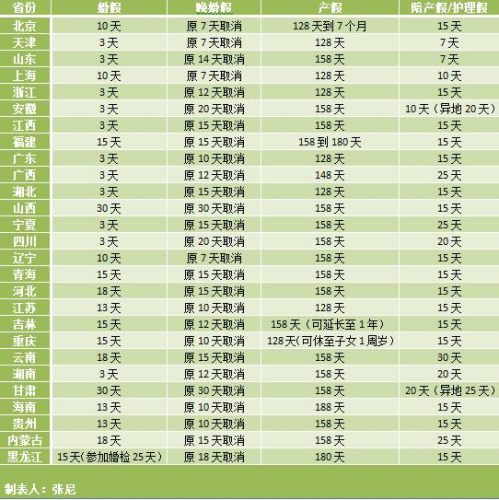
Regulations on Family Planning in 27 Provinces Heilongjiang: You can take an extra 10 days’ marriage leave if you take part in the marriage check-up.
According to the statistics of Zhongxin. com reporters, up to now, there are at least 20 people including Beijing, Tianjin, Shandong, Shanghai, Zhejiang, Anhui, Jiangxi, Fujian, Guangdong, Guangxi, Hubei, Shanxi, Ningxia, Sichuan, Liaoning, Qinghai, Hebei, Jiangsu, Jilin, Chongqing, Yunnan, Hunan, Gansu, Hainan, Guizhou, Inner Mongolia and Heilongjiang.
In the new family planning regulations of all provinces, the original late marriage leave was cancelled, and the number of days of marriage leave was adjusted in some areas.
Among them, Tianjin, Shandong, Zhejiang and other 11 provinces have implemented the basic legal three-day marriage leave. More than 10 provinces, including Beijing, Shanghai and Fujian, have increased the original number of days of marriage leave. After the increase, the number of days of marriage leave in these areas ranges from 10 to 30 days. Among them, Heilongjiang also specifically stipulates that couples who register for marriage according to law enjoy 15 days of marriage leave, and those who participate in pre-marital medical examination will be given 10 days of marriage leave.
In terms of maternity leave, 27 provinces have also extended it to varying degrees. At present, female workers who have given birth in accordance with laws and regulations in the above 27 provinces can also enjoy at least 128 days of maternity leave, while some provinces have made more relaxed adjustments.
For example, Fujian stipulates that a woman can enjoy a holiday of 158 to 180 days regardless of giving birth to one child or two children; Chongqing stipulates that female workers who have given birth in accordance with laws and regulations can take continuous leave after the expiration of maternity leave until their children are one year old upon their own application and approval by the unit.
In addition, 27 provinces have also defined male nursing leave in the newly revised family planning regulations. The minimum nursing leave is 7 days, and the longest is 30 days.
There are differences in fertility policies in different places. Experts: It is not a one-size-fits-all approach.
In addition to policy adjustments such as marriage leave and maternity leave, the re-birth policies in various places have also received much attention.
Re-birth of children refers to the situation of giving birth to three children or more. Observing the new regulations issued in various places, in addition to making clear the re-birth policy of "bearing sick and disabled children", there are also detailed regulations on the re-birth of remarried couples.
For example, Beijing, Shanghai, Tianjin, Liaoning, Heilongjiang and other provinces have clearly stipulated that remarried couples who have more than two children before marriage may ask for another child if they do not have children together after marriage.
In view of the economic and social conditions in various places, the re-fertility policies are also different.
For example, Heilongjiang stipulates that if both husband and wife are residents of 18 border counties (cities, districts) such as Mohe and Tahe, or if both husband and wife are Oroqen, Ewenki, Hezhe, Daur, Kirgiz, Xibe and Russian, they can have another child on the basis of having two children according to law.
Hainan, on the other hand, makes it clear that rural residents in areas where ethnic minorities live in concentrated communities, if both husband and wife are ethnic minorities (excluding ethnic minorities with a population of more than 10 million) and both husband and wife work and live in areas where ethnic minorities live in concentrated communities, and both children are girls, they can apply for another child.
In response to the re-birth policy introduced by various places, the State Council Counselor Ma Li told the reporter of Zhongxin.com that the total fertility rate in China should reach 2, which is more conducive to the adjustment of population structure. From the current point of view, even if the "two-child policy is implemented, considering that some couples are unable or unwilling to have children, it is unlikely that the total fertility rate will reach 2. Moderately relaxing the fertility of remarried couples and ethnic minority couples can play a positive role.
"At the same time, the adjustment of local policies also reflects the human side, so that everyone has the right to give birth." Ma Li said.
In fact, the state has not made unified regulations on the birth of "three children" from the legal level. Zhang Chunsheng, director of the Legal Department of the National Health and Family Planning Commission, pointed out earlier that "all localities have implemented the management of fertility for many years. In order to ensure the continuity and stability of fertility in all localities, local comrades believe that it is difficult for the state to make very detailed regulations, especially in the population and family planning law."
"The re-fertility policy formulation is not across the board." Ma Li said that each province’s population policy is based on its own economic and social development. Some provinces have a large population and relatively strict policies, while provinces with low total fertility rates such as Heilongjiang and Jilin are relaxed accordingly. Such regulations are scientific and reasonable. (End)