Happiness is like a flower-Xinjiang’s "flower economy" drives the masses to get rich
Xinhua News Agency, Urumqi, May 19th Title: Happiness is like a flower — — Xinjiang’s "flower economy" drives the masses to get rich
Xinhua News Agency reporter Hao Yu
In May, the temperature in the Ili Valley in Xinjiang, "south of the Great Wall", warmed up, and the car went west along the Ili Valley, with flowers and flowers all the way. In recent years, focusing on flowers as a medium and promoting agriculture with flowers, Xinjiang has developed a "flower economy" based on the advantages of flower resources, laid out diversified industries, created a new bright spot for the integration of culture and tourism, and driven the masses to become rich.
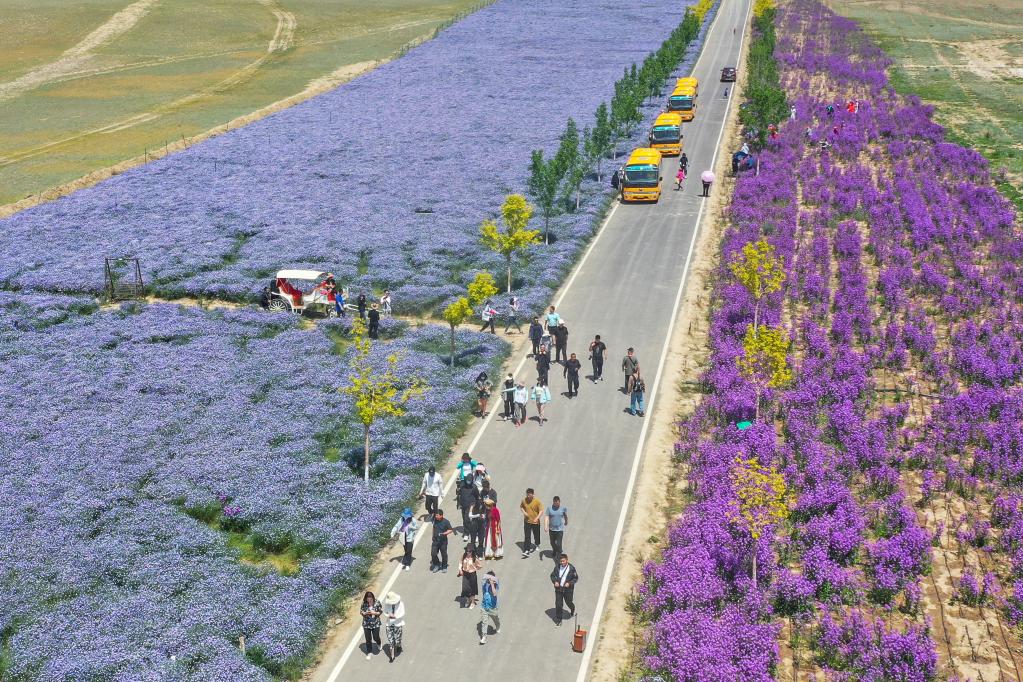
Tourists are sightseeing in Tianshan Huahai National Agricultural Industrial Park, Yining County, Yili Kazakh Autonomous Prefecture, Xinjiang (photo taken on May 18, drone photo). Xinhua News Agency reporter Ding Lei photo
"Lavender is a treasure, which can be used as a daily chemical product and a toy." Ma Zhongliang, a villager from Sigong Village, Lucaogou Town, Huocheng County, said. On the shelves of his own shop, all kinds of lavender deep-processed products such as essential oil, dried flowers and pillows are neatly packed.
Because it is at the same latitude as Provence in France, and the climate and soil conditions are similar, Sigong Village began to try planting lavender in 2005. After years of cultivation, the local lavender planting area has reached more than 12,000 mu, accounting for 96% of the total cultivated area.
"If you want to get rich, planting alone is not enough. You must find ways to increase the added value of lavender." Li Zengjie, secretary of the Party Committee of Lucaogou Town, said. In 2010, Sigong Village developed lavender industry, established Yinongxiang Cooperative, introduced essential oil processing enterprises, and gradually formed a characteristic industrial chain from planting, development and sales to the later stage of lavender straw recycling and turning waste into treasure. More than 300 farmers changed from "flower farmers" to "flower merchants".
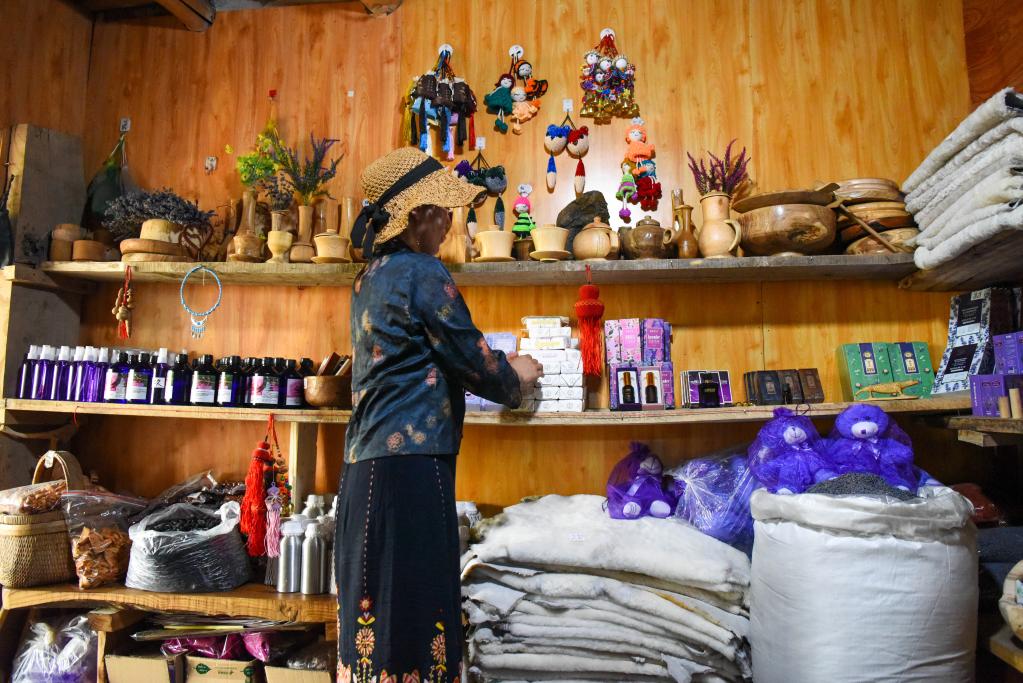
In Sigong Village, Lucaogou Town, Huocheng County, Yili Kazakh Autonomous Prefecture, Xinjiang, various lavender products, such as essential oil, dried flowers, pillows and so on, are placed in the lavender handmade specialty shop run by villager Ma Zhongliang (photo taken on May 17). Xinhua News Agency reporter Ding Lei photo
"Lavender essential oil is the most popular in the store, and tourists from Guangzhou and Shanghai have the highest evaluation." Ma Zhongliang said. With the increasing added value of lavender, in 2022, the per capita income of 718 villagers in Sigong Village was 22,000 yuan, about 2,000 yuan higher than that of the whole town.
The ever-expanding flower industry chain is expanding the path for more people to get rich. Despite 20 years of experience in planting corn and peach trees, Yang Yulan, a farmer in Taohua Village, Daxigou Township, Huocheng County, has put down her "housekeeping skills" and is busy around the hotel room. "The land has flowed out, and now her mind is on the hotel."
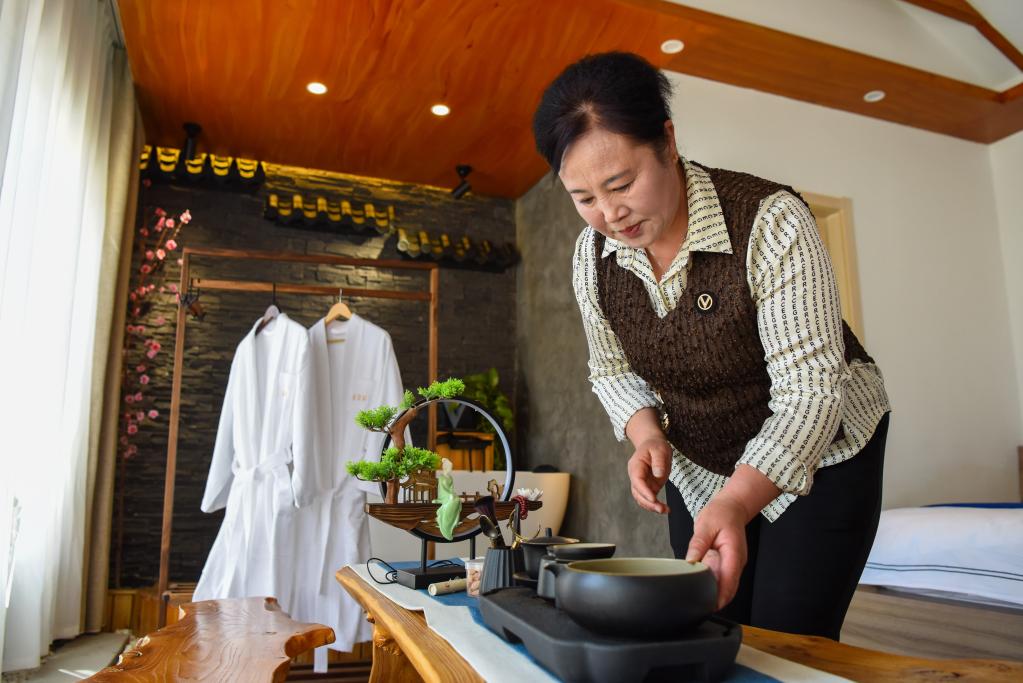
In Taohua Village, Daxigou Township, Huocheng County, Yili Kazakh Autonomous Prefecture, Xinjiang, villager Yang Yulan tidied up the guest room in the hotel (photo taken on May 17). Xinhua News Agency reporter Ding Lei photo
Every April, when apricot blossoms and peach blossoms are in full bloom, the Chinese Fushou Mountain Scenic Area in Huocheng County is crowded with people. Because of its proximity to the scenic spot, Taohua Village has always been popular. However, due to the single tourism products and lack of matching in the past, tourists stopped because of the shipwreck of flowers.
In order to change the "flow" into "reserve", in 2020, Taohua Village explored a new format of increasing tourism income, introduced enterprises to implement infrastructure renovation, starry sky tents and other projects, and encouraged local villagers to actively participate in the renovation of homestays to meet the needs of tourists for eating, living, traveling and entertainment.
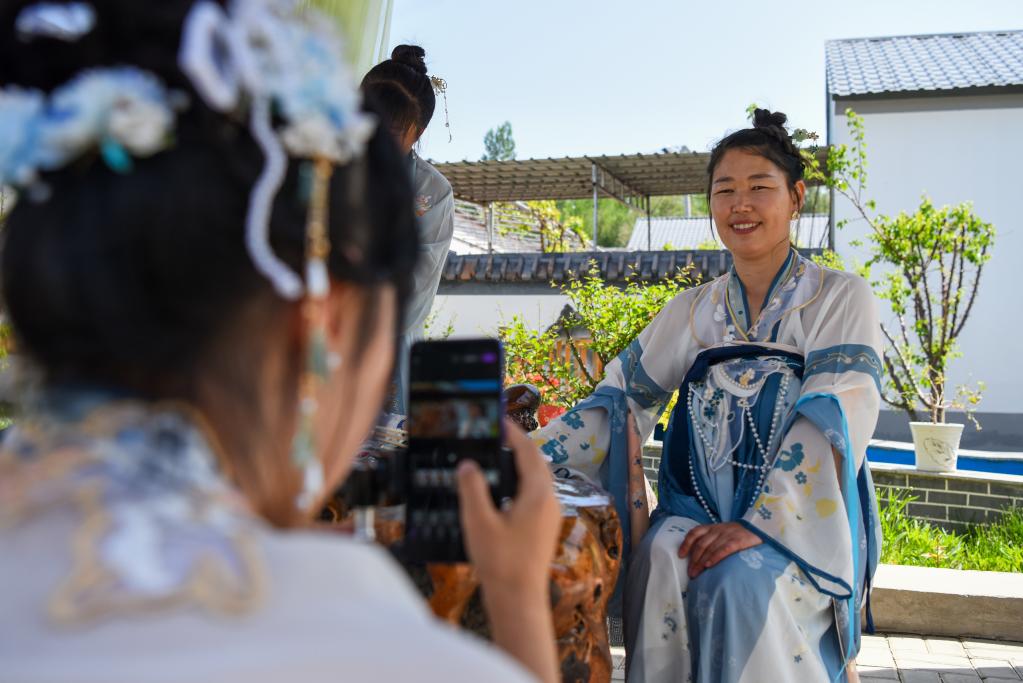
In Taohua Village, Daxigou Township, Huocheng County, Yili Kazakh Autonomous Prefecture, Xinjiang, tourists dressed in Hanfu filmed short videos in a hotel (photo taken on May 17). Xinhua News Agency reporter Ding Lei photo
"Being a farmer all my life, I never thought I could make money from outside the land." Yang Yulan said frankly that she was not enthusiastic about the business of Zhang Luo B&B at first, but since 2021, the number of tourists in the village has gradually increased, catching up with the summer tourist season, and a large number of tourists go to the B&B for consumption, bringing her about 50,000 yuan in tourism income every year. At present, Taohua Village has built 22 theme homestay courtyards, which has led to more than 40 local jobs and an annual per capita income of 2,000 yuan.
As the "flower economy" continues to heat up, more and more farmers leave their homes and become industrial workers. In the summer, we walked into the Tianshan Huahai Scenic Area in Yining County, where peony and flax flowers were in full bloom, and workers were stepping up weeding and maintenance in the field.
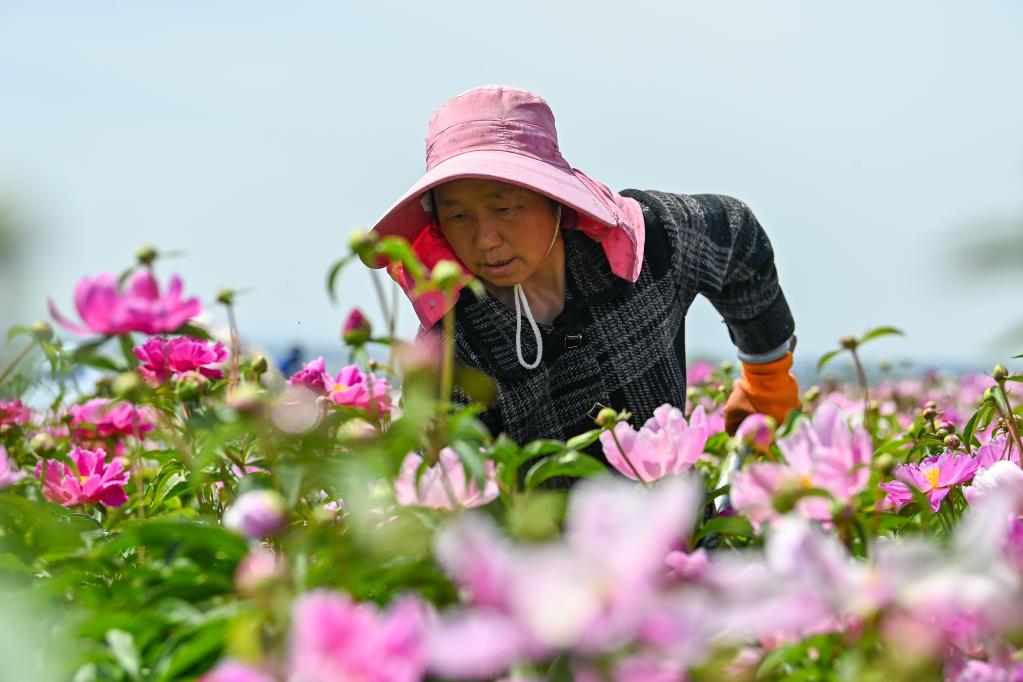
Workers are weeding the flower fields in Tianshan Huahai Modern Agriculture Demonstration Park in Yining County, Yili Kazakh Autonomous Prefecture, Xinjiang (photo taken on May 18). Xinhua News Agency reporter Ding Lei photo
In 2017, Yining County introduced the Yili Tianshan Huahai Modern Agriculture Demonstration Park project, and built it into a well-known local scenic spot with the integration development model of primary, secondary and tertiary industries. Gao Shaochun, deputy general manager of Ili Tianshan Huahai Tourism Development Co., Ltd., introduced that at present, the base has cultivated more than 10 kinds of flowers and 20,000 mu of characteristic forest fruits, and enriched the employment form of farmers through the operation of planting, sorting, intensive processing and fresh-keeping logistics. "The daily labor consumption in the busy farming season reached more than 2,800 people, providing more than 2,000 fixed jobs."
Do a good job of "flowers" and explore new "flowers". Today, Xinjiang’s "flower economy" is gaining momentum and is pushing the "rich door" for more people.