70 Years of New China Fine Arts | Yangtze River Delta Joint Exhibition: Liu Haisu painted while the iron was hot, Wu Qingxia painted with rice seedlings.

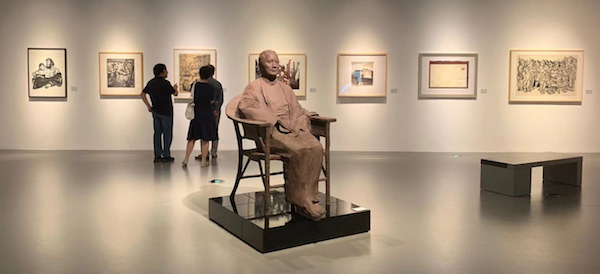
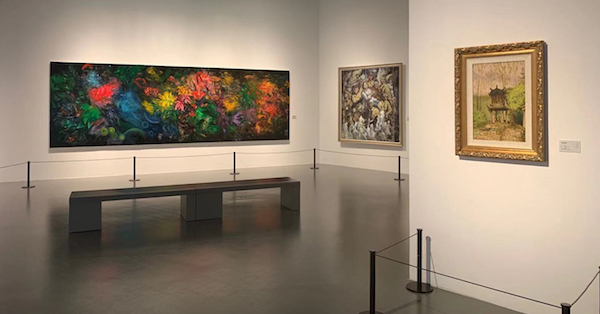
On September 29th, "Red Flag Rolling: Exhibition on Collection and Promotion of Theme Art Works of Art Museums in Yangtze River Delta Region" opened in Liu Haisu Art Museum. This exhibition takes the theme art creation in the Yangtze River Delta region as the breakthrough point, and follows the chronological order of 70 years since the founding of New China. It displays 68 works selected and sent by 31 parents’ triangular cooperation mechanism units, including Shanghai Liu Haisu Art Museum, Zhu Qizhan Art Museum, Changzhou Wu Qingxia Art Institute, Anhui Yaming Art Museum and Kunshan Hou Beiren Art Museum.

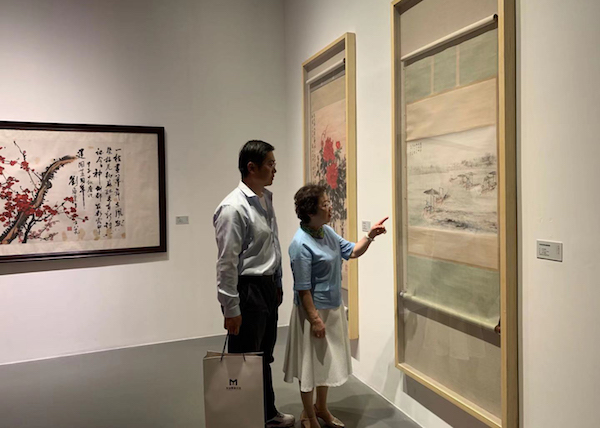
Exhibition site

The exhibition tells the story from the "red classics" in the context of "literature and art serve the people, workers, peasants and soldiers" in the early days of the founding of the People’s Republic of China to the confrontation and balance under the impact of foreign culture of reform and opening up, and then to the pluralistic coexistence of China’s artistic ecology under the background of contemporary globalization.

Ruan Jun, deputy director of Shanghai Liu Haisu Art Museum, explained three key words of the exhibition, namely, 70th anniversary of the founding of New China, showing people’s beautiful life, and how artists show their works, and interpreted the thematic works from the perspective of poetic Jiangnan meaning: "Jiangnan culture contains the pursuit of beauty and yearning for a better life, from which artists can see their understanding of life and intuitive observation of social changes."

Exhibition site

How do artists transform in historical changes?

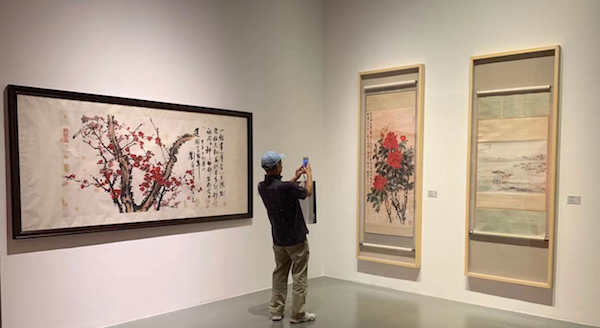
Walking into the exhibition hall, first of all, two large-scale flower works created by Liu Haisu for the 30th anniversary and the 35th anniversary of the founding of New China are presented. These two exhibits are from the Liu Haisu Art Museum in Changzhou, and they respectively use peony and red plum as metaphors for the new atmosphere of Shenzhou. Two oil paintings by Liu Haisu, "Picking the Mud" and "Strike the Iron", selected by Liu Haisu Art Museum, show the labor scene in full swing. At the same time, these two works also show the diversity of artists’ styles, among which "Strike while the Iron is Hot" seems to draw lessons from Van Gogh’s shadow.

Liu Haisu’s Oil Painting While the Iron is Striked: 81×60.3cm Selected by Liu Haisu Art Museum

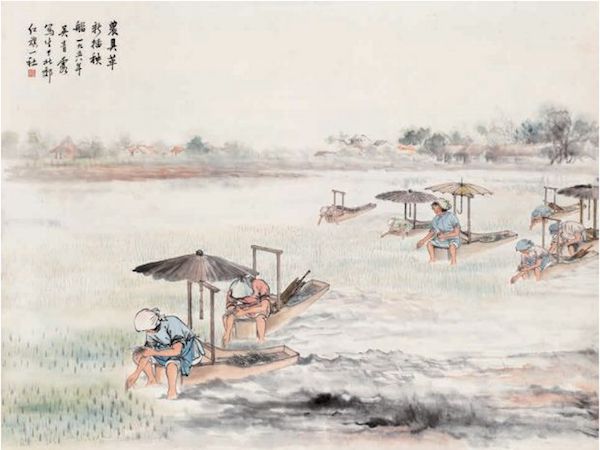
Next to these two colorful works is the 1958 work of the female painter Wu Qingxia, namely "Innovative Rice Transplanter with Agricultural Tools". From the inscription, it can be seen that this work was "sketched in the northern suburb of Hongqi No.1 Society". Like Liu Haisu, she walked out of Changzhou, and became famous as "Carp Wu" in middle age. In her octogenarian years, she donated her fine paintings and famous paintings and calligraphy jointly collected by her husband, Mr. Wu Yunrui, to Changzhou Municipal Government for free. The exhibition "Agricultural Tools Innovation Transplanting Boat" is from Changzhou Wu Qingxia Art Museum.

Wu Qingxia’s 56×75cm Chinese painting "Farm Tools Innovating Transplanting Boat" Selected by Wu Qingxia Art Institute.

Zhang Huan, the daughter of Wu Qingxia, told the The Paper reporter that Wu Qingxia came from a painting family, and Liu Haisu and Wu Qingxia’s cousins were good friends. Originally, they planned to go to Shanghai to run an art school, but Liu Haisu went to Shanghai alone after Wu Qingxia’s cousin died of illness. At that time, the China Painting Academy called on painters to go to the workers, peasants and soldiers, live in factories and rural areas, and eat, live and work with farmers, so as to draw such vivid works.

It is different from the image of farmers wearing straw hats and bending over to transplant rice seedlings. In this work, a woman dressed in Jiangnan sits at the front of the "boat", with seedlings to be inserted behind it, and there is also a special device for holding an umbrella to shade the sun. Just like the title of the work "Innovative Rice Transplanter with Agricultural Tools", Wu Qingxia recorded the working conditions of that era with a brush.

Zhang Huan, the daughter of Wu Qingxia, tells her son about Wu Qingxia’s works at the exhibition site.

How do different times and backgrounds affect artists’ creation?

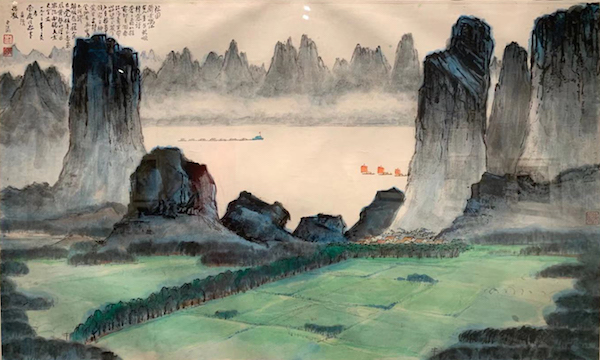
The exhibition also exhibited works by Zhu Qizhan, Zong Qixiang, Ying Yeping and others. Among them, a landscape painting by Liu Kaiqu is quite rare. As we all know, Liu Kaiqu is a sculptor, and his masterpiece is the Monument to the People’s Heroes. The Statue of Cai Yuanpei in Shanghai Jing ‘an Park is also from Liu Kaiqu. One of Liu Kaiqu’s works in the exhibition is called "Scenery of the Motherland", which is a collection of Wang Qiangzhong. This work originated from his father, who was a military representative of the Central Academy of Fine Arts at that time. Liu Kaiqu thanked him for giving it.

Liu Kaiqu, The Scenery of the Motherland.

Following the first part of the old man’s interpretation of the times, the second and third parts of the exhibition are the works of current artists. Shen Hu, an expert of the Art Committee of Liu Haisu Art Museum, used to appear as a theoretical researcher. In this exhibition, his "Wujintu" was created in the mid-1980s, depicting the production situation of coal miners.

Shen Hu’s Wujintu

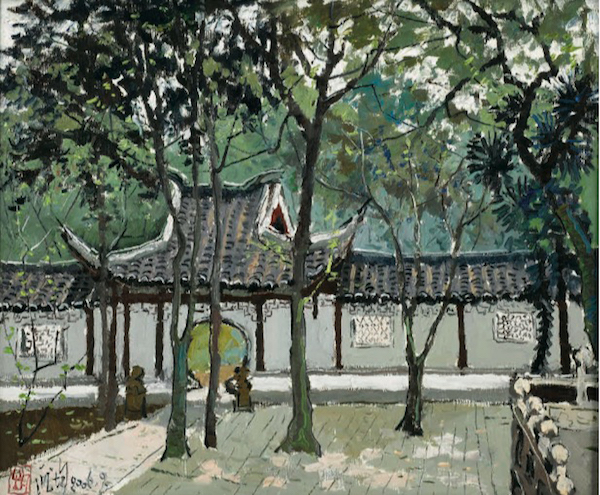
Huang Azhong’s "Workers’ Village" depicts the construction of the Shanghai Workers’ Village and the cultural and leisure life of the workers with relaxed brushwork. Pang Jun’s "East Courtyard of Broken Mountain Temple" selected by Changshu Art Museum, although it is also a sketch of scenery, covers the history of culture and art. The "Broken Mountain Temple" is located at the foot of Yushan Mountain in Changshu, and there is often a poem "a buddhist retreat behind broken-mountain temple" in the Tang Dynasty. The painting "East Courtyard of Broken Mountain Temple" seems to show the poetry of "my path has wound, through a sheltered hollow and of boughs and flowers, to a Buddhist retreat" in the Tang Dynasty as an oil painting landscape. These works express the theme creation in a relaxed and freehand way. He Xi’s "After Rain Clears Up" injects contemporary ideas into thematic creation.

Pang Jun’s "Broken Mountain Temple East Courtyard"

According to Zhao Zongguan, secretary general of the collaboration mechanism of the Yangtze River Delta Art Museum, the works on display were collected from the works of art related to the founding of New China in various museums, and many collections were exhibited for the first time. Among them, we can see that the older generation of artists went deep into life to express the new achievements of socialism after the founding of New China. These old gentlemen used to paint traditional themes, and they incorporated new enthusiasm and sentiment into their traditional skills. The thematic works of art in different times bring different thoughts to Chinese people.

Exhibition site

The exhibition will last until October 10th.

Nature Home Upgrade "Healthy Whole House Customization" Resets Whole Assembly Thinking

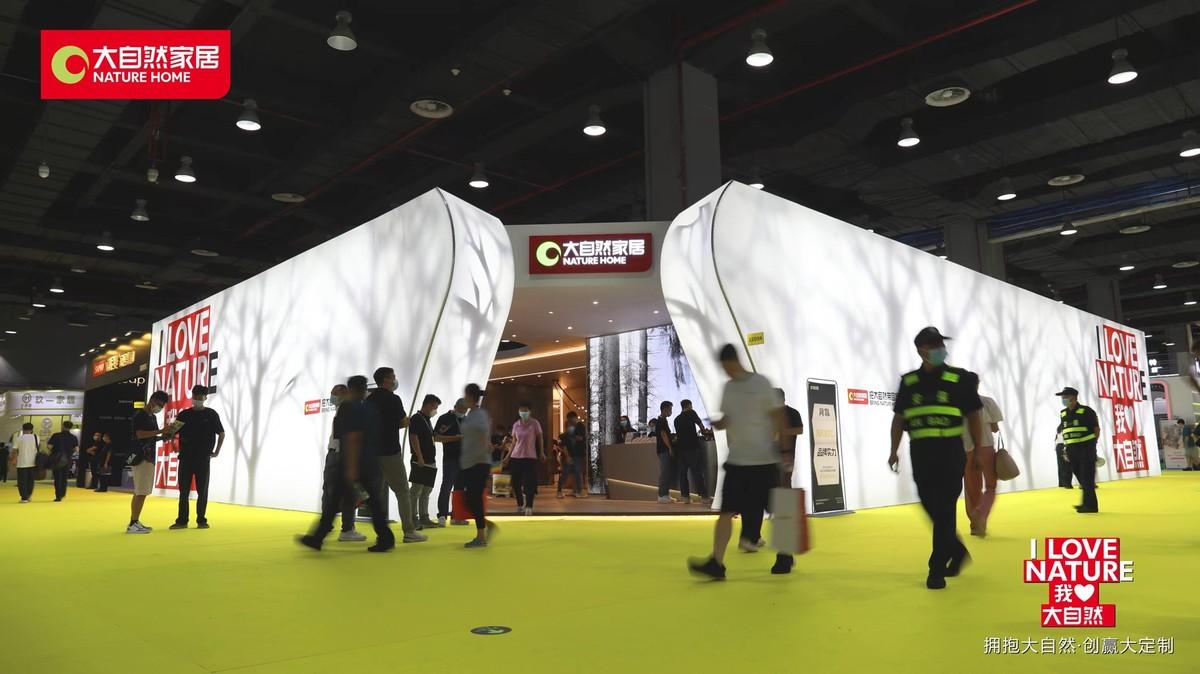
In the past two years, since the "self-assembly" broke into the public opinion of the home furnishing industry, various businesses have sought resource integration and scale expansion, and entered the customized self-assembly track. The natural home with 28 years of deep accumulation in the field of wood work has always been exploring how to satisfy the concept of "whole house customization". From June 23rd to 25th, 2022, the 11th Guangzhou Custom Home Exhibition was successfully held in Guangzhou Poly World Trade Expo Hall and Guangzhou International Purchasing Center. More than 50 new products were exhibited by Nature Home, and the aesthetic imagination of space was reset with the concept of "healthy whole house customization", which inspired more inspiration for the development direction of custom home enterprises.

Debut at Guangzhou Custom Home Furnishing Exhibition, Interpreting "Integrated Thinking"

The success of Guangzhou Custom Home Furnishing Exhibition shows that the exhibition will continue to take "full chain connection and deep empowerment" as its value orientation, deeply link the upstream and downstream elements of the industrial chain, lead the development trend of the industry and provide new ideas for the development of the home furnishing industry.

Nature Home was invited to participate in this year’s Guangzhou Custom Home Exhibition, and made a stunning appearance at booth 11D04 of National Mining Museum, releasing over 50 brand-new custom home products based on healthy plant water paint, double noise reduction and mute technology, zero formaldehyde intelligent manufacturing and antibacterial technology: Pascal series living room space products, Moonlight series study space products, Notik series bedroom space products, Beth series bedroom products … Multi-style selection and multi-space coverage, opening up the vertical boundary of space. More integrated and opened up a number of IT systems, such as easy-to-make, flat-to-lie, cool-to-enjoy, etc., improved efficiency through intelligent information systems, and made exhibitors live in the scene with reasonable regional division, interpreted the thinking of empowering space integration from "customization+layout", and conveyed the understanding of space aesthetics in nature homes.

Nature home furnishing Pascal series-living room

Yuexi series-study room

Continue the "green" gene and define "healthy whole house customization"

From a series of new products released, it is not difficult to see that the focus of the whole house customization of nature home upgrade is still "green health", which always takes "environmental responsibility, healthy life and healthy home" as the corporate mission. Raw materials and products such as APG soybean rubber flooring, nano antibacterial flooring, low formaldehyde solid wood filled wooden doors, water-based painted wooden doors, bamboo and wood fiberboard wallboard, and cabinets and wardrobes all made of formaldehyde-free added plates can reach the national E1, international E0 and the highest European EN300 standards, meeting the deep needs of consumers for environmental protection and health.

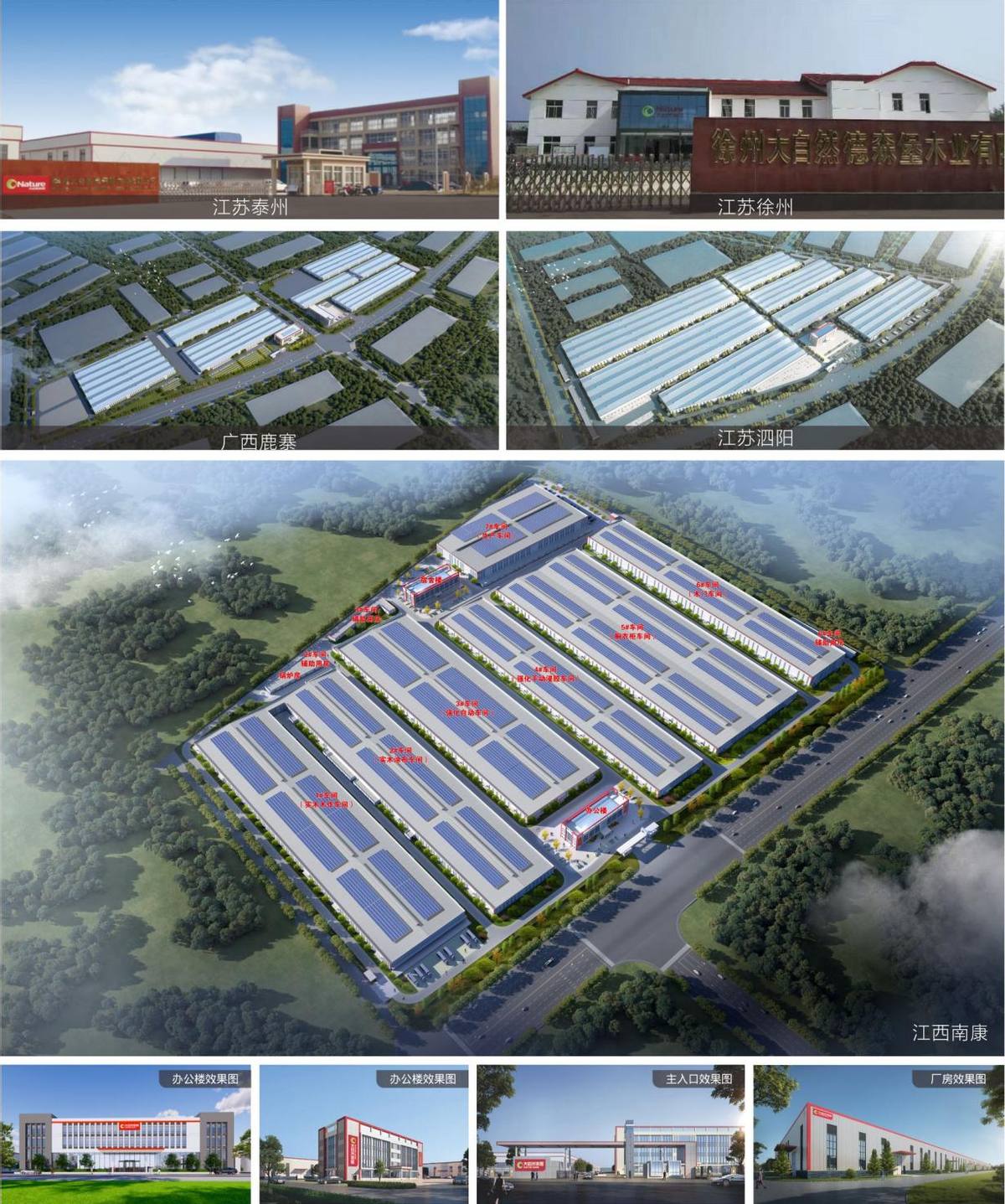
In order to provide a healthy whole house customized solution, Nature Home has built a "green industrial chain" from raw materials to production to installation. At present, Nature Home has nine wood supply bases in the world, namely, Brazil, Peru, North America, Russian, French, Gabon, Myanmar, Indonesia, Northeast China and other places to meet the wood supply of Nature Home. At the same time, six intensive intelligent manufacturing bases have been built in Siyang, Jiangsu, Taizhou, Nankang, Jiangxi, Luzhai, Anhui, Yeji and Cambodia. Nature defines "healthy whole house customization" with rooted natural environmental protection genes to help consumers realize their dream of green living.

Open up the whole house customization thinking and reorganize the whole industry structure.

Throughout the 28-year road of researching products in nature home, the idea of "whole package" has been laid out for ten years. In nature’s view, "whole house customization" needs not simple matching and matching, but real integration. To achieve this, it is necessary to get through the whole house customization thinking and integrate the space facade customization including doors, walls and cabinets, and truly realize "whole house customization" with unified design, style and style.

The newly upgraded "Healthy Whole House Customization" of Nature Home has become the focus of media and industry at the exhibition. The reasons are as follows: firstly, it puts the concept of health and environmental protection in the first place, insists on starting with products and controlling environmental protection from the source, forming a core competitive advantage and core competitiveness; Second, work hard on the construction of operation management information system, deepen the reform of digitalization and intelligence, integrate the supply chain of consumers from purchase to back-end by opening up multiple IT systems, promote the linkage of different links, break the data island and realize end-to-end empowerment.

In this exhibition, Nature Home showed high-end customized life with high concept, high value and high quality to each exhibitor through the exhibition of immersive experience, which echoed the enthusiasm of the industry, reshaped the industry’s understanding of the whole outfit and opened up a new path for the whole house customization. In the future, Nature will continue to pursue the health and environmental protection of products as a long-term goal, focus on product quality improvement, and constantly carry out technological innovation to boost the healthy and vigorous development of the industry and forge ahead in a higher and broader world.

Reporting/feedback

United Nations Convention on the Carriage of Goods by Sea, 1978 (Hamburg Rules)

(Effective date:-Expiry date:)

The States Parties to this Convention,
  Recognize that need to determine by agreement a numb of rules governing the carriage of goods by sea,
  Decided to conclude a convention for this purpose, and agreed as follows:
  The first part of the general rules

  The first definition
  In this Convention:
  1. "Carrier" means any person who has entered into a contract of carriage of goods by sea with the shipper by himself or in his name.
  2. "Actual carrier" means any person entrusted by the carrier to carry out the transport of goods or part of the transport of goods, including any other person entrusted to carry out this transport.
  3. "Shipper" means any person who has entered into a contract of carriage of goods by sea with a carrier or who has actually delivered the goods to the carrier related to the contract of carriage of goods by sea.
  4. "Consignee" means the person who has the right to take delivery of the goods.
  5. "Goods" include live animals. Where goods are packed in containers, pallets or similar means of transport, or goods are packaged, and such means of transport or packaging are provided by the shipper, "goods" include them.
  6. "Contract of carriage by sea" means any contract under which the carrier collects freight and undertakes to transport goods from one port to another by sea; However, a contract that includes both maritime transport and some other modes of transport is regarded as a contract of carriage by sea within the scope of this Convention.
  7. "Bill of Lading" refers to a document used to prove the contract of carriage by sea and that the goods are taken over or loaded by the carrier, so that the carrier can guarantee the delivery of the goods. The stipulation in the document that the goods should be delivered to the designated consignee or to the order, or to the holder of the bill of lading constitutes this guarantee.
  8. "Written" includes, among other means, telegram and telex.

  Article 2 Scope of application
  1. The provisions of this Convention apply to all contracts of carriage by sea between two different countries if:
  (a) The port of loading stipulated in the contract of carriage by sea is located in a Contracting State, or
  (b) The port of discharge stipulated in the contract of carriage by sea is located in a Contracting State, or
  (c) One of the alternative ports of discharge stipulated in the contract of carriage by sea is the actual port of discharge, and the port is located in a Contracting State, or
  (d) The bill of lading or other documents evidencing the contract of carriage by sea is issued in a Contracting State, or
  (e) The bill of lading or other documents evidencing the contract of carriage by sea stipulates that the provisions of this Convention or the legislation of any country implementing this Convention shall bind the contract.
  2. The provisions of this Convention shall apply irrespective of the nationality of the ship, the carrier, the actual carrier, the shipper, the consignee or any other interested person.
  3. The provisions of this Convention do not apply to charterparties. However, if the bill of lading is issued in accordance with the charter party and the relationship between the carrier and the holder of the bill of lading who is not the charterer is drawn, the provisions of this Convention shall apply to the bill of lading.
  If the contract stipulates that the goods will be transported in batches within an agreed time limit, the provisions of this Convention shall apply to each batch of transportation. However, if the transportation is carried out in accordance with the charter party, the provisions of paragraph 3 of this article shall apply.

  Article 3 Interpretation of this Convention
  When interpreting and applying the provisions of this Convention, attention should be paid to the international nature of this Convention and the need to promote unification.

  Part II Liability of the Carrier

  Article 4 Period of responsibility
  1. According to this Convention, the period of the carrier’s responsibility for the goods includes all the periods when the goods are in the carrier’s charge at the port of loading, during the transit and at the port of discharge.
  2. For the purposes of paragraph 1 of this article, the carrier shall be deemed to be in charge of the goods during the following period:
  (a) Since the carrier takes over the goods from:
  (i) The shipper or a person acting on his behalf; or
  (ii) According to the applicable laws or regulations at the port of loading, the goods must be delivered to the authorities where they are shipped or other third parties;
  (b) Until the carrier delivers the goods to:
  (i) Deliver the goods to the consignee; or
  (ii) If the consignee fails to take delivery of the goods from the carrier, the goods shall be placed under the control of the consignee in accordance with the contract or the applicable laws or special trade practices at the port of discharge; or
  (iii) Deliver the goods to the authorities or other third parties who must deliver them according to the laws or regulations applicable at the port of discharge.
  3. The carrier or consignee mentioned in paragraphs 1 and 2 of this article means not only the carrier and the consignee, but also the servant or agent of the carrier or the consignee respectively.

  Article 5 Basis of Responsibility
  1. Unless the carrier proves that his servant or agent has taken all reasonable measures to avoid the accident and its consequences, the carrier shall be liable for the losses caused by the loss of or damage to the goods or the delay in delivery. If the accident that caused the loss, damage or delay in delivery occurred while the carrier was in charge, as mentioned in Article 4.
  2. If the goods fail to be delivered at the port of discharge stipulated in the contract of carriage by sea within the clearly agreed time, or if there is no such agreement, they fail to be delivered at the port of discharge within the time reasonably required by a diligent carrier in consideration of the actual situation, it is a delay in delivery.
  3. If the goods are not delivered in accordance with the requirements of Article 4 within 60 consecutive days after the delivery time stipulated in Paragraph 2 of this Article expires, the person entitled to claim for the loss of the goods may regard the goods as lost.
  4. (a) The carrier is liable for:
  (i) The loss, damage or delay in delivery of the goods caused by the fire, if the claimant proves that the fire was caused by the fault or negligence of the carrier, his servants or agents;
  (ii) Loss, damage or delay in delivery of the goods proved by the claimant due to the negligence or negligence of the carrier, its servants or agents in taking all measures that can be reasonably required to extinguish the fire disaster and avoid or mitigate its consequences.
  (b) Where the fire on the ship affects the goods, if the claimant or the carrier requests, the cause and situation of the fire must be investigated in accordance with the maritime practice, and a report of the investigator shall be provided to the carrier and the claimant as required.
  With regard to live animals, the carrier shall not be liable for loss, damage or delay in delivery caused by any special risks inherent in such transportation. If the carrier proves that he acted in accordance with any special instructions on animals given to him by the shipper, and proves that the loss, damage or delay in delivery can be attributed to this kind of risk according to the actual situation, it shall be presumed that the loss, damage or delay in delivery is caused in this way, unless it is proved that all or part of the loss, damage or delay in delivery is caused by the fault or negligence of the carrier, his servants or agents.
  6. The carrier shall not be liable for loss, damage or delay in delivery caused by taking measures to save life or reasonable measures to save property at sea, except contributing to general average.
  7. If the loss, damage or delay in delivery of the goods is caused by the fault or negligence of the carrier, its servants or agents and other reasons, the carrier shall be liable for compensation only to the extent that the loss, damage or delay in delivery is caused by their fault or negligence, but the carrier shall prove that it is not the amount of loss, damage or delay in delivery caused by such fault or negligence.

  Article 6 limitation of liability
  1. (a) According to the provisions of Article 5, the carrier’s liability for compensation for losses caused by loss of or damage to goods shall be limited to the amount equivalent to 835 accounting units or 2.5 accounting units per kilogram of gross weight for each lost or damaged goods or other freight units, whichever is the higher.
  (b) According to Article 5, the carrier’s liability for delay in delivery is limited to an amount equivalent to 2.5 times of the freight payable for the delayed goods, but shall not exceed the total freight payable under the contract of carriage of goods by sea.
  (c) According to subparagraphs (a) and (b) of this paragraph, the total liability of the carrier shall in no case exceed the limit of liability for total loss of goods stipulated in subparagraph (a) of this paragraph.
  2. According to paragraph 1 (a) of this article, the following rules shall be observed when calculating the higher amount:
  (a) When containers, pallets or similar means of transport are used to assemble goods, if a bill of lading is issued, the number of pieces or other freight units contained in such means of transport, which is listed in the bill of lading or in any other document evidencing the contract of carriage by sea, shall be regarded as the number of pieces or freight units. In addition to the above situation, the goods in this transportation device are regarded as a freight unit.
  (b) When the means of transport itself is lost or damaged, if it is not owned or provided by the carrier, it shall be regarded as a separate freight unit.
  3. The unit of account refers to the unit of account mentioned in Article 26.
  4. The carrier and the shipper may, by agreement, determine the limit of liability in excess of that stipulated in paragraph 1.

  Article 7 Application of Non-contractual Claims
  1. The defences and limits of liability provided for in this Convention shall apply to the loss or damage of the goods involved in the contract of carriage by sea, as well as any lawsuit brought against the carrier for delay in delivery, whether such lawsuit is based on contract, tort or otherwise.
  2. If such an action is brought against the servant or agent of the carrier, and the servant or agent can prove that he acted within the scope of his employment, he is entitled to avail himself of the defences and limits of liability that the carrier is entitled to invoke under this Convention.
  3. Except as provided in Article 8, the total amount of compensation obtained from the carrier and any person referred to in paragraph 2 of this Article shall not exceed the limitation of liability stipulated in this Convention.

  Article 8 Loss of the right to limit liability
  1. If it is proved that the loss, damage or delay in delivery is caused by an act or omission of the carrier that intentionally caused such loss, damage or delay in delivery, or by an act or omission of the carrier that was done recklessly knowing that such loss, damage or delay in delivery might occur, the carrier shall not be entitled to the benefit of the limitation of liability stipulated in Article 6.
  2. Notwithstanding paragraph 2 of Article 7, if it is proved that the loss, damage or delay in delivery is caused by the act or omission of the employee or agent intentionally causing such loss, damage or delay in delivery, or by the act or omission of the employee or agent recklessly knowing that such loss, damage or delay in delivery may occur, the employee or agent of the carrier shall not be entitled to the benefit of the limitation of liability stipulated in Article 6.

  Article 9 deck cargo
  1. The carrier has the right to carry the goods on deck only in accordance with the agreement with the shipper, or in accordance with specific trade practices, or in accordance with the requirements of laws and regulations.
  2. If the carrier and the shipper agree that the goods should or can be carried on deck, the carrier must put a corresponding statement on the bill of lading or other documents evidencing the contract of carriage by sea. Without this statement, it is the carrier’s responsibility to prove that an agreement has been reached for carriage on deck. However, the carrier has no right to invoke this agreement against the third party, including the consignee, who believes in and holds the bill of lading.
  3. If the goods are carried on deck in violation of the provisions of paragraph 1 of this article, or the carrier cannot invoke the agreement on carriage on deck in accordance with paragraph 2 of this article, notwithstanding the provisions of paragraph 1 of Article 5, the carrier shall still be liable for the loss or damage of the goods and the delay in delivery caused only by carriage on deck, and the limit of its liability shall be determined in accordance with the provisions of Article 6 or Article 8 of this Convention as the case may be.
  Loading the goods on deck in violation of the express agreement to load the goods in the cabin shall be regarded as an act or omission of the carrier within the meaning of Article 8.

  Article 10 Liability of the carrier and the actual carrier
  1. If the performance of the transport or part of the transport is entrusted to the actual carrier, the carrier shall still be responsible for the whole transport in accordance with the provisions of this Convention, regardless of whether it is entitled to do so under the contract of carriage by sea. With regard to the transportation performed by the actual carrier, the carrier shall be responsible for the acts or omissions of the actual carrier and its employees and agents within the scope of their employment.
  2. All the provisions of this Convention on the carrier’s liability also apply to the actual carrier’s liability for the transportation performed by it. If a lawsuit is brought against the employee or agent of the actual carrier, the provisions of paragraphs 2 and 3 of Article 7 and paragraph 2 of Article 8 shall apply.
  3. Any special agreement under which the carrier assumes the obligations not stipulated in this Convention or waives the rights conferred by this Convention can only affect the actual carrier if he expressly agrees in writing. Whether the actual carrier has agreed or not, the carrier is still bound by the obligations or waivers caused by this special agreement.
  4. If both the carrier and the actual carrier are liable, they shall be jointly and severally liable within the scope of this liability.
  5. The total amount of compensation obtained from the carrier, the actual carrier and their servants and agents shall not exceed the limitation of liability stipulated in this Convention.
  6. The provisions of this article are without prejudice to any right of recourse between the carrier and the actual carrier.

  Article 11 through transport
  1. Notwithstanding the provisions of Article 10, paragraph 1, if the contract of carriage by sea clearly stipulates that a specific part of the carriage included in the contract shall be performed by a designated person other than the carrier, the contract may also stipulate that the carrier shall not be responsible for the loss, damage or delay in delivery of the goods during this part of the carriage, which is under the control of the actual carrier. However, if legal proceedings cannot be brought against the actual carrier in a competent court in accordance with the provisions of Article 21, paragraph 1 or paragraph 2, any provision limiting or exempting such liability shall be null and void. The carrier shall bear the burden of proof to prove that any loss, damage or delay in delivery is caused by the above-mentioned events.
  2. According to Article 10, paragraph 2, the actual carrier shall be responsible for the loss, damage or delay in delivery of the goods caused by accidents while in his charge.

  Part III Liability of Shipper

  Article 12 General rules
  The shipper shall not be liable for the loss suffered by the carrier or the actual carrier or the damage suffered by the ship, unless such loss or damage is caused by the fault or negligence of the shipper, his servants or agents. Any servant or agent of the shipper shall not be liable for such loss or damage, unless such loss or damage is caused by his own fault or negligence.

  Article 13 Special rules on dangerous goods
  1. The shipper must mark or label the dangerous goods in an appropriate way.
  2. When the shipper delivers the dangerous goods to the carrier or the actual carrier, the shipper must inform the danger of the goods and, if necessary, the preventive measures to be taken. If the shipper fails to do so, and the carrier or the actual carrier does not know the dangerous characteristics of the goods from other sources, then:
  (a) The shipper shall be liable to the carrier and any actual carrier for the losses caused by carrying such goods. and
  (b) The goods can be unloaded, destroyed or rendered harmless at any time according to the needs of the situation without compensation;
  3. No one may invoke the provisions of paragraph 2 of this article if he takes over the goods knowing the dangerous characteristics during transportation.
  4. If the provisions of paragraph 2 (b) of this article are not applicable or can not be invoked, and the dangerous goods cause actual danger to life or property, the goods may be unloaded, destroyed or rendered harmless without compensation, except for the obligation of general average contribution or the liability of the carrier according to Article 5.

  Part IV Transport Documents

  Article 14 issuance of bills of lading
  1. When the carrier or actual carrier takes over the goods, the carrier must issue the bill of lading to the shipper at the request of the shipper.
  2. The bill of lading may be signed by the person authorized by the carrier. A bill of lading signed by the captain of the ship carrying the goods shall be deemed to be signed on behalf of the carrier.
  3. The signature on the bill of lading can be handwritten, copied, punched, stamped, symbolized, or by any other mechanical or electronic means provided that it does not violate the laws of the country where the bill of lading is issued.

  Article 15 Contents of Bill of Lading
  1. The bill of lading must include the following items, among other things:
  (a) The category of the goods, the main signs necessary to identify the goods, such as dangerous goods, a clear description of the dangerous characteristics of the goods, the number of packages or pieces, the weight of the goods or the quantity expressed in other ways, etc., all of which are provided by the shipper;
  (b) the appearance of the goods;
  (c) The name and principal place of business of the carrier;
  (d) the name of the shipper;
  (e) If the shipper designates the consignee, the name of the consignee;
  (f) The port of loading stipulated in the contract of carriage by sea and the date when the carrier takes over the goods at the port of loading;
  (g) the port of discharge stipulated in the contract of carriage by sea;
  (h) If there is more than one original bill of lading, specify the number of original bills of lading;
  (i) the place of issue of the bill of lading;
  (j) The signature of the carrier or its representative;
  (k) The amount of freight payable by the consignee or other explanations of freight paid by the consignee;
  (l) The declaration referred to in article 23, paragraph 3;
  (m) In the case of deck cargo, a statement that the cargo should or can be transported on deck;
  (n) If expressly agreed by both parties, the date or time limit for delivery of the goods at the port of discharge shall be specified; and
  (o) Any increased liability limit agreed in accordance with Article 6, paragraph 4.
  2. After the goods are loaded, the carrier must issue a "loaded" bill of lading to the shipper if the shipper so requests. In addition to the items specified in paragraph 1 of this article, the bill of lading must also indicate that the goods have been loaded on one or more designated ships and one or more loading dates. If the carrier has previously issued a bill of lading or other documents of title to the shipper on any part of the goods, the shipper must return such documents in exchange for the "on board" bill of lading at the request of the carrier. In order to meet the shipper’s requirements for the "on board" bill of lading, the carrier may modify any previously issued documents, but the modified documents shall include all the items required in the "on board" bill of lading.
  3. The lack of one or more of the items specified in this article does not affect the legal nature of the document as a bill of lading, but the document must meet the requirements specified in Article 1, paragraph 7.

  Article 16 Bill of Lading: Reservation and Evidence Effect
  1. If the carrier or other person who issues the bill of lading on his behalf knows or has reasonable grounds to suspect that the items contained in the bill of lading, such as the category, main marks, number of packages or pieces, weight or quantity, do not accurately represent the goods actually taken over, or in the case of issuing the "on board" bill of lading, do not accurately represent the goods actually shipped, or he has no proper method to check these items, the carrier or other person must make a reservation on the bill of lading, indicating.
  2. If the carrier or other person who issues the bill of lading on his behalf fails to annotate the appearance of the goods on the bill of lading, it shall be deemed that he has indicated that the goods are in good appearance on the bill of lading.
  3. In addition to the reservation of permission for the relevant project and its scope according to the provisions of paragraph 1 of this article:
  (a) The bill of lading is prima facie evidence that the carrier takes over or, if a "on board" bill of lading is issued, loads the goods described in the bill of lading;
  (b) If the bill of lading has been transferred to a third party, including the consignee, who believes in the description of the goods in the bill of lading and acts accordingly, the carrier will not accept the evidence to the contrary.
  4. If the bill of lading fails to specify the freight or otherwise state that the freight is paid by the consignee or that the demurrage incurred at the loading port is paid by the consignee in accordance with Article 15, paragraph 1 (k), the bill of lading is prima facie evidence that the consignee does not pay the freight or demurrage. If the bill of lading has been transferred to a third party, including the consignee, who believes that there is no such statement on the bill of lading, the evidence to the contrary presented by the carrier will not be accepted.

  Article 17 the shipper’s warranty
  1. The shipper shall be deemed to have assured the carrier that the category, mark, number of pieces, weight and quantity of the goods listed in the bill of lading provided by him are correct. The shipper must compensate the carrier for the losses caused by the inaccuracy of these items. Even if the shipper has transferred the bill of lading, he is still liable for compensation. This right of compensation obtained by the carrier will in no way reduce his liability for compensation to anyone other than the shipper under the contract of carriage by sea.
  2. Any letter of guarantee or agreement under which the shipper guarantees to compensate the carrier for the losses caused by issuing the bill of lading because the carrier or its representative fails to provide the consignor with comments and reservations on the items or the appearance of the goods included in the bill of lading is invalid for any third party, including the consignee.
  3. This letter of guarantee or agreement is valid for the shipper, unless the carrier or his representative does not endorse the reservation referred to in paragraph 2 of this article as intentional fraud, and a third party, including the consignee, believes in the description of the goods in the bill of lading. In the latter case, if the unmarked reservation is related to the items provided by the shipper for inclusion in the bill of lading, the carrier has no right to demand compensation from the shipper in accordance with paragraph 1 of this article.
  4. In case of intentional fraud referred to in paragraph 3 of this article, the carrier shall not enjoy the benefit of the limitation of liability stipulated in this Convention, and shall be liable for the losses suffered by the third party, including the consignee, who acted because of believing the description of the goods contained in the bill of lading.

  Article 18 Documents other than bills of lading
  If the carrier issues a document other than the bill of lading to prove the receipt of the goods to be shipped, the document is the preliminary evidence of the conclusion of the contract of carriage by sea and the carrier’s taking over the goods described in the document.

  Part V Claims and Litigation

  Article 19 Notice of loss, damage or delay in delivery
  1. Unless the consignee sends a written notice of loss or damage to the carrier not later than the first working day after the date when the goods are handed over to him, stating the general nature of the loss or damage, such handover shall be regarded as the prima facie evidence of the carrier’s delivery of the goods described in the transport document or, if no such document is issued, as the prima facie evidence of the delivery of the goods in good condition.
  2. In case of inconspicuous loss or damage: if the written notice is not sent within fifteen consecutive days after the goods are delivered to the consignee, the provisions in paragraph 1 of this article shall apply accordingly.
  3. If the condition of the goods has been jointly inspected or inspected by the parties at the time of delivery to the consignee, there is no need to send a written notice on the loss or damage identified in the inspection or inspection.
  In case of any actual or unexpected loss or loss, the carrier and the consignee must provide all reasonable facilities for each other to inspect and count the goods.
  5. Unless the carrier is notified in writing within 60 consecutive days after the goods are delivered to the consignee, no compensation will be paid for the losses caused by the delayed delivery.
  6. If the goods are delivered by the actual carrier, any notice given to him according to this article has the same effect as that given to the carrier, and similarly, any notice given to the carrier has the same effect as that given to the actual carrier.
  7. Unless the carrier or the actual carrier sends a written notice of the loss or damage to the shipper not later than the occurrence of the loss or damage accident or within 90 consecutive days after the delivery of the goods in accordance with Article 4, paragraph 2, whichever occurs later, stating the general nature of such loss or damage, the failure to submit such notice is prima facie evidence that the carrier or the actual carrier has not suffered loss or damage due to the fault or negligence of the shipper or its servants or agents.
  8. For the purposes of this article, a notice shall be deemed to have been delivered to the carrier, the actual carrier or the shipper respectively if it is delivered to the person acting on behalf of the carrier or the actual carrier, including the master or the officer in charge of the ship, or to the person acting on behalf of the shipper.

  Article 20 Limitation of action
  1. Any litigation concerning the carriage of goods in accordance with this Convention shall be time-barred if judicial or arbitration proceedings are not instituted within two years.
  2. The limitation period starts from the date when the carrier delivers the goods or part of the goods. If the goods are not delivered, it starts from the last day when the goods should be delivered.
  3. The starting date of the limitation period is not counted in the period.
  4. The person against whom compensation is claimed may, at any time within the limitation period, submit a written explanation to the claimant to extend the limitation period. This time limit may be further extended by another statement or statements.
  5. If the lawsuit is filed within the time permitted by the national laws of all countries where the lawsuit is filed, the person liable for compensation may file a lawsuit for compensation even after the expiration of the limitation period stipulated in the above paragraphs. However, the time allowed shall not be less than 90 days from the date when the person who initiated the claim lawsuit has settled his compensation or the summons filed by himself has been delivered.

  Article 21 Jurisdiction
  1. According to the provisions of this Convention, the plaintiff may choose to bring a lawsuit in such a court, which has jurisdiction according to the laws of the country where the court is located, and one of the following places is located within the jurisdiction of the court:
  (a) The defendant’s principal place of business or, if there is no principal place of business, his usual residence; or
  (b) the place where the contract was concluded, provided that the contract was concluded through the defendant’s business office, branch or agency there; or
  (c) Port of loading or port of discharge; or
  (d) Any other place designated for this purpose in the contract of carriage by sea.
  2. (a) Notwithstanding the above provisions of this Article, if a ship carrying cargo or any other ship belonging to the same owner is detained in any port or place of a Contracting State in accordance with the applicable legal rules of that country and the rules of international law, a lawsuit may be brought in the court of that port or place. However, in this case, upon the request of the defendant, the plaintiff must transfer the lawsuit to one of the competent courts referred to in paragraph 1 of this article selected by the plaintiff to make a judgment on the claim. However, before the lawsuit is transferred, the defendant must provide sufficient deposit to ensure the payment of the amount that may be finally awarded to the plaintiff in the lawsuit.
  (b) All questions concerning the adequacy of the security deposit shall be decided by the court of the port or place of detention.
  3. All legal proceedings concerning the carriage of goods in accordance with this Convention shall not be brought at a place not specified in paragraphs 1 or 2 of this article. The provisions of this paragraph are without prejudice to the jurisdiction of States parties to take temporary or protective measures.
  4. (a) If a lawsuit has been filed in a court that has jurisdiction according to paragraph 1 or 2 of this article, or a judgment has been made by such a court, a new lawsuit may not be filed between the same parties for the same reason, unless the judgment of the court that handled the first lawsuit cannot be enforced in the country where the new lawsuit is filed;
  (b) For the purposes of this article, measures taken to enforce the judgment shall not be regarded as bringing new proceedings;
  (c) For the purposes of this article, the transfer of proceedings to another court in the same country or to a court in another country in accordance with paragraph 2 (a) of this article shall not be regarded as the institution of new proceedings.
  5. Notwithstanding the provisions of the above paragraphs, after the claim is filed in accordance with the contract of carriage by sea, the agreement reached by the parties to designate the place where the claimant can bring an action shall be valid.

  Article 22 Arbitration
  1. In accordance with the provisions of this Article, the parties may agree in writing that any dispute concerning the carriage of goods that may arise under this Convention shall be submitted to arbitration.
  2. If the charter party contains a clause that disputes arising from the contract shall be submitted for arbitration, and the bill of lading issued under the charter party does not specifically indicate that this clause is binding on the holder of the bill of lading, the carrier shall not invoke this clause against the holder of the bill of lading who believes in the bill of lading.
  3. The plaintiff may choose to initiate arbitration proceedings in one of the following places:
  (a) At a certain place in a country, there should be:
  (i) The defendant’s principal place of business or, if there is no principal place of business, his usual residence; or
  (ii) the place where the contract was signed, provided that the contract was concluded through the defendant’s business office, branch or agency there; or
  (iii) Port of loading or port of discharge; or
  (b) Any place designated for this purpose in the arbitration clause or agreement.
  4. Arbitrators or arbitral tribunals shall apply the rules of this Convention.
  5. The provisions in paragraphs 3 and 4 of this article shall be regarded as part of each arbitration clause or agreement, and any provisions in the arbitration clause or agreement that are inconsistent with these two paragraphs shall be null and void.
  6. Nothing in this article shall affect the validity of the relevant arbitration agreement concluded by the parties after the claim is filed in accordance with the contract of carriage by sea.

  Part VI Supplementary Provisions

  Article 23 contract terms
  1. Any clause in the contract of carriage by sea, bill of lading or any other document evidencing the contract of carriage by sea shall be null and void to the extent that it directly or indirectly violates the provisions of this Convention. The invalidity of such clauses shall not affect the validity of the provisions as other parts of the contract or document. A clause transferring the insurable interest of the goods to the carrier, or any similar clause, is null and void.
  2. Notwithstanding the provisions of paragraph 1 of this article, the carrier may increase his responsibilities and obligations stipulated in this Convention.
  3. When issuing the bill of lading or any other document evidencing the contract of carriage by sea, it must contain a statement that the carriage complies with the provisions of this Convention, and any clause that deviates from this Convention and is harmful to the shipper or consignee shall be null and void.
  4. If the claimant of the goods concerned suffers losses due to this clause invalidating a contract clause or omitting the statement referred to in paragraph 3 of this article, in order to compensate the claimant, the carrier must stipulate the compensation within the required limit for any loss or damage of the goods and delay in delivery and payment in accordance with this Convention. In addition, the carrier must compensate the claimant for the expenses incurred in exercising his rights, but the expenses incurred in the lawsuit invoking the above provisions shall be determined in accordance with the laws of the country where the lawsuit is filed.

  Article 24 General average
  1. The provisions of this Convention shall not prejudice the application of the provisions on general average adjustment in the contract of carriage by sea or national laws.
  2. In addition to Article 20, the provisions of this Convention on the carrier’s liability for loss of or damage to the goods also determine whether the consignee can refuse to contribute in general average and the carrier’s liability for any such contribution or salvage charges paid by the consignee.

  Article 25 Other Conventions
  1. This Convention shall not change the rights or obligations of the carrier, the actual carrier and their servants and agents as stipulated in international conventions or national laws on the limitation of liability of maritime shipowners.
  2. The provisions of Articles 21 and 22 of this Convention shall not prevent the application of the mandatory provisions of any other multilateral convention that has entered into force on the date of conclusion of this Convention, provided that the dispute completely occurs between parties whose principal places of business are in contracting countries of such other conventions. However, this paragraph shall not affect the application of paragraph 4 of Article 22 of this Convention.
  3. The damage caused by a nuclear accident shall not be liable for compensation according to the provisions of this Convention, if the operator of the nuclear device is liable for the damage according to the following provisions:
  (a) According to the Paris Convention on Third Party Liability in the Field of Nuclear Energy of July 29th, 1960 as amended by the Additional Protocol of January 28th, 1964 or the Vienna Convention on Civil Liability for Nuclear Damage of May 21st, 1963, or
  (b) according to the national laws that provide for compensation for such damage, provided that such laws are as beneficial to the person who may suffer damage in all aspects as the Paris Convention or the Vienna Convention.
  4. If the carrier is liable for any loss, damage or delay in delivery of the luggage according to any international convention or national laws concerning the carriage of passengers and their luggage by sea, no liability will occur according to the provisions of this Convention.
  5. The provisions of this Convention shall not prevent the Contracting States from applying any other international convention that has entered into force on the date of the conclusion of this Convention, which is compulsorily applicable to contracts of carriage of goods whose main mode of transport is not maritime transport. This provision also applies to any subsequent revision or modification of this international convention.

  Article 26 Accounting unit
  1. The unit of account referred to in Article 6 of this Convention is the special drawing right stipulated by the International Monetary Fund. The amount mentioned in Article 6 shall be converted into the domestic currency according to the value of the national currency on the judgment date or the date agreed by the parties. Where a State Party to this Convention is a member of the International Monetary Fund, the value of its domestic currency expressed in special drawing rights shall be calculated according to the fixed value method applied in the business and transactions of the International Goods Fund on the above date. The value of the national currency expressed by special drawing rights in a country that is not a member of the International Monetary Fund shall be calculated according to the method decided by that country.
  2. However, a country that is not a member of the International Monetary Fund and whose laws do not allow the application of the provisions of paragraph 1 of this article may declare at the time of signature, or at the time of ratification, acceptance, approval or accession, or at any time thereafter that the limitation of liability stipulated in this Convention is applicable within its territory, and it shall be determined as follows:
  12,500 currency units per package of goods or other freight units, or 37.5 currency units per kilogram of gross weight of goods.
  3. The monetary unit referred to in paragraph 2 of this article is equal to 65.5 milligrams of gold with a purity of 900%. When converting the amount referred to in paragraph 2 into the national currency, it shall be handled in accordance with the laws of that country.
  4. The calculation mentioned in the last sentence of paragraph 1 of this article and the conversion mentioned in paragraph 3 of this article shall be carried out in such a way that the actual value of the amount expressed in the currency of a Contracting State is the same as that expressed in the unit of account in Article 6 as far as possible. When signing, or when depositing their instruments of ratification, acceptance, approval and accession, or when making use of the options provided for in paragraph 2 of this article, and when there is a change in the calculation method or the conversion result, a Contracting State must, as the case may be, notify the depositary of the Convention of the calculation method decided in accordance with paragraph 1 of this article or the conversion result mentioned in paragraph 3 of this article.

  Part VII Final Clauses
  Article 27 Custodian
  The Secretary-General of the United Nations is hereby designated as the depositary of this Convention.

  Article 28 Signature, ratification, acceptance, approval and accession
  1. This Convention is open to all countries for signature at the United Nations Headquarters in new york before April 30th, 1979.
  2. This Convention is subject to ratification, acceptance or approval by signatory States.
  3. After April 30th, 1979, this Convention is open to all countries that are not signatories for accession.
  4. The instruments of ratification, acceptance, approval and accession shall be kept by the Secretary-General of the United Nations.

  Article 29 Reservations
  No reservations shall be made to this convention.

  Article 30 comes into force
  1. This Convention shall enter into force on the first day of the month following the expiration of one year from the date of deposit of the twentieth instrument of ratification, acceptance, approval or accession.
  2. For each country that becomes a contracting party to this Convention after the date of deposit of the twentieth instrument of ratification, acceptance, approval or accession, this Convention shall enter into force on the first day of the month following the expiration of one year from the date of deposit of the corresponding documents by that country.
  3. Each Contracting State shall apply the provisions of this Convention to contracts of carriage by sea signed on or after the date of entry into force of this Convention for that State.

  Article 31 Withdrawal from other conventions
  1. When becoming a contracting party to this Convention, all contracting parties to the International Convention for the Unification of Certain Rules on Bills of Lading (1924 Convention) signed in Brussels on August 25th, 1924 must notify the Belgian government as the depositary of the 1924 Convention to withdraw from the Convention, and declare that the withdrawal will take effect as of the date when this Convention comes into effect for that country.
  2. According to Article 30, paragraph 1, when this Convention enters into force, the depositary of this Convention must notify the Belgian Government, the depositary of the 1924 Convention, of the date of entry into force and the names of the contracting States for which this Convention enters into force.
  3. The provisions of paragraphs 1 and 2 of this article shall be applicable to the contracting States of the Protocol amending the International Convention for the Unification of Certain Rules on Bills of Lading signed in Brussels on August 25th, 1924 on February 23rd, 1968.
  4. Notwithstanding the provisions of Article 2 of this Convention, as far as paragraph 1 of this article is concerned, a Contracting State may, if it deems it necessary, postpone its withdrawal from the 1924 Convention and the 1924 Convention as amended by the 1968 Protocol for a maximum period of five years from the date of entry into force of this Convention, in which case it shall notify the Belgian government of its intention. During this transitional period, the State Party must apply this Convention to other States Parties, but not to any other conventions.

  Article 32 Revision and revision
  1. At the request of not less than one third of the States parties to this Convention, the depositary shall convene a meeting of the States parties to revise or modify this Convention.
  2. Any instrument of ratification, acceptance, approval or accession deposited after the entry into force of the amendment to this Convention shall be deemed to be applicable to this Convention as amended.

  Article 33 Revision of quota and accounting unit or monetary unit
  1. Notwithstanding the provisions of Article 32, the depository shall, in accordance with the provisions of Paragraph 2 of this Article, convene a meeting specifically for the purpose of amending the amounts specified in Article 6 and Paragraph 2 of Article 26 or replacing two or one of the units specified in Paragraphs 1 and 3 of Article 26 with other units. Only when the actual value of the amount has changed significantly can it be revised.
  2. At the request of not less than one quarter of the Contracting States, the depositary shall convene an amendment conference.
  3. Any decision of the conference must be made by a two-thirds majority of the participating countries. The amendment shall be sent by the depositary to all States parties for acceptance and notified to all signatories to the Convention.
  4. Any amendment adopted shall enter into force on the first day of the month following the expiration of one year from the date when it is accepted by two thirds of the States parties. When accepting an amendment, an official document expressing acceptance shall be deposited with the custodian.
  5. After the amendment comes into force, the Contracting State that accepts the amendment has the right to apply the revised convention in its relations with the Contracting State that has not notified the depositary that it is not bound by the amendment within six months after the adoption of the amendment.
  6. Any instrument of ratification, acceptance, approval or accession deposited after the entry into force of the amendment to this Convention shall be deemed to apply to the amended Convention.

  Article 34 Withdrawal
  1. A Contracting State may denounce this Convention at any time by written notification to the Depositary.
  2. Denunciation of this Convention shall take effect on the first day of the month following the expiration of one year from the date when the depositary receives the notification. If a longer period is specified in the notice, the denunciation of this Convention shall take effect upon the expiration of the longer period after the depositary receives the notice.
  Done at Hamburg on March 31st, 1978 in one original. Its Arabic, Chinese, English, French, Russian and Spanish texts are equally authentic.
  In witness whereof, the following plenipotentiaries, duly authorized by their governments, have signed this Convention.
   Common understanding adopted by the United Nations Conference on the Transport of Goods by Sea
  We have reached the following common understanding: According to this Convention, the carrier’s liability is based on the principle of presumption of fault or negligence. In other words, the carrier usually bears the burden of proof, but in some cases, the provisions of the convention will change this rule.
   Resolutions adopted by the United Nations Conference on the Transport of Goods by Sea
  "United Nations Conference on the Transport of Goods by Sea,
  "Noting with gratitude the kind invitation of the Federal Republic of Germany to hold a meeting in Hamburg,
  "Recognizing that the facilities provided to the Conference by the Government of the Federal Republic of Germany and the Free and Hanseatic City of Hamburg and the warm hospitality extended to the participants have contributed greatly to the success of the Conference,
  "Thanks to the Government and people of the Federal Republic of Germany,
  "At the request of the United Nations Conference on Trade and Development, the Convention on the Carriage of Goods by Sea was adopted on the basis of the draft convention prepared by the United Nations Commission on International Trade Law.
  "Thanks to the United Nations Commission on International Trade Law and the United Nations Conference on Trade and Development for their outstanding contributions to the simplification and harmonization of the laws governing the carriage of goods by sea,
  "Decided to name the convention adopted by the conference as’ 1978 United Nations Convention on the Carriage of Goods by Sea’,
  "It is suggested that the rules contained in this Convention be called’ Hamburg Rules’."

Millennium Plan, National Event —— On-the-spot Report on the Planning and Construction of xiong’an new area, Hebei Province, made by the CPC Central Committee with the Supreme Leader as the core

  Xinhua News Agency, Beijing, April 13th: Millennium Plan, National Events — — On-the-spot report on the planning and construction of xiong’an new area, Hebei Province, made by the CPC Central Committee with the Supreme Leader as the core

  Xinhua news agency reporter

  In Baiyangdian in early April, the green willows are dancing and the blue waves are rippling. Looking at the waterfowl playing, I heard frogs.

  The lapel belt is divided into lakes and lakes, and it is dry and depends on Wang Jinghua — —

  This pair of couplets on Baiyangdian Pavilion in Anxin County, Hebei Province, has an unusual connection with Beijing, the capital located more than 100 kilometers northeast in this spring.

  On April 1st, 2017, Xinhua News Agency was authorized to announce that the Central Committee of the Communist Party of China and the State Council decided to set up xiong’an new area. As soon as the news came out, it was like a flat spring thunder, which resounded across the country.

  Xiong’an new area, involving Xiongxian County, Rongcheng County and Anxin County in Hebei Province and some surrounding areas, has quickly become the focus of great concern at home and abroad.

  The establishment of xiong’an new area is an important historical strategic choice made by the CPC Central Committee with the Supreme Leader as the core. This is another new district with national significance after Shenzhen Special Economic Zone and Shanghai Pudong New Area, and it is a Millennium plan and a national event.

  Since the 18th National Congress of the Communist Party of China, the CPC Central Committee with the Supreme Leader as the core has been far-sighted and far-sighted, focused on the overall development of the party and the country, based on the grand historical view, and further promoted the coordinated development strategy of Beijing-Tianjin-Hebei. Taking the planning and construction of xiong’an new area in Hebei as an important breakthrough, it has explored a new model for the optimal development of densely populated areas, sought a new way for regional development, and created a new growth pole for economic and social development.

  On the land of Yanzhao, the spring tide is surging, and it is playing a surging movement that creates history and leads development … …

  A historic measure to grasp the general trend of the times — — The establishment of xiong’an new area is a major choice made by the CPC Central Committee with the Supreme Leader as the core to further promote the coordinated development of Beijing-Tianjin-Hebei.

  "This is the construction of a new district that the central authorities seized after the 18th CPC National Congress. Xiong’an new area is a capital function development zone approved by the CPC Central Committee, which has the same national significance as Shanghai Pudong and Guangdong Shenzhen. This positioning must be well grasped. " — — On May 27th, 2016, General Secretary of the Supreme Leader presided over the the Political Bureau of the Communist Party of China (CPC) Central Committee Conference.

  In the North China Plain, everything is moist at the beginning of the snow.

  On the morning of February 23rd, 2017, General Secretary of the Supreme Leader set off from Zhongnanhai, drove more than 100 kilometers, and made a special trip to Anxin County, Hebei Province to inspect the general situation of the core area of the planned new district.

  In Xiaowangying Village, Dawang Town, the general secretary walked into an open field and looked far away. This is the core plot of the planned xiong’an new area starting area.

  Before a planning map is launched, the supreme leader carefully examines the location and planning situation, and learns more about the population relocation and resettlement, geological and hydrological conditions in the region, etc.

  "How are the people living in this place? What is the population density? What is the demolition population? " General Secretary of the Supreme Leader asked Zhao Kezhi, secretary of Hebei Provincial Party Committee. He exhorted: To set up xiong’an new area, people must get more benefits and have a real sense of gain.

  At noon that day, the Supreme Leader hosted a small symposium in Anxin County. He emphasized that the planning and construction of xiong’an new area is a strategic choice of great historical significance and a historic project to relieve Beijing’s non-capital function and promote the coordinated development of Beijing, Tianjin and Hebei.

  Great development requires great strategy, and great strategy requires great efforts.

  Thirty-seven years ago, Shenzhen Special Economic Zone in South China started from a small fishing village and developed into a prosperous city, leading the economic growth pole of the Pearl River Delta and becoming an important symbol of China’s opening to the outside world.

  Twenty-five years ago, Pudong New Area, located in East China, changed from a wilderness butterfly to a financial center gathering wealth, which led the Yangtze River Delta to become one of the six major urban agglomerations in the world and became a new symbol of China’s reform and opening up.

  Beijing-Tianjin-Hebei, located in North China, is home to Beijing, Tianjin, Shijiazhuang and other important cities in the north, but the development between regions has been uneven for many years: on the one hand, the "obesity" of Beijing and Tianjin, the "big city diseases" such as population expansion and traffic congestion are prominent, on the other hand, the surrounding areas are too "thin", showing a significant gap.

  Realizing the coordinated development of Beijing-Tianjin-Hebei is an inevitable choice for China to climb the hill and cross the hurdle in the background of the world’s second largest economy and its economic development entering a new normal, and it is also an urgent need to create a new growth pole in northern China.

  Focus on the overall situation and strategize — —

  Since the 18th National Congress of the Communist Party of China, from planning the coordinated development strategy of Beijing-Tianjin-Hebei, to proposing to choose a centralized bearing place for relieving Beijing’s non-capital functions, and then deploying the construction of xiong’an new area, the CPC Central Committee with the Supreme Leader as the core has planned and deployed with superb political wisdom, broad strategic pattern and strong mission. General Secretary of the Supreme Leader has visited Beijing, Tianjin and Hebei provinces and cities for many times, presided over meetings for research, deployment and implementation, made a series of important instructions and devoted a lot of efforts.

  In May 2013, General Secretary of the Supreme Leader pointed out during his investigation in Tianjin that it was necessary to write a "Tale of Two Cities" of Beijing and Tianjin for socialist modernization in the new era. In August of the same year, when he presided over the study of Hebei’s development in Beidaihe, he stressed the need to promote the coordinated development of Beijing, Tianjin and Hebei. In February 2014, he visited Beijing and presided over a symposium to clearly put forward the major strategy of coordinated development of Beijing-Tianjin-Hebei.

  In promoting the implementation of the Beijing-Tianjin-Hebei coordinated development strategy, the task of relieving Beijing’s non-capital function is the top priority. And the idea of choosing a centralized bearing place to relieve Beijing’s non-capital functions has gradually surfaced.

  I have deep feelings for the capital Beijing, as the supreme leader of "Old Beijing" — —

  The pattern of "convex", the study of "nine meridians and nine latitudes" and "left ancestors and right societies" … … Beijing, with a history of more than 3,000 years and a history of more than 860 years, bears the wisdom and advanced ideas of the ancients and embodies the Chinese style and capital style.

  However, in the 21st century, Beijing, though unprecedentedly prosperous, is facing all kinds of troubles of "big city disease".

  How to glow the historical details of a thousand-year-old city in the evolution of the times? What kind of capital will China, which is rapidly moving towards national rejuvenation, build? How to solve the problems in urban planning and construction so as to promote coordinated development? A series of questions of the times haunted the mind of the Supreme Leader General Secretary.

  "Building and managing the capital well is an important part of the modernization of the national governance system and governance capacity." "It is necessary to uphold and strengthen the core functions of the capital, adjust and weaken the functions that are not suitable for the capital, and transfer some functions to Hebei and Tianjin. This is the truth of Dayu’s water control." General Secretary of the Supreme Leader’s speech during his inspection in Beijing.

  Should be sparse and not blocked, and build a big pattern.

  On October 17th, 2014, the General Secretary of the Supreme Leader gave an instruction to the Overall Thinking Framework of Beijing-Tianjin-Hebei Coordinated Development Plan, stating: "At present, the development gap between Beijing-Tianjin-Hebei is quite large, so it is impossible to carry out quick march and plane promotion, nor can it continue to widen the gap. We should proceed from reality, choose qualified regions to take the lead in promoting, and promote the development of other regions through pilot demonstrations."

  After continuous thinking, at the Central Economic Work Conference held at the end of 2014, the General Secretary of the Supreme Leader emphasized that the core issue of the coordinated development of Beijing-Tianjin-Hebei is to ease the function of Beijing as a non-capital, reduce the population density of Beijing, and promote economic and social development to adapt to the population, resources and environment.

  The direction has become clearer and the thinking has become clearer, and the strategic concept of setting up a new city outside Beijing has gradually matured.

  On February 10th, 2015, the 9th meeting of the Central Financial and Economic Leading Group deliberated and studied the outline of Beijing-Tianjin-Hebei coordinated development plan. In his speech, General Secretary of the Supreme Leader put forward the idea of "more points, one city and restructuring the old city". "One city" is to study and think about building a new city outside Beijing.

  On April 2, 2015 and April 30, 2015, the Supreme Leader presided over the Standing Committee of the Political Bureau of the Communist Party of China Central Committee Conference and Politburo meeting of the Chinese Communist Party studied the Outline of Beijing-Tianjin-Hebei Coordinated Development Plan. He once again stressed that in order to study and demonstrate the problem of new city in depth, we can consider planning in a suitable place in Hebei to build a modern new city led by new development concepts.

  The Outline of Beijing-Tianjin-Hebei Coordinated Development Plan issued in June 2015 fully embodies the strategic concept of the Supreme Leader General Secretary, and clearly puts forward: "In-depth research and scientific demonstration, planning and construction have a large scale and a centralized bearing place equivalent to the development environment."

  For quite some time, "centralized bearing place" has become synonymous with "new district".

  Where is this new district chosen? In what position?

  According to the important instructions of the Supreme Leader General Secretary, the Beijing-Tianjin-Hebei Collaborative Development Leading Group has organized relevant departments of the State Council, Hebei Province, Beijing-Tianjin-Hebei Collaborative Development Expert Advisory Committee and other relevant parties to hold special meetings and small-scale meetings, comprehensively considering factors such as location, transportation, land, water resources and energy security, environmental capacity, population and economic and social development, and repeatedly demonstrating the location of the new district after several rounds of comparison.

  On March 24, 2016, the Supreme Leader presided over the Standing Committee of the Political Bureau of the Communist Party of China Central Committee meeting, listened to the report of the Beijing Administrative Sub-center and the relief of Beijing’s non-capital functional centralized bearing areas, and made an important speech.

  The supreme leader pointed out: from the international experience, the solution to the problem of "big city disease" basically uses the method of "jumping out" to build a new city; From China’s experience, since the reform and opening up, we have vigorously promoted the development of the Pearl River Delta and the Yangtze River Delta through the construction of Shenzhen Special Economic Zone and Shanghai Pudong New Area.

  The Supreme Leader stressed: Beijing is facing a historic choice. It will be a new "two wings" of Beijing and a new growth pole of Beijing-Tianjin-Hebei region to plan and build Beijing’s sub-center and centralized bearing place outside the central city of Beijing.

  Important speeches again and again, scientific arguments one after another, and further progress step by step … … From thinking to planning, from instructions to planning, from requirements to deployment, from macro to micro, the strategic thinking of the Supreme Leader General Secretary on the establishment of the new district has been deepened, and the idea has gradually become a reality.

  On May 27th, 2016, it was a big day to study the establishment of xiong’an new area in Hebei — —

  On this morning, the the Political Bureau of the Communist Party of China (CPC) Central Committee meeting was held in Huairentang, Zhongnanhai, to review the Report on Planning and Building Beijing Sub-center and Studying and Setting up xiong’an new area, Hebei Province. "xiong’an new area" first appeared in the title of the report.

  The Supreme Leader stressed: In the stage of accelerating modernization and urbanization, Beijing is facing a historic spatial pattern adjustment. No matter from its healthy development and solving problems, we must make a choice and finally make this choice.

  Top-level design, aiming at the Millennium.

  In 1153, the capital of Jin Jian was in Yanjing, which opened the capital history of Beijing for more than 860 years.

  In 2017, the planning and establishment of xiong’an new area in Hebei Province will open a new page in the development of Beijing.

  "This matter is indeed a Millennium plan and a national event." The Supreme Leader stressed that the planning and construction of the Beijing City Sub-center and xiong’an new area should stand the test of the Millennium history, which is also the historical legacy left by our generation of the Communist Party of China (CPC) people to future generations.

  Taking a quasi-historical orientation and focusing on the new characteristics of the times, we will continue to write a new chapter in the construction of Beijing’s Millennium ancient capital and plan the development of China.

  "Look at Shenzhen in the 1980s, Pudong in the 1990s and Xiong ‘an in the 21st century" — — Today’s popular new phrase is not rhetoric, it is the choice of the times, but also the promise of history.

  "Today in Shenzhen and Pudong is the tomorrow we hope to see in Xiong ‘an. The opportunities and challenges for xiong’an new area’s development are unprecedented. " Academician Wu Hequan, deputy head of the Beijing-Tianjin-Hebei Collaborative Development Expert Advisory Committee, said that the Millennium plan precisely expresses the determination and determination of the central government to implement this strategy.

  Overlooking the map of China, Shenzhen, Pudong and Xiong ‘an are in a gradient, occupying three dimensions of the south, middle and north of the country respectively, which will jointly promote the overall balanced development of China and change the situation that the economic development is "strong in the south and weak in the north".

  The article on the Financial Times website commented that xiong’an new area, an economic vitality zone, will seek to give birth to the development vitality of Beijing-Tianjin-Hebei region or even a wider range.

  "The water town of Huaxian County is now Xinyi, and the ancient city of Jiangnan in the north." Xiong’an new area, a land with thousands of years’ long history and contemporary glorious revolutionary tradition, will become a new fulcrum for China’s development under the background of great times and will surely create a new legend for the development of the times.

  Strategic decision to answer the new requirements of practice — — Scientifically demonstrate the site selection, optimize the urban layout and spatial structure of Beijing, Tianjin and Hebei, form a new wing of Beijing’s development, and create an innovation-driven highland.

  "Where to build it specifically is a question of scientific argumentation. Once it is settled, Beijing, Tianjin and Hebei and relevant departments should unify their thinking, raise their awareness and look at this major event with a big historical view. " — — On March 24th, 2016, General Secretary of the Supreme Leader presided over the Standing Committee of the Political Bureau of the Communist Party of China Central Committee Conference.

  Great ambition and long-term stability.

  "Xiong ‘an" — — The name of the city of the future, taken from the word "Xiongxian County and Anxin County", is catchy and well-known, which respects history and symbolizes auspiciousness.

  The word "Xiong" means grandeur, masculinity and heroism; The word "An" contains stability, firmness and well-being, embodies regional characteristics, conforms to Chinese traditional culture, and meets the inherent requirements of the Chinese dream of realizing the goal of "two hundred years" and realizing the great rejuvenation of the Chinese nation.

  Why did Da Ren bring down Xiong ‘an?

  On February 10, 2015, General Secretary of the Supreme Leader presided over the 9th meeting of the Central Financial and Economic Leading Group, and clearly put forward the idea of studying and considering building a new city outside Beijing. Since then, he has repeatedly proposed to build a new city in a suitable place in Hebei on different occasions. Therefore, it has become a realistic requirement to choose a centralized bearing place to relieve Beijing’s non-capital function. The important speech of the Supreme Leader General Secretary provided strategic guidance for the final establishment of xiong’an new area.

  In accordance with the requirements of the Supreme Leader General Secretary, the Beijing-Tianjin-Hebei Collaborative Development Leading Group took the lead in organizing research and demonstration on the establishment of centralized bearing sites. In February 2015, the site selection work started, and all relevant parties launched intensive scientific argumentation:

  — — Based on the principles of seriousness, prudence, science and democracy, the site selection of the new district comprehensively considers factors such as location, transportation, land, water resources and energy security, environmental capacity, population and economic and social development;

  — — The Beijing-Tianjin-Hebei Collaborative Development Leading Group conducted multi-site and multi-scheme comparison on the planning and site selection of centralized bearing land. After repeated investigation and demonstration, it was discussed and studied for several rounds.

  — — The Beijing-Tianjin-Hebei Collaborative Development Expert Advisory Committee, composed of 16 top experts, conducted on-the-spot investigation and research on multiple site selection, and held more than 10 meetings to listen to the reports of Hebei Province and the planning group;

  — — Hebei Province organized many departments in the province, continued to conduct several rounds of research, and planned to submit multiple site selection schemes;

  — — The preliminary plan was discussed by the Beijing-Tianjin-Hebei Collaborative Development Leading Group, and the opinions were fed back to Hebei Province. Hebei province adjusted the plan accordingly, and the expert advisory Committee made another on-the-spot investigation and listened to the opinions of Hebei province and China Urban Planning and Design Institute. The plan was revised and reported to the Beijing-Tianjin-Hebei Collaborative Development Leading Group for discussion again;

  — — On February 29, 2016, the State Council held a special meeting to study the related issues of centralized bearing sites;

  — — In March and May, 2016, the final site selection plan was submitted to the Standing Committee of the Political Bureau of the Communist Party of China Central Committee meeting and Politburo meeting of the Chinese Communist Party for consideration.

  The site selection of planning and construction of the new district is related to the overall development, and it is a historic project involving the capital, which must stand the test of history.

  Every investigation is meticulous and rigorous, and every discussion is full of enthusiasm. "Xiongxian — Rongcheng — The scheme of Anxin was gradually confirmed in several schemes and finally stood out.

  Choose a new district that focuses on Beijing’s non-capital functions. This place can’t be too far away or too close. Too close is easy to connect, and it can’t achieve the purpose of reconciliation; If it is too far away, it will be difficult to accept Beijing’s radiation and drive, and it will not be able to better undertake and transfer non-capital functions.

  Xiong’an new area is located in Baoding. Baoding’s name, which means "defending the metropolis and stabilizing the world", has been an important place in both capital and capital since ancient times.

  Baoding East Station Square, about 40 minutes’ high-speed train ride from Beijing, stands a tall building with the "Gate of Gyeonggi" to remind the bustling people of the special status of this city. It takes more than half an hour to reach xiong’an new area from Baoding East Station to the northeast along the expressway.

  The new district is located in the hinterland of Beijing-Tianjin-Baoding, with obvious advantages of all parties, excellent supporting conditions of land, water conservancy and environmental geology, and abundant development space. It is the first choice to centrally undertake the function relief of Beijing’s non-capital:

  — — Location advantage. Located in North China Plain, Ma Pingchuan. Xiong’an new area forms an equilateral triangle with Beijing and Tianjin, about 105km, 105km, 155km and 30km away from Beijing, Tianjin, Shijiazhuang and Baoding respectively.

  — — Convenient transportation. Xiong’an new area is east to Daguang Expressway and Beijing-Kowloon Railway, south to Baocang Expressway, west to Beijing-Hong Kong-Macao Expressway and Beijing-Guangzhou Passenger Dedicated Line, and north to Rongwu Expressway and Jinbao Railway. Basically form a half-hour commute circle with Beijing, Tianjin, Shijiazhuang and Baoding. At the same time, it has the advantage of airport, about 55 kilometers away from Beijing New Airport, which can fully meet the development needs of high-end high-tech industries.

  — — Good ecology. Baiyangdian Lake, the largest freshwater lake in North China Plain, is intersected by many rivers, such as Caohe River, Nanpu River, Pinghe River and Nanjuma River. At the lower tip of the Nine Rivers, they gather into lakes and dotted with reed fields, rocking boats into the lakes, but they see vast smoke waves, pale reeds, leisurely boats and people on the shore, just like "the south of North China".

  — — Low degree of development. Xiong’an new area has a low population density, few buildings and little demolition. The population under the jurisdiction of the core area is less than 100 thousand, which is only equivalent to a community in Beijing. The land that can be developed and constructed is abundant and plastic, and it has certain urban basic conditions.

  On March 24th, 2016, the Supreme Leader presided over the Standing Committee of the Political Bureau of the Communist Party of China Central Committee meeting, deliberated and agreed in principle on the Report on Beijing’s Administrative Sub-center and the Relief of Beijing’s Non-capital Functional Concentrated Bearing Land, determined the planning and site selection of the new district, and agreed to name it "xiong’an new area".

  "Where to build it specifically is a question of scientific argumentation. You can’t pat your head and say it’s in Xiong ‘an." In his speech at this meeting, the General Secretary of the Supreme Leader stressed that this result has been formed after repeated argumentation and joint research with Beijing and Hebei Province. Once it is finalized, Beijing, Tianjin and Hebei and relevant departments should unify their thinking, raise their awareness and look at this great event with a grand historical view.

  According to the spirit of this meeting of the Standing Committee, the Beijing-Tianjin-Hebei Collaborative Development Leading Group held a small-scale meeting to revise and improve the planning plan. On May 27th, 2016, the Supreme Leader presided over the the Political Bureau of the Communist Party of China (CPC) Central Committee meeting, and heard a report on the planning and construction of the Beijing City Sub-center and the research and establishment of xiong’an new area in Hebei Province.

  In his speech, the Supreme Leader pointed out: "Building the Beijing Sub-center and two new cities in xiong’an new area will form a new ‘ Two wings ’ . This is a new choice for the development of our city. In the new historical stage, it is a Millennium plan and a national event to concentrate on building these two new cities and form a new skeleton for Beijing’s development.

  In order to keep improving, under the organization of the Beijing-Tianjin-Hebei Collaborative Development Leading Group, the Office of the Beijing-Tianjin-Hebei Collaborative Development Leading Group and the Expert Advisory Committee studied and improved the Implementation Plan for the Establishment of xiong’an new area in Hebei Province.

  From July 31 to August 6, 2016, the Expert Advisory Committee conducted a week-long closed study, and invited responsible comrades, experts and scholars from the National Development and Reform Commission, Hebei Province, China Urban Planning and Design Institute and other relevant parties to further improve the implementation plan of the new district.

  "It can be said that the location of the new district was decided after repeated and in-depth argumentation by all parties, and finally this implementation plan was formulated." Academician Xu Kuangdi, head of the Expert Advisory Committee on Beijing-Tianjin-Hebei Collaborative Development and honorary chairman of the Presidium of China Academy of Engineering, who experienced the whole process of site selection and went to Xiong ‘an for field research, said.

  When General Secretary of the Supreme Leader visited the planned xiong’an new area, he was satisfied with its location, population density and natural conditions. He said that this place is well chosen, and building a new city here will not disturb the lives of local people too much, involving less relocation, and can start quickly and see results.

  Great rivers and mountains, the coordinates have been set.

  The planning and construction of xiong’an new area takes a specific area as the starting area for first development, with the starting area of about 100 square kilometers, the medium-term development area of about 200 square kilometers and the long-term control area of about 2000 square kilometers — — This city of the future, which is responsible for the development of the new era, will emerge.

  The "newness" of the new district lies in "breaking the situation with new ones", constructing a "new pattern" of coordinated development of Beijing, Tianjin and Hebei, and also providing replicable and generalizable experience for China to realize regional coordinated development.

  Internationally, many countries have tried to solve the problem of "big city disease" by jumping out, which has been effective and successful so far.

  In some famous big cities in the world, there are also companion cities next to them. For example, there are New Jersey outside new york, and San Jose near San Francisco. Outside Tel Aviv, Israel, there is Haifa, the city of innovation; 50 kilometers away from Tokyo, Japan, there is Tsukuba, a science city where high-tech industries gather.

  Dapeng spreads its wings nine Wan Li — —

  From the location of the capital, the Beijing City Sub-center and xiong’an new area, as two wings, are located in the east and southwest of the central city of Beijing, with clear positioning and misplaced development, and the capital has achieved new leaps;

  From the location of Hebei Province, xiong’an new area and Zhangbei area, which will be promoted by the 2022 Beijing Winter Olympics, present a south and a north, which are also the two wings that drive Yanzhao to take off.

  Seek the potential in the overall situation, and the key points will fall.

  Xiong’an new area will start from a high standard and a high starting point, base itself on the present and take a long-term view, and become a highland for innovation-driven development and reform and opening up.

  General Secretary of the Supreme Leader stressed: xiong’an new area is different from the new district in the general sense. Its orientation is to relieve Beijing of its non-capital functional concentration, focusing on undertaking administrative institutions, headquarters enterprises, financial institutions, institutions of higher learning, scientific research institutes, etc. that Beijing has relieved. Those that do not meet the requirements cannot be resolutely refused.

  Xiong’an new area is by no means a gathering area dominated by traditional industries and real estate. The innovation drive will be xiong’an new area’s development base, which will carry out reform and innovation in system, technology and entrepreneurial environment, attract high-end high-tech enterprises to gather, and build an innovative development demonstration area integrating technology research and development, transfer transactions, results incubation and transformation, and integration of production and city.

  The news of the establishment of xiong’an new area has aroused strong repercussions at home and abroad.

  Some overseas media pointed out, "If we only pay attention to the centralized bearing place of non-capital function relief, but ignore that this is the innovation and development demonstration zone of new development concept, we will not see the root of xiong’an new area’s original design intention."

  The positioning of xiong’an new area has also attracted the echoes of many domestic scientific research units, headquarters of central enterprises and industrial giants. China Academy of Sciences, CSIC, Aerospace Science and Technology Group, China Development and Investment Corporation, China Jiaojian, Sinopec, etc. all expressed their firm support for the decision-making and deployment of the CPC Central Committee and took the initiative to dock the construction of xiong’an new area. Some central enterprises have clearly indicated that they will take practical actions to "relocate enterprises".

  In the new historical stage, the establishment of xiong’an new area has pressed the start button to promote a new round of reform and development, and opened a brand-new door of transformation and development.

  The great practice of implementing the new development concept — — Adhere to the world vision, international standards, China characteristics and high-point positioning, and create a China sample of world-class urban agglomerations

  "The construction of xiong’an new area is a historic project, and we must maintain historical patience, with ‘ I don’t have to succeed ’ The spiritual realm. " — — On February 23rd, 2017, General Secretary of the Supreme Leader visited xiong’an new area and presided over a symposium.

  At the lower tip of the Nine Rivers, the West Lake in the north. Xiong’an new area covers the whole water area of Baiyangdian Lake.

  On February 23rd, General Secretary of the Supreme Leader made a special trip to Baiyangdian during a field trip to xiong’an new area’s construction planning. This is the first time that the Supreme Leader has come to Baiyangdian. He said: "When I was a child, I read the story of Zhang Ga, a soldier, and I was fascinated by this place. I used to work in Zhengding, Hebei Province, but I never had a chance to come. "

  Walking through the Baiyangdian levee in Anxin country park, along the long wooden plank road, the supreme leader stepped into the depths of the lake area. The water is sparkling, the reeds haven’t turned green yet, and the sun shines golden and dazzling. He boarded a wooden observation deck and looked around the open Baiyangdian Lake.

  The supreme leader once worked in southern cities such as Ningde, Fuzhou and Hangzhou, and was deeply touched by the beautiful scenery and ecological beauty.

  During the inspection, the General Secretary emphasized that the Baiyangdian Lake must be restored and protected in order to build xiong’an new area. In the future, the city is so close to Baiyangdian that there should be a protected zone. There must be strict management methods, and it is absolutely not allowed to discharge sewage into it, and it is absolutely not allowed to be vandalized.

  High starting point, new dream. Xiong’an new area will adhere to ecological priority and build a green ecological city — —

  The Supreme Leader repeatedly stressed: "We must adhere to ecological priority and green development, delineate development boundaries and ecological red lines, realize the integration of the two lines, and strive to build a new district integrating green, forest, wisdom and water city."

  Harmony between man and nature, Taoism and nature … … Xiong’an new area will build an eco-city with blue-green interweaving, fresh and bright, harmonious water city, and multi-group intensive and compact development.

  "Water will flow nine times, and it is comparable to a blue wave floating boat. He drove ten miles, and he dreamed of Su Causeway without labor. " In the future planning and construction, the scenery of Baiyangdian Lake will only become more beautiful, the water will be clearer and the lake will be more open.

  High standards, new ideas. Xiong’an new area will stick to planning first and build a benchmark city — —

  Plan ahead, plan ahead. In February 2014 and February 2017, General Secretary of the Supreme Leader visited Beijing twice. He paid special attention to the role of urban planning in leading economic and social development, and stressed: "When investigating a city, we should first look at planning. Planning science is the greatest benefit, planning mistakes are the greatest waste, and planning tossing is the biggest taboo." "Whether urban planning and construction is done well or not will ultimately be measured by people’s satisfaction."

  At several important meetings when planning the establishment of xiong’an new area, the Supreme Leader repeatedly emphasized that "every inch of land should be clearly planned before construction can begin" and "it should be carefully promoted without historical regret".

  When holding a forum in Anxin County, the General Secretary solemnly warned: xiong’an new area will be our historical legacy for future generations, and we must adhere to the concept of "world vision, international standards, China characteristics, and high-point positioning" and strive to create an innovative development demonstration zone that implements the new development concept. "We must persist in planning, designing and building with the most advanced concepts and world-class standards, which can stand the test of history."

  Low population density, low degree of development and abundant development space … … A piece of white paper can draw the most beautiful picture.

  According to the requirements of the Supreme Leader General Secretary, the Beijing-Tianjin-Hebei Collaborative Development Leading Group, together with the Expert Advisory Committee, the National Development and Reform Commission and other relevant departments, the Hebei Provincial Party Committee and the provincial government, is working hard to organize the preparation of the master plan of xiong’an new area, the regulatory planning of the starting area, the regulatory detailed planning of the starting area and the ecological environment control and protection planning of Baiyangdian Lake.

  The new district will learn from international experience, organize domestic and international first-class planners to carry out urban design, carefully and rigorously design individual buildings, especially details, and build benchmark projects, which will become a model for future urban construction.

  "Planning should reach the level of a world-class city, and at the same time, the elements of Chinese culture should be fully reflected in the building. In the construction process, it should be carefully crafted to create a century-old building with the spirit of artisans and leave a thousand-year heritage." He Lifeng, director of the National Development and Reform Commission, said.

  High level, new home. Xiong’an new area will adhere to the people-centered thinking and become a modern livable city — —

  If before, most of China’s modern cities were built by learning from other countries, then on the basis of years’ accumulation, xiong’an new area will build a modern city that is vigorous, endogenous, self-confident and open, so as to achieve "from running with others to leading the world".

  Xiong’an new area will not simply copy Shenzhen and Pudong, but will create a new model of national new district and urban development.

  "We must adhere to the people-centered, proceed from the needs of the citizens, be dense, green and low-carbon, return to nature, provide a livable environment and quality public services, and effectively attract Beijing’s population and functions." At the beginning of the new district planning, the Supreme Leader General Secretary emphasized this.

  Man struggles upwards, but water flows downwards. According to the plan, the new district will carry a population of 2 million to 2.5 million in the long term. The construction of the new district will closely focus on the core layout of "people", fully improve the level of basic public services, develop social undertakings, support high-quality education and medical care resources, and enhance the attractiveness of resolving high-end talents in Beijing’s non-capital functions.

  Watertown integration is like a water town in the south of the Yangtze River. A large number of pipe corridors are hidden underground, cars in underground passages are busy, pedestrians are walking leisurely on the road, traditional buildings on both sides of the street are particularly bright, rivers flow through the city, the air in forest parks is fresh and comfortable, and Baiyangdian Lake surrounded by green trees is rippling … … Academician Xu Kuangdi described the picturesque future of xiong’an new area, and the three new development spaces of production, life and ecology make people yearn for it.

  High requirements, new mechanism. Xiong’an new area will adhere to the reform of institutional mechanisms and build a city of innovation and development — —

  As early as a year ago, at the Standing Committee of the Political Bureau of the Communist Party of China Central Committee Conference, General Secretary of the Supreme Leader pointed out that effective measures should be taken to prevent problems such as land speculation.

  Since June 2016, the freezing of real estate, planning, land, projects and household registration, such as houses, has been gradually implemented in the planning area of xiong’an new area to prepare for the preparation of the new district.

  Xiong’an new area will formulate a brand-new housing policy and prohibit large-scale real estate development. Experts from the Expert Advisory Committee said that the country will explore a new road of real estate reform here, control real estate prices and ensure people’s housing needs.

  Household registration reform, medical reform, public service reform, deepening the reform of administrative management system, implementing large-scale system and negative list management, exploring the reform of investment and financing system, strengthening foreign cooperation to promote trade facilitation, and establishing urban management rules and systems in line with international standards … … The reform of institutional mechanism will be the institutional guarantee for the development of the new district.

  In the big chess game of comprehensively deepening reform, Xiong ‘an will strive to be a "pioneer of reform", and some reform measures will be tried first here, and a new path that can be replicated and popularized will be found in the "deep water area".

  Leading the development of the times and building a highland for reform, people will also understand the future of China from here.

  "Baiyangdian, the scenery is good, there are many heroes, and there are brothers everywhere." Take a boat from Baiyangdian Wharf and take a half-hour water journey to Zhaozhuangzi Village — — The hometown of the film prototype "Private Zhang Ga".

  Recalling the past, this is the old revolutionary base area that witnessed the eventful years;

  Looking at the present, this is a new development area with a historical mission.

  "Our generation has all kinds of dreams, but we have never had such dreams." Zhao Wenxiang, secretary of the Party branch of Zhaozhuangzi Village, said, "These days, the villagers are discussing the construction of the new district after dinner and imagining the future of their hometown."

  "When the plan is finalized, it must be strictly implemented to ensure that ‘ A blueprint to the end ’ 。”

  "We must respect the laws of urban development and construction, reasonably grasp the pace of development, and work steadily and steadily, one after another."

  "This matter is an irreversible work, so we must carry forward the spirit of artisans and advance it carefully."

  … …

  Under the leadership of the CPC Central Committee with the Supreme Leader as the core, from the central government to the local government, from the national ministries and commissions to various departments in Hebei Province, the construction of the new district is being carried out in an intense and orderly manner, and the xiong’an new area Preparatory Committee has been established … …

  Looking to the future, the bright future is inspiring — —

  Three years later, in 2020, the prototype of a new city will initially appear. The backbone traffic network in xiong’an new area has been basically completed, and the infrastructure construction and industrial layout framework in the starting area have basically taken shape;

  Five years later, in 2022, when the Beijing Winter Olympics was successfully held, it was further closely linked with the major cities of Beijing, Tianjin and Hebei, and it was misplaced with the central city of Beijing. The infrastructure of the starting area was completed and the core area of the new district was basically completed.

  Thirteen years later, in 2030, a green, low-carbon, information-intelligent, livable and suitable modern new city showed its vitality and became a famous urban star with strong competitiveness and influence, harmonious coexistence between man and nature.

  Xiong’an new area, will blossom a dazzling light! (Reporter: Huo Xiaoguang, Zhang Xudong, Wang Min, Cao Guochang, Li Yahong)


Ma Baochuan, political commissar of the full-page reporter of the military newspaper, is low: there will be a large number of such reforms below the neck

One question: How big is the psychological gap when the political commissar of the division is the political commissar of the brigade?

"whoever puts this matter aside has no idea, but in the final analysis, the idea should obey the principle of party spirit."

Under the lamplight, I looked at Ma Baochuan, the political commissar of the brigade, with a conspicuous diploma on his chest. Recalling the scene when he took the lead in charging in the snow and ice during the day, the reporter cut to the chase: It must be a big psychological gap to learn from the political commissar of the brigade, right?

Ma Baochuan didn’t answer immediately, but looked out the window and lost in thought. At this moment, the snow is flying outside the window, and the cold wind is blowing the trees, just like that night three years ago.

On that day, a motorized infantry division was removed from the brigade, and the Party Committee of the Group Army announced the order: Ma Baochuan, the political commissar of the division, was appointed as the political commissar of the special warfare brigade in a higher position … "Although I was mentally prepared, when the order was really announced, my mind was still blank." Ma Baochuan said frankly: That night, he didn’t go back to the dormitory after dinner, and he walked around the camp alone in the snow.

Looking at the familiar grass and trees, he thought a lot: when he took office at the beginning of the year, he walked into the camp in high spirits and was full of energy. In those days, family members, teachers and classmates called to congratulate them. But now, just half a year later, I "go back". What do friends and relatives think when they know?

People are afraid of comparison! Among his comrades-in-arms, he is one of the few people who became the political commissar of the division; Among relatives, he is the biggest "official", which can be said to be the focus of attention.

"You just asked me how big the psychological gap is. To tell the truth, who has no idea about this matter, but in the final analysis, the idea should obey the principle of party spirit!" Ma Baochuan still can’t forget it. After he turned around for more than 10 times, he pushed open the door and saw his wife Song Lingling, who was visiting relatives in the team, busy cooking supper for herself in the kitchen. He was not happy: Why should he talk to her?

When the wife heard the noise, she looked back and saw him leaning against the door frame. She came over and asked, "Has it been announced?"

"Announced! Report tomorrow. " The wife looked at him and said nothing. She turned and took jiaozi out of the pot and brought it to Ma Baochuan: "I watched a TV series of the Eighth Route Army two days ago. You have done so many things."

That night, Ma Baochuan lost sleep. A word that my wife inadvertently said echoed in my mind again and again. "My father worked as a soldier all his life, beat the Japanese devils away, and came back as a soldier. During the war years, in order to meet the needs of the revolution, the commander can be the head of the regiment; Today, building an information-based army, in order to strengthen the army and promote the army, what is the political commissar of the division as a political commissar of the brigade! "

When the sky was a fish-belly grey in the east, Ma Baochuan was calm! The newly formed special operations brigade, as the only special operations force of the group army, is the blade of the future information battlefield. The organization put him in this brigade as a political commissar, which is both a test and a great trust!

He got up with clothes and solemnly wrote in his diary: "Loyalty is like gold! December 5, 2013. "

When I woke up in the morning, my wife found a note written by her husband at the bedside: "Don’t worry about your new job."

Ma Baochuan

Second question: how to adjust your mentality when you build a team with your former subordinates?

"In the final analysis, in a word, the sense of superiority of the political commissar of the division must be completely erased from the deep heart."

Many people didn’t expect that Ma Baochuan and his former subordinates made a "golden partner" by oorganization.

But at first, it wasn’t that simple.

The first time I went to the alpine skiing training ground, the deputy brigade commander actually reported to him: "Comrade Chief, the first special operations battalion is organizing alpine skiing training …"

Not only the deputy brigade commander, but even the brigade commander sometimes habitually calls him "the head". At first, every time I walked with the Standing Committee members, everyone always inadvertently surrounded him in the middle, and then half a step slower than him; Every time he has a working meal, he doesn’t move his chopsticks and everyone waits …

For these details, Ma Bao Chuan understands and is very vigilant: the brigade commander used to be his "deputy", the deputy brigade commander was the head of his former "staff", and there was even a section chief in the team when he was the political commissar of the division. He used to report and salute when he entered his office …

"It’s understandable that everyone doesn’t adapt, but I can’t pretend to be confused." Ma Bao Chuan knows very well that people are so polite to him because they still regard him as the political commissar of the division. What he didn’t expect was that many members of the Standing Committee said to him, "You are a division political commissar, which is not the same as us. You can give guidance if you have anything, and we will do the specific work.".

In a word, let Ma Baochuan calm heart and a ripple-the problem seems to be out of the standing committee, but the root is in my heart. Although I always tell myself that I am now the political commissar of the brigade, I still subconsciously regard myself as the political commissar of the division. How can you expect others to change their attitude if you haven’t changed your mind?

To change their attitude, you have to make a good appearance first. Therefore, Ma Baochuan took taking the lead as the first lesson to change his identity.

"But soon I found the problem again." Ma Baochuan said, whether you can’t do it or not, you can’t do it too much. During a study of political work, a standing committee member talked about a topic that coincided with his key work in the division, and Ma Baochuan casually seconded two sentences. I didn’t expect him to "slap the board", but all the other members of the Standing Committee were "one-sided" in unison.

"This quickly made me realize that I still have a mentality to change: I, the party secretary, must’ delegate power’ and not’ cover the sky with one hand’." Ma Baochuan and the members of the team "made three chapters": no one should be the "boss" in front of major issues, no one should be flexible in collective decisions, and no one should be special in daily life. When something happens, it must be discussed collectively, first democratic and then centralized!

Jiang Jinghui, the deputy brigade commander, recalled that the party Committee was silent. Although there was no interruption and no applause, several members of the Standing Committee heard the implication: the political commissar told everyone to let go of their hands and feet.

There is a training land in the brigade that has been occupied by a factory for a long time, which is a problem left over from history and it is quite difficult to deal with. The brigade party Committee arranged for a deputy leader to go to work. Some people found the brigade chief officer through local leaders and wanted to "accommodate". As a result, they searched all the team members, all with the same caliber: the decision of the party Committee could not be changed, and the training land was simply taken back.

On the day when the training land was recovered, the members of the team and the grassroots officers and men were all happy. Ma Baochuan said: "I know that at this time I got the work’ admission ticket’ and became a veritable brigade political commissar in the minds of officers and men."

Three questions: I am still a PK young man at the age of 50. Why do you fight so hard?

"If you spit a hole, you have to do it if you say something, and I have to give you a good start in reforming the current people’s minds."

In the evening, the reporter knocked on the door of Ma Baochuan’s office, and a "fishy smell" came to my face. Ma Baochuan’s cheekbones were red with cold, and her hair was soaked and tied into a wisp …

While greeting the reporter, he turned over the mask and gloves baked on the heater, and the reporter knew where this "fishy smell" came from.

"In these three years, I have this smell almost every day!" Seeing the reporter’s expression, Ma Baochuan, who had just returned from the ski training ground, was a little embarrassed.

Why are you working so hard? In the dead of night, Ma Baochuan opened his heart: "Indeed, many people say that I don’t need to work so hard. I look at it this way: at the first party Committee meeting, I made a public statement and looked at me first. If you say it, you have to do it. "

How? You have to focus on the hardest thing to do.

The special warfare brigade is composed of officers and men of 11 troops. It is undoubtedly the most difficult to carry out special warfare training, and many people are afraid of difficulties. "No one will. At this time, the leader will not take the lead!" In terms of training and mobilization, Ma Baochuan’s words have so far made people excited: "I am the highest position in the whole brigade, look at me!"

"It’s easier said than done!" Ma Baochuan said frankly, "I am a person who is almost 50 years old. It is really tiring to fight with a young man of eighteen or nineteen years old. The most important thing is danger!"

"I’m not afraid of your jokes when I say it. On the eve of my first skydiving, I even wrote my suicide note." Ma Baochuan said that he had been a soldier for more than 30 years, and this was his first time to write a suicide note. The first parachute jump training in the brigade, the brigade commander and the deputy brigade commander thought it was too dangerous, so they took turns to do the work and told him not to jump, but he didn’t do it.

"I’m in danger, the soldiers are not dangerous? If I don’t jump, how dare I let others jump? " Ma Baochuan JiYan.

"Being quick-eyed is quick-eyed. I really got on the helicopter and looked down. My heart was really sudden!" The moment the helicopter door opened, Ma Baochuan walked to the door and looked down, and his legs trembled unconsciously. I can think of a large group of new soldiers behind me. He immediately turned around and said, "It’s not very stable!" "

"Don’t be afraid, everyone. Jump according to the action essentials. I’ll give you a sample!" Say that finish, he jumped out of the hatch.

Ma Baochuan and the team members.

Four questions: How do you understand others’ incomprehension?

"My name is Ma Baochuan, but Ma Pingchuan’s life will not be wonderful. We have caught up with the era of reforming and strengthening the army. This experience is a treasure for a lifetime. "

A few days ago, Ma Baochuan finally put down his work and took a vacation to return to his home in Shenyang.

A few days after he got home, an old classmate took him and his wife home for dinner. Ma Baochuan and his old classmates sat opposite each other, telling each other their true feelings.

After listening to his experience, his old classmates were aggrieved for him: "Baochuan, why are you so happy to be a division political commissar and’ demoted’ to be a brigade political commissar?" If you can’t come back, let’s work together, and you can earn 1.8 million in less than one year! " Ma Baochuan smiled and didn’t answer the words.

In recent years, there are also local leaders who are interested in him, promising him important positions and persuading him to take off his military uniform and return to local development. But he always smiles and doesn’t pick up summer crops.

"Who doesn’t want to live a good life and who doesn’t want a good life." Every time I don’t understand, Ma Baochuan said that after being a soldier for more than 30 years, the army trained me step by step from a rural baby to a full-time teacher-level leading cadre. It can be said that this military uniform has been integrated into my body and I can’t get rid of it.

Ma Baochuan’s feelings for the army, his wife ling-ling song is the most clear. He is healthy and handsome in a suit, so his wife specially bought him several sets. But Ma Baochuan, whether he is off work or on vacation, is either dressed in a military uniform or a camouflage uniform, so that he has bought several suits for several years, and he still hasn’t got up once.

Ma Baochuan said that everyone has their own goals in life. Old classmates fight business, and he feels that making more money is the value of life; But I have always believed that there must be some people in this society who silently guard this country. "I am destined to be such a person in my life!" He said.

"My name is Ma Baochuan, but Ma Pingchuan’s life will not be wonderful! Looking at the problem from another angle, we have caught up with the era of reforming and strengthening the army. " Ma Baochuan said: Personally, I don’t think this is news. It may not be long before the political commissar of the division becomes a political commissar of the brigade-the reform of "below the neck" has begun, and perhaps more teachers and political commissars of the division will become brigade commanders and political commissars of the brigade …

"This experience is a lifetime treasure, which makes me bite my teeth and do so many things that others think are’ impossible’." Ma Baochuan picked up a pencil and drew a circle on the paper: "A person who takes individuals as the center and interests as the radius all day can’t see the distant scenery." 

attach

Ma Baochuan is unusual.

Liu Jianwei Li Dapeng Deng Qingying

Who’s Ma Baochuan?

Political commissar of a special operations brigade of the 16th Army of the Army, with a Chinese face, rough voice, medium build and straight back.

At first glance, he seems to be no different from many brigade political commissars of China Army. But when you open his file, you will be surprised: four years ago, he was already a political commissar of motorized infantry division!

Why "demoted"? It turned out that three years ago, when the army establishment system was adjusted and reformed, a certain motorized infantry division was removed and changed to a brigade, and Ma Baochuan became a brigade political commissar overnight.

In the appointment order, 11 regimental cadres changed from chief officers to deputy officers, and hundreds of cadres rotated their jobs.

At this point, everyone’s eyes were fixed on Ma Baochuan, wanting to see "when this volcano will erupt".

However, Ma Baochuan’s performance was unexpected.

On the first day when he was a political commissar of the brigade, he was the first to stand at the forefront of the exercise training; At the first democratic life meeting, he was the first to "fire" himself; The first training assessment, he was the first to play; During the first construction, he carried sand with the officers and men …

Ma Baochuan has the highest post, the oldest and the oldest qualification in the Special Operations Brigade. Many people say that you are a political commissar of a division, and it is a kind of dedication to lie down as a political commissar from a provincial capital city to a remote ravine.

But Ma Baochuan doesn’t seem to be used to living a comfortable life.

In the first assessment, Ma Baochuan stunned the officers and men of the whole brigade: in the snowstorm, he actually hit five people’s heads with five bullets in the 810m sniper assessment field, breaking the record of the whole brigade!

Why does a political chief work hard on the training ground? Ma Bao Chuan has his own understanding: "As a new type of fighting force in the future battlefield, the special warfare brigade is a fighting cadre regardless of military cadres or political cadres. Besides, political work is not only done by talking, but also by doing it! Only the pens and guns are hard, and the waist of political cadres is hard! "

Ma Baochuan knows better: Silent actions can boost the morale of the army more than strict orders. The reform of "below the neck" has begun, and many officers and men have such concerns, some worry that they will be laid off, and think that it is useless to do more; Some people are worried about the limited development in the next step and want to stop and watch and see the situation.

"Only when leading cadres have no distractions can officers and men be unaffected." In alpine skiing training, Ma Baochuan insists on being the first to be present every day. After three years, he has practiced 3 km cross-country skiing for 13 minutes and 53 seconds.

It is not easy to practice alpine skiing, and it is even more difficult to practice skydiving and diving, which not only requires high physical and psychological quality, but also is dangerous. Ma Baochuan is still the first one-

After two consecutive skydiving, he made the first real jump in the whole brigade, setting a record for the highest position and the oldest skydiving in the whole brigade. The whole brigade organized diving training. Like the soldiers, he carried hundreds of kilograms of diving equipment every day, and the skin on his back was dried off layer by layer. He successively completed more than 10 subjects such as fixed depth diving, directional diving, underwater shooting and underwater obstacle breaking. Assessment.

What surprises Ma Baochuan is not that he broke four training records of the whole brigade in a year, but that he won the first prize in the major practical research project of the "Warrior I" project of the Group Army, and he was the only political work cadre among all the winners.

These achievements not only surprised the officers and men, but also produced great inspirational effects among them. Not long ago, in the brigade special forces level certification assessment, the passing rate of the officers and men of the brigade was as high as 96.3%. All the political cadres of the brigade mastered the main special combat skills such as parachuting, downhill, diving, sniper and climbing, and all passed the special forces level certification assessment …

Today, many people are slowly savoring what Ma Baochuan said three years ago: "Worry less and take more responsibility; Look at my work and stay and listen to the party. "

Ma Baochuan, not ordinary. The officers and men said that the political commissar was "unusual" because he did what he said.

The "Ma Baochuan phenomenon" is going on.

Alex Gao

The political commissar of the brigade was originally the political commissar of the division. Ma Baochuan’s story is not a case.

Searching the news in recent years, we found that in addition to Ma Baochuan, in 2013, there were two comrades in the former shenyang military area command, Fu Wenhua and Feng Zhongguo, who were transferred from the division commander to the brigade commander because of the adjustment of the army establishment system.

If we look at the nearly 90-year history of the People’s Army, there are countless Sichuan-style cases in Ma Bao, which can even be called the "Ma Baochuan phenomenon" unique to the People’s Army.

During the revolutionary war years, the reorganization of the people’s army was a common occurrence. During the Long March alone, the Red Army involved the reorganization of units above the regiment level for more than ten times. The downsizing or even cancellation of the army’s organizational system will inevitably lead to the demotion or transfer of the corresponding commanders. In the face of these contradictions, there has never been a unit that did not listen to the command and a commander that did not obey the command.

After the outbreak of War of Resistance against Japanese Aggression, the Red Army was reorganized into "the Eighth Route Army of the National Revolutionary Army" based on the national justice. The original three front armies of the Red Army were changed into three divisions, with the commander-in-chief of the front army as the division commander, the head of the army as the brigade commander, and the commander as the head of the army. Many senior generals were demoted to four or even six levels. Among them, He Long, the commander-in-chief of the Red Second Army, was appointed as the division commander of the No.120 Division, and Xiao Ke, the deputy commander-in-chief of the Red Second Army, was appointed as the deputy division commander of the No.120 Division, and was demoted by 4 levels. And Li Xiannian was appointed as the battalion commander by the military political commissar, which was equivalent to a 6-level demotion.

After the founding of New China, in order to adapt to the development of war forms and the needs of national security, the People’s Army has continuously streamlined and reorganized its military scale. Before President Xi announced that "China will reduce the number of military personnel by 300,000", the army had successfully completed 10 large-scale disarmament, and dozens of military regions, corps and service headquarters were successively abolished, and thousands of affiliated institutions such as military hospitals, schools and farms were abolished, transferred or downsized, and the total number of military personnel was reduced from 6.27 million at the peak to 2.3 million.

In recent years, although there is no smoke of war, the Sichuan-style story of Ma Bao is still repeated. The most typical one is Major General Gan Zuchang. In the fourth disarmament, in order to support the reform and not burden the organization, he offered to return to his hometown as a farmer.

The reason why "Ma Baochuan" has become a phenomenon is closely related to the people’s army’s adherence to the road of elite soldiers with China characteristics and its adaptation to the rapid development of the new military revolution in the world.

The focus of this round of military scale structure and strength reform will be to reduce the number, improve the quality, and build a lean and efficient modern standing army by optimizing the composition of military scale. From this perspective, the "Ma Baochuan phenomenon" must be continuous, not perfect. It can be predicted that a large number of commanders will face the same tests and challenges as Ma Baochuan after the "below the neck" reform is fully launched.

Facing the test of reality, Ma Bao’s Sichuan style of "advancing and retreating, listening to all organizations, never bargaining before difficulties" has become the common attitude of our officers and men, and it is also inseparable from our military’s value orientation.

In the 12th Army of the Army, every year, new cadres at or above the regimental level must go to the Military History Museum to review a passage. That was the military order issued by Wang Jinshan, the commander of the column of the predecessor of the group army, before the battle of Dingtao: I will be the brigade commander after one brigade is left; There is one group left, and I will be the head; There is one company left, and I will be the company commander …

The value of revolutionary soldiers lies not in the size of ranks and positions, but in how much they have contributed to combat effectiveness and in their persistent pursuit of victory.

Ma Baochuan’s unit was changed from a division to a brigade, which is an optimization of our army’s strength composition based on combat effectiveness. In the future, the characteristics of lean, integration, miniaturization, modularization and versatility will become more and more prominent in our army. In a sense, Ma Baochuan, the political commissar of the brigade, has reduced his position compared with the previous political commissar of the division, but his responsibilities on his shoulders have not been alleviated at all.

As a soldier, what should we pursue? Yesterday’s "Ma Baochuan" gave an answer with blood and life. Today’s "Ma Baochuan" are writing their answers with their own actions.

On the journey of strengthening the army, transformation and reshaping are the norm. No matter yesterday, today or tomorrow, in the river of time when the people’s army grows, the "Ma Baochuan phenomenon" is a continuous tense. Every soldier should not only have the courage to hit the water in the middle stream, but also have the responsibility and mind to follow the trend.

Learn every day to understand the supreme leader’s concept of life first from an allusion.

On September 8th, at the national commendation meeting for fighting COVID-19 epidemic, General Secretary of the Supreme Leader delivered an important speech, which incisively summarized and profoundly explained the great anti-epidemic spirit of life first, national unity, risking one’s life and forgetting one’s death, respecting science and sharing common destiny.

In his nearly 10,000-word speech, General Secretary of the Supreme Leader mentioned "people" and "life" many times. He also explained the historical and cultural roots of the supremacy of life by using the old saying "love others and things is called benevolence", which fully demonstrated the profound heritage of Chinese civilization.

[Interpretation]

"Benevolence" is the ideological core of Confucianism, and Taoism also stresses "benevolence", which is where Confucianism and Taoism meet. However, the "benevolence" mentioned by Confucianism is mainly for people, and Zhuangzi’s "theory of uniformity of things" pushes "benevolence" to all things: "All things are universal, and heaven and earth are integrated." ("Zhuangzi Tianxia") advocates that "loving others and things is benevolence". To expand "benevolence" to a deeper level and a wider field, we should not only "love" but also "benefit". The so-called "benefiting things" means caring for all living and non-living substances in nature, which fully embodies the Taoist idea of harmony between man and nature and "harmony between man and nature".

[Interpretation]

"Love for others and things" is the traditional virtue of the Chinese nation and the spiritual bond on which the Chinese nation depends for its survival and development, which has been fully demonstrated in the process of fighting the epidemic.

The COVID-19 epidemic is a major public health emergency with the fastest spread, the widest infection range and the most difficult prevention and control in China since the founding of New China. It is also a crisis and a big test for China. In the face of the sudden severe epidemic, General Secretary of the Supreme Leader personally commanded and deployed, taking overall situation into consideration and making decisive decisions, which strengthened confidence, consolidated strength and pointed out the direction for the people of China to fight the epidemic. With the mission of being highly responsible to the people, the CPC Central Committee has always put the people’s life safety and physical health first, earnestly adhered to the people-centered development idea, and spared no expense in the short-term "shutdown" of the economy and the enormous financial pressure, but also concentrated all resources and tried every means to fight the epidemic. Mobilize the best doctors, the most advanced equipment and the most urgently needed resources throughout the country, and go all out to invest in disease treatment; In the process of treatment, no infected person is left out, and every patient is not abandoned, so as to realize "all due, all cured, all checked and all separated". From the baby born just over 30 hours to the elderly over 100 years old, all the treatment expenses are borne by the state … … Looking back on the course of anti-epidemic, people first and life first are the distinctive background of China’s anti-epidemic, and it is the general consensus of China society to try our best to save lives.

Under the guidance of the Supreme Leader General Secretary, China has created countless life miracles and achieved great strategic achievements in the fight against epidemic diseases. The 1.4 billion people of China have helped each other in the same boat, fought side by side, overcome difficulties together, and written a great chapter in the struggle against major infectious diseases with practical actions. As General Secretary of the Supreme Leader said: "It is the people of Chinese who have given us strength and confidence to overcome this epidemic." "The people are the real heroes. As long as we rely closely on the people, we will be able to overcome all difficulties and obstacles and realize the great rejuvenation of the Chinese nation. " 

The people are only the country, and the country is better. A country that cherishes the people will prosper, and a political party that seeks happiness for the people will have a lasting foundation.(Author Yang Lixin)

(Central Radio and Television General Station CCTV Network)

Good morning world | Putin: It is unacceptable for NATO to expand eastward by absorbing Ukraine.

Today’s "Good Morning World" includes: "General Meeting", each saying his own words, Biden and Ukrainian President talking on the phone; New Zealand has issued a smoke-free action plan, and groups aged 14 and below will be "banned for life"; A large number of Nigerian COVID-19 vaccines have expired, and most of them are stocks donated by Europe near the shelf life; The SpaceX Falcon 9 rocket was launched with the goal of studying black holes. 

Click on the phone to see the big picture-

Global focus

The "general meeting" each said his own words, and Biden spoke on the phone with Ukrainian President.

On December 7, 2021, local time, in Washington, D.C., Russian President Vladimir Putin and US President Biden held a two-hour online closed-door video conference.

During the two-hour conversation, Putin "strictly followed the one-on-one mode" and kept his translator in another separate room all the time. At the other end of the video, US President Biden held a dialogue accompanied by the whole team. On December 9, 2021, the Kremlin said that the talks between Russian President Vladimir Putin and US President Biden were frank and pragmatic. In the statement of Kegong, Biden emphasized that "the threatening nature of Russia’s deployment of troops near the Ukrainian border shows that once the situation escalates further, the United States and its allies will take sanctions." In response, Russian President Vladimir Putin said that Russia should not be blamed because it was NATO that made a dangerous attempt to use Ukrainian territory.

On December 9, 2021, local time, Ukrainian President Zelensky made a phone call with US President Biden to follow up the security meeting between Biden and Russian President Vladimir Putin.

Putin: It is unacceptable for NATO to expand eastward by absorbing Ukraine.

On December 8, 2021, in Sochi, Russia, Russian President Vladimir Putin held a press conference.

Putin said that NATO pursues an unfriendly policy toward Russia and even declares Russia as its opponent. Russia cannot accept NATO’s eastward expansion by absorbing Ukraine, and Russia has the right to safeguard its national security.

Russian Chief of Staff: Preparing to invade Ukraine is false news and will put out provocative actions.

Valery gerasimov, Chief of Staff of the Russian Armed Forces (data map).

Valery Gerasimov, chief of the general staff of the Russian armed forces, told foreign military attaché s at a news conference on Thursday (December 9, 2021) that the news that Russia was preparing to "invade" Ukraine was false-domestic military operations did not need to be notified.

A quick tour of the world

Former US President Trump will be summoned because his company is suspected of fraud.

Former US President Trump (data map).

On December 10th, 2021, according to a report quoted by people familiar with the matter on December 9th, local time in Washington post, Letitia James, the Attorney General of New York, will summon former US President Trump on January 7th next year, asking him to testify against the alleged fraud of Trump Group.

New Zealand has issued a smoke-free action plan, which will ban smoking for life for people aged 14 and below.

On December 9, 2021, in Wellington, New Zealand, Ayesha Verrall, Deputy Minister of Health of New Zealand, sat in Wellington’s office.

The New Zealand government released the Smoke-Free Action Plan for 2025 on December 9, local time. The plan proposes that people aged 14 and under living in New Zealand will be banned from buying tobacco for life when the relevant anti-smoking bill comes into effect. This means that all New Zealanders born after 2009 cannot legally buy tobacco products even when they are adults. The New Zealand government plans to enact a bill supporting the reform of smoking ban before June 2022, and plans to make the bill come into effect in 2023.

The body of Indian chief of defense staff was transported to New Delhi, and Prime Minister Modi mourned.

On December 9, 2021, in New Delhi, India, the remains of 13 people, including Indian Defense Chief of Staff Biping Lava, were transported to the airport, and Prime Minister Modi and the families of the victims mourned. It is reported that on December 8, 13 people, including Indian Defense Chief of Staff Rawat, were killed in the crash.

On December 9, 2021, local time, in Tamil Nadu, India, a funeral was held for the victims of the plane crash.

A large number of Nigerian COVID-19 vaccines have expired, and most of them are stocks donated by Europe near the shelf life.

On November 19th, 2021, local time in Abuja, Nigeria, a large-scale COVID-19 vaccination was carried out.

On December 9th, 2021, on the 8th local time, some media reported that one million doses of unused COVID-19 vaccine in Nigeria had expired in November. On the same day, the Nigerian Ministry of Health confirmed that there was indeed an expired vaccine, and said that most of these vaccines were donated by some European countries and were about to expire when they arrived in Nigeria.

Paris Disneyland employees held a strike demonstration.

On December 9, 2021, local time, employees of Disneyland Paris demonstrated in front of the Disney theme park in Greater Paris, France. Due to dissatisfaction with salary and shift system, some employees of Disneyland Paris, France protested outside the park, demanding better working conditions.

The death toll from the eruption of Mount Semeru in Indonesia rose to 40.

On December 9, 2021, a man stood outside the damaged house in Lumajiang, East Java, Indonesia.

The latest report from the Disaster Relief Agency in Lumajiang, Indonesia shows that the death toll caused by the eruption of Semeru volcano in East Java, Indonesia has risen to 40, and another 105 people have been injured.

The chimney of Long garnett coal power station in England was demolished, which was once the largest coal power station in Europe.

On December 9, 2021, local time, the chimney of Long garnett Coal Power Station was demolished in Scotland, England. The Long garnett Power Station, completed in 2016, was once the largest coal-fired power station in Europe.

The SpaceX Falcon 9 rocket was launched with the goal of studying black holes.

On December 9, 2021, local time, the SpaceX Falcon 9 rocket was launched from the launch site 39A of Kennedy Space Center in Cape Canaveral, USA. This is a space mission to study black holes.

This article is a picture of Xinhua News Agency’s people’s visual surging image

Financial precision helps high-quality economic development.

  Cctv news(News Network): Since the beginning of this year, under the guidance of the macro-policy of cross-cycle adjustment, China’s financial institutions have continuously increased their support for small and medium-sized micro-and technology-based enterprises, and reasonable and abundant liquidity funds have strongly supported the high-quality economic development.

  In the first half of the year, finance accurately supported key areas and weak links such as small and micro enterprises and manufacturing. At the end of June, the balance of China’s inclusive small and micro loans was 17.7 trillion yuan, a year-on-year increase of 31%; The balance of medium and long-term loans in manufacturing industry increased by 41.6% year-on-year, which was 24.8 percentage points higher than the growth rate of medium and long-term loans in all industries.

  Not only that, financial support for technological innovation and high-quality development has increased. By the end of June, the loan balance of small and medium-sized science and technology enterprises was 2.86 trillion yuan, a year-on-year increase of 19.96%. A total of 398,000 key enterprise banks have been established nationwide, and financial institutions have issued loans totaling 7 trillion yuan to 180,000 enterprises, which has driven nearly 30 million people to obtain employment.

  Hunan, a national high-tech enterprise with 16 utility model patents and 2 invention patents, has an annual operating income of tens of millions of yuan. Due to the increase in orders this year, it is in urgent need of replenishing working capital.

  Supporting innovative enterprises requires innovative financial policies. The bank cooperates with many intellectual property agencies to collect scientific and technological innovation data of high-tech enterprises, so that intellectual property rights can be changed from light paper to heavy credit.

  Not only that, the People’s Bank of China has also creatively added two monetary policy tools that go directly to the real economy: on the one hand, it uses the central bank’s funds to encourage banks to "delay" small and micro loans, and on the other hand, it greatly increases the supply of credit loans. By the end of June, the national banking financial institutions had postponed the loan principal and interest of 11.8 trillion yuan, and issued a total of 6.9 trillion yuan of inclusive micro-credit loans.

  In the second half of the year, a prudent monetary policy will continue to focus on supporting the real economy and guide financial institutions to increase their support for small and micro enterprises, agriculture, rural areas and farmers, manufacturing and other key areas and weak links.

ECOWAS leaders demand that Niger coup soldiers hand over power within a week.

  Xinhua News Agency, Abuja, July 30 (Reporter Guo Jun) The leaders of the Economic Community of West African States (ECOWAS) held an emergency meeting in Abuja, Nigeria, on the 30th, demanding that the coup d’ é tat soldiers in Niger release the detained President Bazoum and restore his presidency within one week.

  The leaders of ECOWAS issued a joint statement after the meeting, strongly condemning the attempt to overthrow the constitutional order in Niger and illegally detaining Bazoum and other personnel, saying that Bazoum is still the legitimate leader of Niger recognized by ECOWAS, the African Union and the international community, and demanding that the soldiers involved in the coup immediately release Bazoum and restore his presidency, and completely restore the constitutional order in Niger.

  The statement stressed that if the relevant requirements are not met within one week, ECOWAS will take all measures, including military intervention, to ensure the restoration of constitutional order in Niger.

  The statement also said that ECOWAS leaders unanimously agreed to immediately impose sanctions on Niger and the Nigerian soldiers involved in the coup, including closing the air and land borders between ECOWAS member States and Niger, prohibiting commercial flights to and from Niger, suspending commercial and financial activities between ECOWAS member States and Niger, freezing the assets of the Niger government and state-owned enterprises in the ECOWAS central bank and related commercial banks, and imposing travel bans and freezing their assets on the soldiers and related personnel involved in the coup.

  On 26th, some soldiers of Niger Presidential Guard detained Bazoum. Late that night, the military representatives of the coup announced the establishment of the National Committee for Defending the Motherland on Nigerian national television, relieved President Bazoum of his functions and powers, and the military regime took over state affairs. The UN Security Council issued a statement on 28th, strongly condemning the coup in Niger and demanding the immediate and unconditional release of Bazoum.

China Southern Airlines will withdraw from SkyTeam! Come and see if your tickets and points are affected.

  Cctv news: Pay attention to the latest change in civil aviation. From January 1st next year (2019), China Southern Airlines will withdraw from SkyTeam. Many people who often fly want to know whether the points are still valid after quitting the league. Can I still use the package I bought? What will happen to flying in the future?

  According to the staff of China Southern Airlines, China Southern Airlines withdrew from SkyTeam on January 1, 2019. 2019 is a transition period, and passengers can still enjoy the same services of the alliance. Passengers who purchase tickets from China Southern Airlines and travel before or including December 31, 2019 can enjoy the same services as SkyTeam, such as redemption of points and lounge service. Passengers who have purchased SkyTeam package tickets and China Southern Airlines tickets sold by SkyTeam member companies still enjoy the same transit service, lounge service and frequent flyer miles service. During the transition period, China Southern will no longer sell SkyTeam package products.

Wu Guoxiang, General Manager of China Southern Airlines International Cooperation Department

Wu Guoxiang, General Manager of China Southern Airlines International Cooperation Department

  Wu Guoxiang, General Manager of China Southern Airlines International Cooperation DepartmentWe are also negotiating bilateral cooperation with more airlines around the world. In the future, passengers of China Southern Airlines can not only enjoy the service resources of the alliance, but also enjoy the effective connection between such service resources and flights of other airlines in other alliances.

  News background: What is an aviation alliance?

  Many passengers may not know, what is an airline alliance? How does the airline joining different alliances affect our passengers’ flight travel?

  An airline alliance is a cooperation agreement between two or more airlines. At present, the three largest aviation alliances in the world are Star Alliance, SkyTeam and OneWorld.

  For airlines, the alliance can provide a larger aviation network for a single airline, share maintenance facilities, operating equipment and staff, and support ground handling and empty kitchen operations to reduce costs.

  For passengers, as long as they become VIP customers of any member in an aviation alliance, they can get the corresponding rights of other member airlines in the alliance and enjoy membership treatment in points exchange, VIP room use, priority boarding, upgrade service, transit and luggage.

  Professor Zou Jianjun of China Civil Aviation Management Cadre CollegeFor ordinary people, it means that I can go to those places and how many flights I can choose in a day. Now their alliance or deep cooperation is actually providing us with this convenience. Simply put, it is accessibility, which has been greatly improved.

  It is more convenient for domestic and foreign airlines to cooperate with passengers to take the flight.

  In recent years, China’s aviation network has been expanding, and the cooperation between domestic airlines and foreign airlines has been deepening. After China Southern withdraws from SkyTeam, it will strengthen cooperation with American airlines. So what changes will the in-depth cooperation between domestic and foreign airlines bring to passengers traveling by air?

  From 2019, China Southern will cooperate with American Airlines to expand code sharing. After in-depth cooperation between domestic and foreign airlines, first of all, in terms of ticket purchase, passengers can choose more cross-border flights.

  Wu Guoxiang, General Manager of China Southern Airlines International Cooperation DepartmentAfter the implementation of the sharing and cooperation agreement, it has extended to 21 cities in the United States through the hub of American Airlines. We have 64 flights between China and the United States every day by China Southern Airlines and American Airlines.

  When flying, domestic and foreign airlines will cooperate to achieve "one vote to the end" for cross-border flights. Take Guangzhou to Washington as an example. Before cooperation, passengers need to buy tickets for two trips from Guangzhou to new york and new york to Washington, and go through check-in and baggage check-in procedures twice. After the cooperation, the check-in procedures during transit will be omitted, and at the same time, the membership mileage and lounge of the two airlines will be shared.

  Professor Zou Jianjun of China Civil Aviation Management Cadre CollegeThis kind of cooperation between overseas airlines and domestic airlines will make it more and more convenient for us people to enter and leave the country, which means that we will have more and more redundancy.