United Nations Convention on the Carriage of Goods by Sea, 1978 (Hamburg Rules)

(Effective date:-Expiry date:)

The States Parties to this Convention,
  Recognize that need to determine by agreement a numb of rules governing the carriage of goods by sea,
  Decided to conclude a convention for this purpose, and agreed as follows:
  The first part of the general rules

  The first definition
  In this Convention:
  1. "Carrier" means any person who has entered into a contract of carriage of goods by sea with the shipper by himself or in his name.
  2. "Actual carrier" means any person entrusted by the carrier to carry out the transport of goods or part of the transport of goods, including any other person entrusted to carry out this transport.
  3. "Shipper" means any person who has entered into a contract of carriage of goods by sea with a carrier or who has actually delivered the goods to the carrier related to the contract of carriage of goods by sea.
  4. "Consignee" means the person who has the right to take delivery of the goods.
  5. "Goods" include live animals. Where goods are packed in containers, pallets or similar means of transport, or goods are packaged, and such means of transport or packaging are provided by the shipper, "goods" include them.
  6. "Contract of carriage by sea" means any contract under which the carrier collects freight and undertakes to transport goods from one port to another by sea; However, a contract that includes both maritime transport and some other modes of transport is regarded as a contract of carriage by sea within the scope of this Convention.
  7. "Bill of Lading" refers to a document used to prove the contract of carriage by sea and that the goods are taken over or loaded by the carrier, so that the carrier can guarantee the delivery of the goods. The stipulation in the document that the goods should be delivered to the designated consignee or to the order, or to the holder of the bill of lading constitutes this guarantee.
  8. "Written" includes, among other means, telegram and telex.

  Article 2 Scope of application
  1. The provisions of this Convention apply to all contracts of carriage by sea between two different countries if:
  (a) The port of loading stipulated in the contract of carriage by sea is located in a Contracting State, or
  (b) The port of discharge stipulated in the contract of carriage by sea is located in a Contracting State, or
  (c) One of the alternative ports of discharge stipulated in the contract of carriage by sea is the actual port of discharge, and the port is located in a Contracting State, or
  (d) The bill of lading or other documents evidencing the contract of carriage by sea is issued in a Contracting State, or
  (e) The bill of lading or other documents evidencing the contract of carriage by sea stipulates that the provisions of this Convention or the legislation of any country implementing this Convention shall bind the contract.
  2. The provisions of this Convention shall apply irrespective of the nationality of the ship, the carrier, the actual carrier, the shipper, the consignee or any other interested person.
  3. The provisions of this Convention do not apply to charterparties. However, if the bill of lading is issued in accordance with the charter party and the relationship between the carrier and the holder of the bill of lading who is not the charterer is drawn, the provisions of this Convention shall apply to the bill of lading.
  If the contract stipulates that the goods will be transported in batches within an agreed time limit, the provisions of this Convention shall apply to each batch of transportation. However, if the transportation is carried out in accordance with the charter party, the provisions of paragraph 3 of this article shall apply.

  Article 3 Interpretation of this Convention
  When interpreting and applying the provisions of this Convention, attention should be paid to the international nature of this Convention and the need to promote unification.

  Part II Liability of the Carrier

  Article 4 Period of responsibility
  1. According to this Convention, the period of the carrier’s responsibility for the goods includes all the periods when the goods are in the carrier’s charge at the port of loading, during the transit and at the port of discharge.
  2. For the purposes of paragraph 1 of this article, the carrier shall be deemed to be in charge of the goods during the following period:
  (a) Since the carrier takes over the goods from:
  (i) The shipper or a person acting on his behalf; or
  (ii) According to the applicable laws or regulations at the port of loading, the goods must be delivered to the authorities where they are shipped or other third parties;
  (b) Until the carrier delivers the goods to:
  (i) Deliver the goods to the consignee; or
  (ii) If the consignee fails to take delivery of the goods from the carrier, the goods shall be placed under the control of the consignee in accordance with the contract or the applicable laws or special trade practices at the port of discharge; or
  (iii) Deliver the goods to the authorities or other third parties who must deliver them according to the laws or regulations applicable at the port of discharge.
  3. The carrier or consignee mentioned in paragraphs 1 and 2 of this article means not only the carrier and the consignee, but also the servant or agent of the carrier or the consignee respectively.

  Article 5 Basis of Responsibility
  1. Unless the carrier proves that his servant or agent has taken all reasonable measures to avoid the accident and its consequences, the carrier shall be liable for the losses caused by the loss of or damage to the goods or the delay in delivery. If the accident that caused the loss, damage or delay in delivery occurred while the carrier was in charge, as mentioned in Article 4.
  2. If the goods fail to be delivered at the port of discharge stipulated in the contract of carriage by sea within the clearly agreed time, or if there is no such agreement, they fail to be delivered at the port of discharge within the time reasonably required by a diligent carrier in consideration of the actual situation, it is a delay in delivery.
  3. If the goods are not delivered in accordance with the requirements of Article 4 within 60 consecutive days after the delivery time stipulated in Paragraph 2 of this Article expires, the person entitled to claim for the loss of the goods may regard the goods as lost.
  4. (a) The carrier is liable for:
  (i) The loss, damage or delay in delivery of the goods caused by the fire, if the claimant proves that the fire was caused by the fault or negligence of the carrier, his servants or agents;
  (ii) Loss, damage or delay in delivery of the goods proved by the claimant due to the negligence or negligence of the carrier, its servants or agents in taking all measures that can be reasonably required to extinguish the fire disaster and avoid or mitigate its consequences.
  (b) Where the fire on the ship affects the goods, if the claimant or the carrier requests, the cause and situation of the fire must be investigated in accordance with the maritime practice, and a report of the investigator shall be provided to the carrier and the claimant as required.
  With regard to live animals, the carrier shall not be liable for loss, damage or delay in delivery caused by any special risks inherent in such transportation. If the carrier proves that he acted in accordance with any special instructions on animals given to him by the shipper, and proves that the loss, damage or delay in delivery can be attributed to this kind of risk according to the actual situation, it shall be presumed that the loss, damage or delay in delivery is caused in this way, unless it is proved that all or part of the loss, damage or delay in delivery is caused by the fault or negligence of the carrier, his servants or agents.
  6. The carrier shall not be liable for loss, damage or delay in delivery caused by taking measures to save life or reasonable measures to save property at sea, except contributing to general average.
  7. If the loss, damage or delay in delivery of the goods is caused by the fault or negligence of the carrier, its servants or agents and other reasons, the carrier shall be liable for compensation only to the extent that the loss, damage or delay in delivery is caused by their fault or negligence, but the carrier shall prove that it is not the amount of loss, damage or delay in delivery caused by such fault or negligence.

  Article 6 limitation of liability
  1. (a) According to the provisions of Article 5, the carrier’s liability for compensation for losses caused by loss of or damage to goods shall be limited to the amount equivalent to 835 accounting units or 2.5 accounting units per kilogram of gross weight for each lost or damaged goods or other freight units, whichever is the higher.
  (b) According to Article 5, the carrier’s liability for delay in delivery is limited to an amount equivalent to 2.5 times of the freight payable for the delayed goods, but shall not exceed the total freight payable under the contract of carriage of goods by sea.
  (c) According to subparagraphs (a) and (b) of this paragraph, the total liability of the carrier shall in no case exceed the limit of liability for total loss of goods stipulated in subparagraph (a) of this paragraph.
  2. According to paragraph 1 (a) of this article, the following rules shall be observed when calculating the higher amount:
  (a) When containers, pallets or similar means of transport are used to assemble goods, if a bill of lading is issued, the number of pieces or other freight units contained in such means of transport, which is listed in the bill of lading or in any other document evidencing the contract of carriage by sea, shall be regarded as the number of pieces or freight units. In addition to the above situation, the goods in this transportation device are regarded as a freight unit.
  (b) When the means of transport itself is lost or damaged, if it is not owned or provided by the carrier, it shall be regarded as a separate freight unit.
  3. The unit of account refers to the unit of account mentioned in Article 26.
  4. The carrier and the shipper may, by agreement, determine the limit of liability in excess of that stipulated in paragraph 1.

  Article 7 Application of Non-contractual Claims
  1. The defences and limits of liability provided for in this Convention shall apply to the loss or damage of the goods involved in the contract of carriage by sea, as well as any lawsuit brought against the carrier for delay in delivery, whether such lawsuit is based on contract, tort or otherwise.
  2. If such an action is brought against the servant or agent of the carrier, and the servant or agent can prove that he acted within the scope of his employment, he is entitled to avail himself of the defences and limits of liability that the carrier is entitled to invoke under this Convention.
  3. Except as provided in Article 8, the total amount of compensation obtained from the carrier and any person referred to in paragraph 2 of this Article shall not exceed the limitation of liability stipulated in this Convention.

  Article 8 Loss of the right to limit liability
  1. If it is proved that the loss, damage or delay in delivery is caused by an act or omission of the carrier that intentionally caused such loss, damage or delay in delivery, or by an act or omission of the carrier that was done recklessly knowing that such loss, damage or delay in delivery might occur, the carrier shall not be entitled to the benefit of the limitation of liability stipulated in Article 6.
  2. Notwithstanding paragraph 2 of Article 7, if it is proved that the loss, damage or delay in delivery is caused by the act or omission of the employee or agent intentionally causing such loss, damage or delay in delivery, or by the act or omission of the employee or agent recklessly knowing that such loss, damage or delay in delivery may occur, the employee or agent of the carrier shall not be entitled to the benefit of the limitation of liability stipulated in Article 6.

  Article 9 deck cargo
  1. The carrier has the right to carry the goods on deck only in accordance with the agreement with the shipper, or in accordance with specific trade practices, or in accordance with the requirements of laws and regulations.
  2. If the carrier and the shipper agree that the goods should or can be carried on deck, the carrier must put a corresponding statement on the bill of lading or other documents evidencing the contract of carriage by sea. Without this statement, it is the carrier’s responsibility to prove that an agreement has been reached for carriage on deck. However, the carrier has no right to invoke this agreement against the third party, including the consignee, who believes in and holds the bill of lading.
  3. If the goods are carried on deck in violation of the provisions of paragraph 1 of this article, or the carrier cannot invoke the agreement on carriage on deck in accordance with paragraph 2 of this article, notwithstanding the provisions of paragraph 1 of Article 5, the carrier shall still be liable for the loss or damage of the goods and the delay in delivery caused only by carriage on deck, and the limit of its liability shall be determined in accordance with the provisions of Article 6 or Article 8 of this Convention as the case may be.
  Loading the goods on deck in violation of the express agreement to load the goods in the cabin shall be regarded as an act or omission of the carrier within the meaning of Article 8.

  Article 10 Liability of the carrier and the actual carrier
  1. If the performance of the transport or part of the transport is entrusted to the actual carrier, the carrier shall still be responsible for the whole transport in accordance with the provisions of this Convention, regardless of whether it is entitled to do so under the contract of carriage by sea. With regard to the transportation performed by the actual carrier, the carrier shall be responsible for the acts or omissions of the actual carrier and its employees and agents within the scope of their employment.
  2. All the provisions of this Convention on the carrier’s liability also apply to the actual carrier’s liability for the transportation performed by it. If a lawsuit is brought against the employee or agent of the actual carrier, the provisions of paragraphs 2 and 3 of Article 7 and paragraph 2 of Article 8 shall apply.
  3. Any special agreement under which the carrier assumes the obligations not stipulated in this Convention or waives the rights conferred by this Convention can only affect the actual carrier if he expressly agrees in writing. Whether the actual carrier has agreed or not, the carrier is still bound by the obligations or waivers caused by this special agreement.
  4. If both the carrier and the actual carrier are liable, they shall be jointly and severally liable within the scope of this liability.
  5. The total amount of compensation obtained from the carrier, the actual carrier and their servants and agents shall not exceed the limitation of liability stipulated in this Convention.
  6. The provisions of this article are without prejudice to any right of recourse between the carrier and the actual carrier.

  Article 11 through transport
  1. Notwithstanding the provisions of Article 10, paragraph 1, if the contract of carriage by sea clearly stipulates that a specific part of the carriage included in the contract shall be performed by a designated person other than the carrier, the contract may also stipulate that the carrier shall not be responsible for the loss, damage or delay in delivery of the goods during this part of the carriage, which is under the control of the actual carrier. However, if legal proceedings cannot be brought against the actual carrier in a competent court in accordance with the provisions of Article 21, paragraph 1 or paragraph 2, any provision limiting or exempting such liability shall be null and void. The carrier shall bear the burden of proof to prove that any loss, damage or delay in delivery is caused by the above-mentioned events.
  2. According to Article 10, paragraph 2, the actual carrier shall be responsible for the loss, damage or delay in delivery of the goods caused by accidents while in his charge.

  Part III Liability of Shipper

  Article 12 General rules
  The shipper shall not be liable for the loss suffered by the carrier or the actual carrier or the damage suffered by the ship, unless such loss or damage is caused by the fault or negligence of the shipper, his servants or agents. Any servant or agent of the shipper shall not be liable for such loss or damage, unless such loss or damage is caused by his own fault or negligence.

  Article 13 Special rules on dangerous goods
  1. The shipper must mark or label the dangerous goods in an appropriate way.
  2. When the shipper delivers the dangerous goods to the carrier or the actual carrier, the shipper must inform the danger of the goods and, if necessary, the preventive measures to be taken. If the shipper fails to do so, and the carrier or the actual carrier does not know the dangerous characteristics of the goods from other sources, then:
  (a) The shipper shall be liable to the carrier and any actual carrier for the losses caused by carrying such goods. and
  (b) The goods can be unloaded, destroyed or rendered harmless at any time according to the needs of the situation without compensation;
  3. No one may invoke the provisions of paragraph 2 of this article if he takes over the goods knowing the dangerous characteristics during transportation.
  4. If the provisions of paragraph 2 (b) of this article are not applicable or can not be invoked, and the dangerous goods cause actual danger to life or property, the goods may be unloaded, destroyed or rendered harmless without compensation, except for the obligation of general average contribution or the liability of the carrier according to Article 5.

  Part IV Transport Documents

  Article 14 issuance of bills of lading
  1. When the carrier or actual carrier takes over the goods, the carrier must issue the bill of lading to the shipper at the request of the shipper.
  2. The bill of lading may be signed by the person authorized by the carrier. A bill of lading signed by the captain of the ship carrying the goods shall be deemed to be signed on behalf of the carrier.
  3. The signature on the bill of lading can be handwritten, copied, punched, stamped, symbolized, or by any other mechanical or electronic means provided that it does not violate the laws of the country where the bill of lading is issued.

  Article 15 Contents of Bill of Lading
  1. The bill of lading must include the following items, among other things:
  (a) The category of the goods, the main signs necessary to identify the goods, such as dangerous goods, a clear description of the dangerous characteristics of the goods, the number of packages or pieces, the weight of the goods or the quantity expressed in other ways, etc., all of which are provided by the shipper;
  (b) the appearance of the goods;
  (c) The name and principal place of business of the carrier;
  (d) the name of the shipper;
  (e) If the shipper designates the consignee, the name of the consignee;
  (f) The port of loading stipulated in the contract of carriage by sea and the date when the carrier takes over the goods at the port of loading;
  (g) the port of discharge stipulated in the contract of carriage by sea;
  (h) If there is more than one original bill of lading, specify the number of original bills of lading;
  (i) the place of issue of the bill of lading;
  (j) The signature of the carrier or its representative;
  (k) The amount of freight payable by the consignee or other explanations of freight paid by the consignee;
  (l) The declaration referred to in article 23, paragraph 3;
  (m) In the case of deck cargo, a statement that the cargo should or can be transported on deck;
  (n) If expressly agreed by both parties, the date or time limit for delivery of the goods at the port of discharge shall be specified; and
  (o) Any increased liability limit agreed in accordance with Article 6, paragraph 4.
  2. After the goods are loaded, the carrier must issue a "loaded" bill of lading to the shipper if the shipper so requests. In addition to the items specified in paragraph 1 of this article, the bill of lading must also indicate that the goods have been loaded on one or more designated ships and one or more loading dates. If the carrier has previously issued a bill of lading or other documents of title to the shipper on any part of the goods, the shipper must return such documents in exchange for the "on board" bill of lading at the request of the carrier. In order to meet the shipper’s requirements for the "on board" bill of lading, the carrier may modify any previously issued documents, but the modified documents shall include all the items required in the "on board" bill of lading.
  3. The lack of one or more of the items specified in this article does not affect the legal nature of the document as a bill of lading, but the document must meet the requirements specified in Article 1, paragraph 7.

  Article 16 Bill of Lading: Reservation and Evidence Effect
  1. If the carrier or other person who issues the bill of lading on his behalf knows or has reasonable grounds to suspect that the items contained in the bill of lading, such as the category, main marks, number of packages or pieces, weight or quantity, do not accurately represent the goods actually taken over, or in the case of issuing the "on board" bill of lading, do not accurately represent the goods actually shipped, or he has no proper method to check these items, the carrier or other person must make a reservation on the bill of lading, indicating.
  2. If the carrier or other person who issues the bill of lading on his behalf fails to annotate the appearance of the goods on the bill of lading, it shall be deemed that he has indicated that the goods are in good appearance on the bill of lading.
  3. In addition to the reservation of permission for the relevant project and its scope according to the provisions of paragraph 1 of this article:
  (a) The bill of lading is prima facie evidence that the carrier takes over or, if a "on board" bill of lading is issued, loads the goods described in the bill of lading;
  (b) If the bill of lading has been transferred to a third party, including the consignee, who believes in the description of the goods in the bill of lading and acts accordingly, the carrier will not accept the evidence to the contrary.
  4. If the bill of lading fails to specify the freight or otherwise state that the freight is paid by the consignee or that the demurrage incurred at the loading port is paid by the consignee in accordance with Article 15, paragraph 1 (k), the bill of lading is prima facie evidence that the consignee does not pay the freight or demurrage. If the bill of lading has been transferred to a third party, including the consignee, who believes that there is no such statement on the bill of lading, the evidence to the contrary presented by the carrier will not be accepted.

  Article 17 the shipper’s warranty
  1. The shipper shall be deemed to have assured the carrier that the category, mark, number of pieces, weight and quantity of the goods listed in the bill of lading provided by him are correct. The shipper must compensate the carrier for the losses caused by the inaccuracy of these items. Even if the shipper has transferred the bill of lading, he is still liable for compensation. This right of compensation obtained by the carrier will in no way reduce his liability for compensation to anyone other than the shipper under the contract of carriage by sea.
  2. Any letter of guarantee or agreement under which the shipper guarantees to compensate the carrier for the losses caused by issuing the bill of lading because the carrier or its representative fails to provide the consignor with comments and reservations on the items or the appearance of the goods included in the bill of lading is invalid for any third party, including the consignee.
  3. This letter of guarantee or agreement is valid for the shipper, unless the carrier or his representative does not endorse the reservation referred to in paragraph 2 of this article as intentional fraud, and a third party, including the consignee, believes in the description of the goods in the bill of lading. In the latter case, if the unmarked reservation is related to the items provided by the shipper for inclusion in the bill of lading, the carrier has no right to demand compensation from the shipper in accordance with paragraph 1 of this article.
  4. In case of intentional fraud referred to in paragraph 3 of this article, the carrier shall not enjoy the benefit of the limitation of liability stipulated in this Convention, and shall be liable for the losses suffered by the third party, including the consignee, who acted because of believing the description of the goods contained in the bill of lading.

  Article 18 Documents other than bills of lading
  If the carrier issues a document other than the bill of lading to prove the receipt of the goods to be shipped, the document is the preliminary evidence of the conclusion of the contract of carriage by sea and the carrier’s taking over the goods described in the document.

  Part V Claims and Litigation

  Article 19 Notice of loss, damage or delay in delivery
  1. Unless the consignee sends a written notice of loss or damage to the carrier not later than the first working day after the date when the goods are handed over to him, stating the general nature of the loss or damage, such handover shall be regarded as the prima facie evidence of the carrier’s delivery of the goods described in the transport document or, if no such document is issued, as the prima facie evidence of the delivery of the goods in good condition.
  2. In case of inconspicuous loss or damage: if the written notice is not sent within fifteen consecutive days after the goods are delivered to the consignee, the provisions in paragraph 1 of this article shall apply accordingly.
  3. If the condition of the goods has been jointly inspected or inspected by the parties at the time of delivery to the consignee, there is no need to send a written notice on the loss or damage identified in the inspection or inspection.
  In case of any actual or unexpected loss or loss, the carrier and the consignee must provide all reasonable facilities for each other to inspect and count the goods.
  5. Unless the carrier is notified in writing within 60 consecutive days after the goods are delivered to the consignee, no compensation will be paid for the losses caused by the delayed delivery.
  6. If the goods are delivered by the actual carrier, any notice given to him according to this article has the same effect as that given to the carrier, and similarly, any notice given to the carrier has the same effect as that given to the actual carrier.
  7. Unless the carrier or the actual carrier sends a written notice of the loss or damage to the shipper not later than the occurrence of the loss or damage accident or within 90 consecutive days after the delivery of the goods in accordance with Article 4, paragraph 2, whichever occurs later, stating the general nature of such loss or damage, the failure to submit such notice is prima facie evidence that the carrier or the actual carrier has not suffered loss or damage due to the fault or negligence of the shipper or its servants or agents.
  8. For the purposes of this article, a notice shall be deemed to have been delivered to the carrier, the actual carrier or the shipper respectively if it is delivered to the person acting on behalf of the carrier or the actual carrier, including the master or the officer in charge of the ship, or to the person acting on behalf of the shipper.

  Article 20 Limitation of action
  1. Any litigation concerning the carriage of goods in accordance with this Convention shall be time-barred if judicial or arbitration proceedings are not instituted within two years.
  2. The limitation period starts from the date when the carrier delivers the goods or part of the goods. If the goods are not delivered, it starts from the last day when the goods should be delivered.
  3. The starting date of the limitation period is not counted in the period.
  4. The person against whom compensation is claimed may, at any time within the limitation period, submit a written explanation to the claimant to extend the limitation period. This time limit may be further extended by another statement or statements.
  5. If the lawsuit is filed within the time permitted by the national laws of all countries where the lawsuit is filed, the person liable for compensation may file a lawsuit for compensation even after the expiration of the limitation period stipulated in the above paragraphs. However, the time allowed shall not be less than 90 days from the date when the person who initiated the claim lawsuit has settled his compensation or the summons filed by himself has been delivered.

  Article 21 Jurisdiction
  1. According to the provisions of this Convention, the plaintiff may choose to bring a lawsuit in such a court, which has jurisdiction according to the laws of the country where the court is located, and one of the following places is located within the jurisdiction of the court:
  (a) The defendant’s principal place of business or, if there is no principal place of business, his usual residence; or
  (b) the place where the contract was concluded, provided that the contract was concluded through the defendant’s business office, branch or agency there; or
  (c) Port of loading or port of discharge; or
  (d) Any other place designated for this purpose in the contract of carriage by sea.
  2. (a) Notwithstanding the above provisions of this Article, if a ship carrying cargo or any other ship belonging to the same owner is detained in any port or place of a Contracting State in accordance with the applicable legal rules of that country and the rules of international law, a lawsuit may be brought in the court of that port or place. However, in this case, upon the request of the defendant, the plaintiff must transfer the lawsuit to one of the competent courts referred to in paragraph 1 of this article selected by the plaintiff to make a judgment on the claim. However, before the lawsuit is transferred, the defendant must provide sufficient deposit to ensure the payment of the amount that may be finally awarded to the plaintiff in the lawsuit.
  (b) All questions concerning the adequacy of the security deposit shall be decided by the court of the port or place of detention.
  3. All legal proceedings concerning the carriage of goods in accordance with this Convention shall not be brought at a place not specified in paragraphs 1 or 2 of this article. The provisions of this paragraph are without prejudice to the jurisdiction of States parties to take temporary or protective measures.
  4. (a) If a lawsuit has been filed in a court that has jurisdiction according to paragraph 1 or 2 of this article, or a judgment has been made by such a court, a new lawsuit may not be filed between the same parties for the same reason, unless the judgment of the court that handled the first lawsuit cannot be enforced in the country where the new lawsuit is filed;
  (b) For the purposes of this article, measures taken to enforce the judgment shall not be regarded as bringing new proceedings;
  (c) For the purposes of this article, the transfer of proceedings to another court in the same country or to a court in another country in accordance with paragraph 2 (a) of this article shall not be regarded as the institution of new proceedings.
  5. Notwithstanding the provisions of the above paragraphs, after the claim is filed in accordance with the contract of carriage by sea, the agreement reached by the parties to designate the place where the claimant can bring an action shall be valid.

  Article 22 Arbitration
  1. In accordance with the provisions of this Article, the parties may agree in writing that any dispute concerning the carriage of goods that may arise under this Convention shall be submitted to arbitration.
  2. If the charter party contains a clause that disputes arising from the contract shall be submitted for arbitration, and the bill of lading issued under the charter party does not specifically indicate that this clause is binding on the holder of the bill of lading, the carrier shall not invoke this clause against the holder of the bill of lading who believes in the bill of lading.
  3. The plaintiff may choose to initiate arbitration proceedings in one of the following places:
  (a) At a certain place in a country, there should be:
  (i) The defendant’s principal place of business or, if there is no principal place of business, his usual residence; or
  (ii) the place where the contract was signed, provided that the contract was concluded through the defendant’s business office, branch or agency there; or
  (iii) Port of loading or port of discharge; or
  (b) Any place designated for this purpose in the arbitration clause or agreement.
  4. Arbitrators or arbitral tribunals shall apply the rules of this Convention.
  5. The provisions in paragraphs 3 and 4 of this article shall be regarded as part of each arbitration clause or agreement, and any provisions in the arbitration clause or agreement that are inconsistent with these two paragraphs shall be null and void.
  6. Nothing in this article shall affect the validity of the relevant arbitration agreement concluded by the parties after the claim is filed in accordance with the contract of carriage by sea.

  Part VI Supplementary Provisions

  Article 23 contract terms
  1. Any clause in the contract of carriage by sea, bill of lading or any other document evidencing the contract of carriage by sea shall be null and void to the extent that it directly or indirectly violates the provisions of this Convention. The invalidity of such clauses shall not affect the validity of the provisions as other parts of the contract or document. A clause transferring the insurable interest of the goods to the carrier, or any similar clause, is null and void.
  2. Notwithstanding the provisions of paragraph 1 of this article, the carrier may increase his responsibilities and obligations stipulated in this Convention.
  3. When issuing the bill of lading or any other document evidencing the contract of carriage by sea, it must contain a statement that the carriage complies with the provisions of this Convention, and any clause that deviates from this Convention and is harmful to the shipper or consignee shall be null and void.
  4. If the claimant of the goods concerned suffers losses due to this clause invalidating a contract clause or omitting the statement referred to in paragraph 3 of this article, in order to compensate the claimant, the carrier must stipulate the compensation within the required limit for any loss or damage of the goods and delay in delivery and payment in accordance with this Convention. In addition, the carrier must compensate the claimant for the expenses incurred in exercising his rights, but the expenses incurred in the lawsuit invoking the above provisions shall be determined in accordance with the laws of the country where the lawsuit is filed.

  Article 24 General average
  1. The provisions of this Convention shall not prejudice the application of the provisions on general average adjustment in the contract of carriage by sea or national laws.
  2. In addition to Article 20, the provisions of this Convention on the carrier’s liability for loss of or damage to the goods also determine whether the consignee can refuse to contribute in general average and the carrier’s liability for any such contribution or salvage charges paid by the consignee.

  Article 25 Other Conventions
  1. This Convention shall not change the rights or obligations of the carrier, the actual carrier and their servants and agents as stipulated in international conventions or national laws on the limitation of liability of maritime shipowners.
  2. The provisions of Articles 21 and 22 of this Convention shall not prevent the application of the mandatory provisions of any other multilateral convention that has entered into force on the date of conclusion of this Convention, provided that the dispute completely occurs between parties whose principal places of business are in contracting countries of such other conventions. However, this paragraph shall not affect the application of paragraph 4 of Article 22 of this Convention.
  3. The damage caused by a nuclear accident shall not be liable for compensation according to the provisions of this Convention, if the operator of the nuclear device is liable for the damage according to the following provisions:
  (a) According to the Paris Convention on Third Party Liability in the Field of Nuclear Energy of July 29th, 1960 as amended by the Additional Protocol of January 28th, 1964 or the Vienna Convention on Civil Liability for Nuclear Damage of May 21st, 1963, or
  (b) according to the national laws that provide for compensation for such damage, provided that such laws are as beneficial to the person who may suffer damage in all aspects as the Paris Convention or the Vienna Convention.
  4. If the carrier is liable for any loss, damage or delay in delivery of the luggage according to any international convention or national laws concerning the carriage of passengers and their luggage by sea, no liability will occur according to the provisions of this Convention.
  5. The provisions of this Convention shall not prevent the Contracting States from applying any other international convention that has entered into force on the date of the conclusion of this Convention, which is compulsorily applicable to contracts of carriage of goods whose main mode of transport is not maritime transport. This provision also applies to any subsequent revision or modification of this international convention.

  Article 26 Accounting unit
  1. The unit of account referred to in Article 6 of this Convention is the special drawing right stipulated by the International Monetary Fund. The amount mentioned in Article 6 shall be converted into the domestic currency according to the value of the national currency on the judgment date or the date agreed by the parties. Where a State Party to this Convention is a member of the International Monetary Fund, the value of its domestic currency expressed in special drawing rights shall be calculated according to the fixed value method applied in the business and transactions of the International Goods Fund on the above date. The value of the national currency expressed by special drawing rights in a country that is not a member of the International Monetary Fund shall be calculated according to the method decided by that country.
  2. However, a country that is not a member of the International Monetary Fund and whose laws do not allow the application of the provisions of paragraph 1 of this article may declare at the time of signature, or at the time of ratification, acceptance, approval or accession, or at any time thereafter that the limitation of liability stipulated in this Convention is applicable within its territory, and it shall be determined as follows:
  12,500 currency units per package of goods or other freight units, or 37.5 currency units per kilogram of gross weight of goods.
  3. The monetary unit referred to in paragraph 2 of this article is equal to 65.5 milligrams of gold with a purity of 900%. When converting the amount referred to in paragraph 2 into the national currency, it shall be handled in accordance with the laws of that country.
  4. The calculation mentioned in the last sentence of paragraph 1 of this article and the conversion mentioned in paragraph 3 of this article shall be carried out in such a way that the actual value of the amount expressed in the currency of a Contracting State is the same as that expressed in the unit of account in Article 6 as far as possible. When signing, or when depositing their instruments of ratification, acceptance, approval and accession, or when making use of the options provided for in paragraph 2 of this article, and when there is a change in the calculation method or the conversion result, a Contracting State must, as the case may be, notify the depositary of the Convention of the calculation method decided in accordance with paragraph 1 of this article or the conversion result mentioned in paragraph 3 of this article.

  Part VII Final Clauses
  Article 27 Custodian
  The Secretary-General of the United Nations is hereby designated as the depositary of this Convention.

  Article 28 Signature, ratification, acceptance, approval and accession
  1. This Convention is open to all countries for signature at the United Nations Headquarters in new york before April 30th, 1979.
  2. This Convention is subject to ratification, acceptance or approval by signatory States.
  3. After April 30th, 1979, this Convention is open to all countries that are not signatories for accession.
  4. The instruments of ratification, acceptance, approval and accession shall be kept by the Secretary-General of the United Nations.

  Article 29 Reservations
  No reservations shall be made to this convention.

  Article 30 comes into force
  1. This Convention shall enter into force on the first day of the month following the expiration of one year from the date of deposit of the twentieth instrument of ratification, acceptance, approval or accession.
  2. For each country that becomes a contracting party to this Convention after the date of deposit of the twentieth instrument of ratification, acceptance, approval or accession, this Convention shall enter into force on the first day of the month following the expiration of one year from the date of deposit of the corresponding documents by that country.
  3. Each Contracting State shall apply the provisions of this Convention to contracts of carriage by sea signed on or after the date of entry into force of this Convention for that State.

  Article 31 Withdrawal from other conventions
  1. When becoming a contracting party to this Convention, all contracting parties to the International Convention for the Unification of Certain Rules on Bills of Lading (1924 Convention) signed in Brussels on August 25th, 1924 must notify the Belgian government as the depositary of the 1924 Convention to withdraw from the Convention, and declare that the withdrawal will take effect as of the date when this Convention comes into effect for that country.
  2. According to Article 30, paragraph 1, when this Convention enters into force, the depositary of this Convention must notify the Belgian Government, the depositary of the 1924 Convention, of the date of entry into force and the names of the contracting States for which this Convention enters into force.
  3. The provisions of paragraphs 1 and 2 of this article shall be applicable to the contracting States of the Protocol amending the International Convention for the Unification of Certain Rules on Bills of Lading signed in Brussels on August 25th, 1924 on February 23rd, 1968.
  4. Notwithstanding the provisions of Article 2 of this Convention, as far as paragraph 1 of this article is concerned, a Contracting State may, if it deems it necessary, postpone its withdrawal from the 1924 Convention and the 1924 Convention as amended by the 1968 Protocol for a maximum period of five years from the date of entry into force of this Convention, in which case it shall notify the Belgian government of its intention. During this transitional period, the State Party must apply this Convention to other States Parties, but not to any other conventions.

  Article 32 Revision and revision
  1. At the request of not less than one third of the States parties to this Convention, the depositary shall convene a meeting of the States parties to revise or modify this Convention.
  2. Any instrument of ratification, acceptance, approval or accession deposited after the entry into force of the amendment to this Convention shall be deemed to be applicable to this Convention as amended.

  Article 33 Revision of quota and accounting unit or monetary unit
  1. Notwithstanding the provisions of Article 32, the depository shall, in accordance with the provisions of Paragraph 2 of this Article, convene a meeting specifically for the purpose of amending the amounts specified in Article 6 and Paragraph 2 of Article 26 or replacing two or one of the units specified in Paragraphs 1 and 3 of Article 26 with other units. Only when the actual value of the amount has changed significantly can it be revised.
  2. At the request of not less than one quarter of the Contracting States, the depositary shall convene an amendment conference.
  3. Any decision of the conference must be made by a two-thirds majority of the participating countries. The amendment shall be sent by the depositary to all States parties for acceptance and notified to all signatories to the Convention.
  4. Any amendment adopted shall enter into force on the first day of the month following the expiration of one year from the date when it is accepted by two thirds of the States parties. When accepting an amendment, an official document expressing acceptance shall be deposited with the custodian.
  5. After the amendment comes into force, the Contracting State that accepts the amendment has the right to apply the revised convention in its relations with the Contracting State that has not notified the depositary that it is not bound by the amendment within six months after the adoption of the amendment.
  6. Any instrument of ratification, acceptance, approval or accession deposited after the entry into force of the amendment to this Convention shall be deemed to apply to the amended Convention.

  Article 34 Withdrawal
  1. A Contracting State may denounce this Convention at any time by written notification to the Depositary.
  2. Denunciation of this Convention shall take effect on the first day of the month following the expiration of one year from the date when the depositary receives the notification. If a longer period is specified in the notice, the denunciation of this Convention shall take effect upon the expiration of the longer period after the depositary receives the notice.
  Done at Hamburg on March 31st, 1978 in one original. Its Arabic, Chinese, English, French, Russian and Spanish texts are equally authentic.
  In witness whereof, the following plenipotentiaries, duly authorized by their governments, have signed this Convention.
   Common understanding adopted by the United Nations Conference on the Transport of Goods by Sea
  We have reached the following common understanding: According to this Convention, the carrier’s liability is based on the principle of presumption of fault or negligence. In other words, the carrier usually bears the burden of proof, but in some cases, the provisions of the convention will change this rule.
   Resolutions adopted by the United Nations Conference on the Transport of Goods by Sea
  "United Nations Conference on the Transport of Goods by Sea,
  "Noting with gratitude the kind invitation of the Federal Republic of Germany to hold a meeting in Hamburg,
  "Recognizing that the facilities provided to the Conference by the Government of the Federal Republic of Germany and the Free and Hanseatic City of Hamburg and the warm hospitality extended to the participants have contributed greatly to the success of the Conference,
  "Thanks to the Government and people of the Federal Republic of Germany,
  "At the request of the United Nations Conference on Trade and Development, the Convention on the Carriage of Goods by Sea was adopted on the basis of the draft convention prepared by the United Nations Commission on International Trade Law.
  "Thanks to the United Nations Commission on International Trade Law and the United Nations Conference on Trade and Development for their outstanding contributions to the simplification and harmonization of the laws governing the carriage of goods by sea,
  "Decided to name the convention adopted by the conference as’ 1978 United Nations Convention on the Carriage of Goods by Sea’,
  "It is suggested that the rules contained in this Convention be called’ Hamburg Rules’."
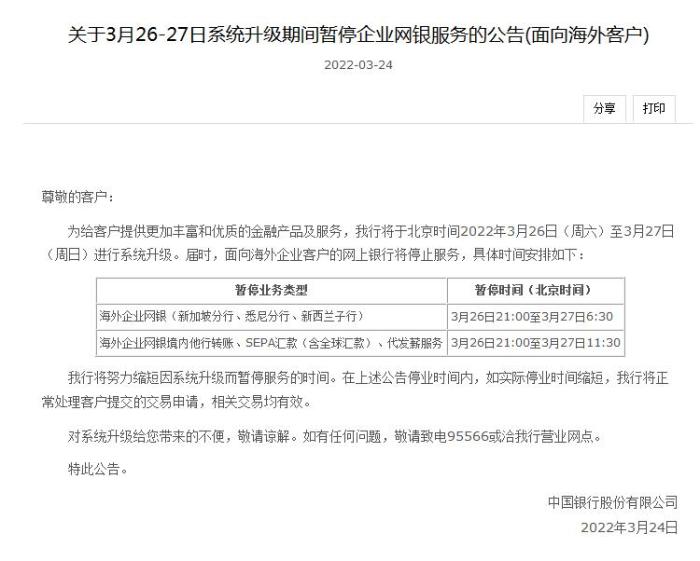
Announcement of Bank of China and Agricultural Bank of China! When the system is upgraded or maintained, many services will be suspended.

  Zhongxin Finance, March 24 th Recently, Bank of China and Agricultural Bank of China respectively announced that Bank of China will upgrade its system in the near future, and related businesses will be affected; Agricultural Bank of China will maintain the production system, and a number of services will be temporarily suspended.

  Screenshot of China Bank official website

  Among them, Bank of China announced that it will upgrade its system from Saturday, March 26th to Sunday, March 27th, 2022. By then, online banking for overseas corporate customers will stop serving.

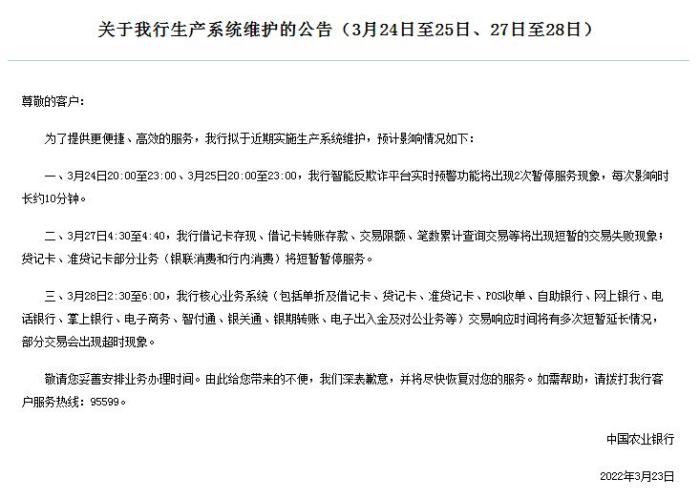
  China Agricultural Bank announced that it plans to implement production system maintenance in the near future.

  China Agricultural Bank official website screenshot

  The expected impact of Agricultural Bank of China is as follows:

  1. On March 24th, from 20:00 to 23:00, and on March 25th, from 20:00 to 23:00, the real-time early warning function of the Bank’s intelligent anti-fraud platform will be suspended for two times, each time lasting about 10 minutes.

  2. On March 27th, from 4:30 to 4:40, there will be a short-term transaction failure in debit card deposit, debit card transfer deposit, transaction limit, and cumulative transaction inquiry. Some services of credit card and quasi-credit card (UnionPay consumption and intra-bank consumption) will be temporarily suspended.

  3. From 2:30 to 6:00 on March 28th, the transaction response time of the Bank’s core business systems (including single-discount and debit cards, credit cards, quasi-credit cards, POS acquiring, self-service banking, online banking, telephone banking, pocket banking, e-commerce, Zhifutong, Yinguantong, bank transfer, electronic deposit and withdrawal and corporate services, etc.) will be temporarily extended for several times. (End)

Programmers can get high salaries, why it is difficult to get rid of the fate of overtime —— The complex ecology behind the "996" working system of Internet enterprises


Recently, a new user named "996icu" appeared on GitHub, an international open source community. He built a new code warehouse named "996.ICU", pointing out that the "996" working system prevailing in Internet companies seriously violated the labor law. Subsequently, this quickly became a professional group of programmers and even a national topic.

The so-called "996" working system refers to working hours from 9: 00 am to 9: 00 pm, with one hour off at noon and evening, totaling more than 10 hours a day, working six days a week and working 72 hours a week. This working time, regardless of whether there is overtime pay, has violated the labor law.

This kind of working system gives people the first impression that enterprises are squeezing employees, but if programmers are weak, then why can programmers get a high salary of 20 thousand to 30 thousand? In fact, programmers are not a vulnerable group, but a group with high salary, high quality, high skills, high attention and high voice. The various factors and logic contained in their rights protection actions are more complicated.

In the consumer market, there are two important methodologies to judge whether an enterprise has violated the interests of consumers: Is there competition? Is consumer sovereignty still there?If the answers to these two questions are yes, I don’t think there is any big problem.

Similarly,On the issue of overtime and wages, there are also two methodologies: is the enterprise in a competitive state in the labor market? Can job seekers choose?If these two answers are in the affirmative, then the problem will not be too serious.

Moreover, under these two premises, safeguarding rights is definitely not as simple as it seems. There must be deep-seated factors besides the simple explanation of "enterprises squeezing employees".

It is worth noting that,Opposing "996" is more of a group appeal, but it has not become a universal behavior of individuals in the group.

Theoretically, programmers have the ability to get rid of the 996 working system by individual choice. For example, ask if you want to work overtime regularly during the interview; Resignation from the company that announced the implementation of 996; You can also choose to go to a smaller company. This kind of dispersed individual behavior will eventually form a group trend, which makes the company dare not implement the 996 working system at will.

In fact, the high salary of programmers comes from this mechanism. Programmers make choices independently and dispersedly, and use the method of "voting with their feet" to make enterprises offer high salaries. Finally, the systematic situation of programmers’ general high salaries is shaped.

Why can the decentralized and independent individual selection mechanism bring high salaries to programmers, but it can’t make them get rid of 996?

From the industry point of view, the Internet and IT industries have fierce competition and rapid development, and the company must strive hard; From the specific nature of work, programmers are often faced with urgent needs and often have unexpected events to solve, which will lead to frequent overtime. The nature of business makes overtime work a "just need" for employees.

From a larger perspective, China’s overall income is not high. According to the economic law, when the income is not high, people tend to work more in exchange for more wages. This makes employees’ motivation against overtime weak. Just as a programmer told reporters: As long as the money is in place, everything can be said.

In fact, the IT industry has experienced explosive growth in the past 30 years. Entrepreneurship, equity and listing have constructed one wealth myth after another.People in IT companies are willing to work overtime, which is largely due to the wealth effect. Entrepreneurship, options, bonuses and dividends all encourage employees in the industry to work overtime.

The industry’s just need for overtime, employees’ expectation of wealth and weak resistance to overtime often form a culture, which leads to all kinds of unnecessary overtime. For example, in a department or a company, when someone works overtime, others are forced to follow suit. Over time, it has become the default consensus that Internet companies work long hours and are not fixed. In the end, the company unscrupulously stood up and implemented the 996 system, turning overtime into a solidified system.

However, the Internet industry is developing at a rapid pace, and many things have changed.

From the perspective of the big economic law, with the increase of wage level, with rich income, the marginal effect of income begins to decrease, and workers will think that leisure is more important than income growth, preferring to increase leisure and reduce working hours.

From the time point of view, "996" was mentioned frequently from about 2014, and it took about five years for this outbreak to be a hot topic. Five years ago, it was the time when the myth of entrepreneurship and wealth creation brought by the mobile Internet kept emerging. Five years later, the economy is in a new normal, the Internet’s wealth-making ability is no longer beautiful, and the incentives are reduced.Without money, overtime culture can’t continue.

Therefore, when the "996ICU" action appeals, awakens and influences the programmers in China, the "996" overtime system will be more severely challenged. Internet companies in China should conform to this general trend and maintain long-term sustainable development with better labor protection and welfare.

Of course, at the same time, the characteristics of the Internet and IT industries also need to be respected. For example, your APP can’t be used, and you definitely want programmers to work continuously to solve this problem. Therefore, the introduction of flexible working hours is also inevitable.

It is worth noting that the implementation of flexible working hours in China needs the approval of relevant supervision departments, so law enforcement departments also need to respect the diversified market formats and make appropriate adjustments.Only legal and clear overtime can make those illegal and vague overtime more obvious, so as to better regulate it.

The 70th Anniversary of China Braille Publishing House and the International Seminar on Visually Impaired Education were held.

  Beijing, 4 Dec (Reporter Chen Jinsong)-The 70th anniversary of the founding of China Braille Publishing House and the international seminar on visually impaired education were held in Beijing a few days ago. Zhang Jianchun, Vice Minister of Publicity Department of the Communist Party of China, and Cheng Kai, Chairman of China Disabled Persons’ Federation, attended the event and made speeches.

  Zhang Jianchun pointed out that the Disabled Persons’ Federation of Publicity Department of the Communist Party of China and China attached great importance to the cultural cause of the blind, and adopted various measures to strengthen the publication of Braille books, implemented the digital reading promotion project for the blind, constantly expanded the supply of high-quality cultural products and services, helped the blind friends to learn culture, acquire information and master skills, and established and enhanced their courage and confidence in life and work. China Braille Publishing House, as the only comprehensive cultural publishing institution serving the blind in China, has made great contributions to serving the overall situation of the work of the Party and the state, meeting the spiritual and cultural needs of the blind and promoting the prosperity and development of cultural undertakings for the blind.

  More than 300 people attended the event, including responsible comrades from relevant departments and directly affiliated units of Publicity Department of the Communist Party of China, Ministry of Education and China Disabled Persons’ Federation, and experts in the field of visually impaired education at home and abroad. At the event site, YTO Express Co., Ltd. donated 3 million yuan to China Braille Publishing House to carry out the public welfare project of "Dream Blind Children Leading to the Future". (People’s Daily Overseas Edition)

Standard essential patent

  [Editor’s Note] Although patent standardization can promote innovation, improve efficiency, reduce consumers’ adaptation costs and eliminate international trade barriers, it also greatly enhances the position of standardization organization participants in patent licensing negotiations, leading them to demand unfair, unreasonable and discriminatory patent licensing fees from standard users, namely patent licensees. Therefore, the patent system needs to fully consider the connection with the standard, and further improve the patent system related to the standard, especially the patent licensing fee system. This paper analyzes the system related to the standard-related essential patent in combination with the legal application of the US court and the China court in the cases of Microsoft v. Motorola and Huawei v. American Interactive Digital Company respectively.

  I. Introduction

  There is no unified and clear definition of Standards-Essential Patents, SEP) [1]. We believe that if the implementation of technical standards must be based on infringement of patent rights, even if there are other technologies that can be included in the standards, the patent is a necessary patent for relevant technical standards. Standard refers to a normative document that is formulated by consensus and approved by recognized institutions, used together and reused in order to obtain the best order in a certain range [2]. Although patent standardization can promote innovation, improve efficiency, reduce consumers’ adaptation costs and eliminate international trade barriers, it also greatly enhances the position of standardization organization participants in patent licensing negotiations, leading them to demand unfair, unreasonable and discriminatory patent licensing fees from standard users, namely patent licensees.

  In order to seek a balance between technical standardization for public use and patent protection, ISO in its relevant intellectual property policies not only requires standard participants to disclose the patents they own or actually control to ISO in time, but also requires them to promise to license all standard implementers to use their patents on fair, reasonable and non-discriminatory terms. This is the "FRAND" principle that the patentee of standard essential patent must abide by in the licensing of standard essential patent.

  Take the European Telecommunication Standard Institute (ETSI) as an example, the 4th.1 of its intellectual property policy stipulates: "During the development of the standards or technical regulations in which it participates, every member shall make reasonable efforts to inform ETSI of its necessary intellectual property rights in time. In particular, members who put forward technical suggestions for standards or technical specifications should draw ETSI’s attention in good faith to any intellectual property rights that may become necessary if their suggestions are adopted. " ETSI’s intellectual property policy 6.1 further stipulates: "If the necessary intellectual property rights related to a specific standard or technical specification have attracted ETSI’s attention, ETSI’s director-general shall immediately require the necessary intellectual property owner to make a written commitment within three months, and at least within the following scope, it is ready to grant an irrevocable use license under fair, reasonable and non-discriminatory conditions; Manufacturing, non-manufacturing or OEM are used to manufacture customized components or subsystems that meet the licensee’s own design standards; Sell, lease or otherwise dispose of the equipment manufactured in the above manner; Maintenance, use or operation of the above equipment; How to use it. "

  However, the standardization organization has not made any provisions or expressed any opinions on how to judge the necessary patent license fee of FRAND standard, which leads to difficulties. In April, 2013 and October, 2013, the US court and the China court respectively expressed their opinions on how to judge the FRAND standard essential patent license fee in the cases of Microsoft v. Motorola and Huawei v. American Interactive Digital Company. However, due to the differences in the cultural background and legal accumulation of the judges of the two countries, the judgments of the two countries have their own characteristics and show great differences. [3] Based on the judgments of the above two cases, this paper makes a comparative study on several issues related to the calculation of essential patent royalties of FRAND standard, and draws some possible beneficial conclusions on this basis.

  Second, the FRAND standard essential patent related system policy considerations

  In the case of Huawei v. Interactive Digital Corporation of America, in order to evaluate the standard necessary patent license fees in line with the FRAND principle, the courts of first and second instance mainly considered the following three policy factors: total control, anti-patent hijacking and anti-patent license fee stacking. The first is total control, which means that the license fee of standard essential patent cannot exceed a certain proportion of the product profit of standard essential patent users. The courts of first and second instance of Huawei case held that technology, investment, management and labor jointly created product profits, and patented technology only created one factor of product profits. Therefore, the license fee required by the patentee should not exceed the total profit of users’ products in any case, otherwise, the license fee cannot be considered as conforming to the FRAND principle. The second is anti-patent hijacking. Patent hijacking refers to the ability of the patentee to claim more than the value of the patented technology itself and the ability to try to grab the value of the technical standard or regulation itself. In the judgment of Huawei v. American Interactive Digital Company, the courts of first instance and second instance did not explicitly use the concept of "anti-patent hijacking", but both courts held that the patentee of standard necessity should not profit from the standard itself, and its contribution lies in innovative technology rather than the standardization of its patent. That is to say, the two courts actually think that the necessary patent license fee should prevent the occurrence of patent hijacking. The third is Anti-Royalty Stacking.Stacking of patent license fees refers to the phenomenon that the licensee pays many different standard essential patentees over the license fees for one standard. Huawei’s courts of first and second instance both hold that a standard or technical specification contains many standard essential patents, and any standard essential patentee can only get the license fee due to him.

  Different from the judgment of Huawei v. American Interactive Digital Company, the judge of Microsoft v. Motorola clearly used the concepts of anti-patent hijacking and anti-patent license fee stacking in addition to the above three policies, and also considered the following two policy factors. First, the necessary patent licensing fees of FRAND standards should be maintained at a level that can promote the wide adoption of standards, which is also the main purpose of ISO [4]. Second, the method of determining the necessary patent license fee of FRAND standard should ensure that valuable patents can get reasonable royalties in order to establish truly valuable standards, which is also one of the goals of ISO [5].

  Comparatively speaking, the judge in the case of Microsoft v. Motorola has considered the policy factors involved in the calculation of FRAND standard essential patent license fees more comprehensively, which is conducive to better balancing the interests of standard essential patentees, standard users and social public interests. In this regard, as stated in the judgment of Microsoft case, if the standard essential patent license fee is too high, although not using ISO standards may mean huge market entry barriers for market participants, if the standard essential patent license fee is higher than the cost for market participants to overcome market entry barriers, market participants will choose not to adopt ISO standards, which is very unfavorable for the popularization and application of standards. On the other hand, the creation of valuable standards is of great benefit to the whole society, but valuable standards depend on valuable technology. After the valuable technology is included in the standard, the patentee will lose the basic incentive to participate in the standardization organization if he can’t get reasonable and sufficient royalties, or even get less royalties than before being included in the standard. Of course, there are many necessary patents in a standard, but the technical content and contribution rate of each patent cannot be completely consistent. How to ensure that patents with more technical content and greater contribution to the standard get more royalties is also a problem that FRAND principle must consider. It is a great pity that the policy considerations in the first and second judgments of Huawei v. American Interactive Digital Company failed to involve the above two extremely important factors.

  Most importantly, when determining the necessary patent license fee of FRAND standard, the first-instance and second-instance judgments of Huawei v. American Interactive Digital Company considered the above three policy factors, but they were limited to general analysis, and this general analysis was not further applied to the specific analysis of the case. For example, the judgments in the first and second instance of Huawei case did not examine how many standard essential patents existed in WCDMA, CDMA2000, TD-SCDMA and other standards involved, how many of these standard essential patents belonged to China standard essential patents, how many of these standard essential patents belonged to American Interactive Digital Company, and what specific standards were involved in the China standard essential patents of Interactive Digital Company. The judgments in the first and second instance of Huawei case also failed to examine the contribution of China standard essential patents of American Interactive Digital Company to relevant specific standards, which products of Huawei used these China standard essential patents of American Interactive Digital Company, and what contribution these standard essential patents of American Interactive Digital Company made to Huawei products. Although it is difficult to investigate and analyze these factors, the courts of first and second instance of Huawei case have to face them because these factors are closely related to whether the patent license fee demanded by American Interactive Digital Company constitutes patent hijacking and patent royalty stacking.

  Different from Huawei’s first-instance and second-instance judgments, Microsoft’s judgment solved the above problems as much as possible despite great difficulties. The Microsoft case first determined that Motorola had the necessary patents in H.264 and 802.11 standards. In order to establish the necessary patent license fee of FRAND standard related to H.264 standard, the Microsoft case first analyzes the development background and technical context of H.264 standard, including the development time of the standard, the technical characteristics and level of the standard itself, patents related to the standard, and Motorola’s contribution in the development and establishment of the standard. Secondly, the contribution of Motorola patent to H.264 standard is analyzed. The Microsoft case first identified six patent families that Motorola is necessary for H.264 standard, and then analyzed the contribution of each patent family to H.264 in detail. Thirdly, the Microsoft case judgment analyzes the contribution of Motorola patents to Microsoft products. The Microsoft case first determines that Microsoft’s products using H.264 include Windows, Xbox, Silverlight, Zune, Lync and Skype, and then reviews the contribution of each patent family of Motorola to each of the above products.

  In order to establish the license fee of FRAND standard essential patents related to the 802.11 standard, the Microsoft case first examines the development history of the standard, and then reviews the relative technical value of different parts of the 802.11 standard, covering the number of all patents of the 802.11 standard, the number of Motorola patents in the 802.11 standard, the number (11) of Microsoft’s use of Motorola 802.11 standard essential patents and products, and the impact of Motorola’s 11 standard essential patents on 8001.

  Third, the economic analysis of FRAND standard essential patent related system

  Next, the specific method of calculating the standard necessary patent license fee is analyzed. In the case of Huawei v. Interactive Digital Corporation of America, neither Huawei as plaintiff nor Interactive Digital Corporation of America as defendant put forward a specific method to calculate the standard and necessary patent license fee in accordance with the FRAND principle. The calculation method adopted in the judgments of first instance and second instance is the comparison method. The so-called comparison method, according to the understanding of the court of second instance of Huawei case, means that the standard essential patent holder should charge the standard essential patent implementer basically the same license fee or adopt basically the same license fee under the condition of basically the same transaction conditions. Under basically the same trading conditions, if the standard essential patentee gives a licensee a lower license fee and gives another licensee a higher license fee, by comparison, the latter has reason to think that it has been discriminated against, so the standard essential patentee violates the promise of non-discriminatory use license. In order to carry out the above comparison method, the first and second judgments of Huawei case selected the standard essential patent license fee granted by American Interactive Digital Company to Apple as the reference object, and therefore determined that the standard essential patent license fee granted by American Interactive Digital Company to Huawei should be roughly the same as that granted to Apple.

  The so-called choice of the standard necessary patent license fee given by Interactive Digital Company to Apple in the first and second judgments of Huawei case is mainly based on the following two aspects of evidence: First, a statistical and analytical report by the world-renowned analysis company STRATEGY ANALYTICS Inc In this report, STRATEGY ANALYTICS Inc counts and analyzes the shipments, market share, net sales and operating income of several famous global mobile phone providers from 2007 to 2012. Nokia, Samsung, Apple, LG Electronics, RIM, Motorola, HTC and Sony are all on its analysis list, but Huawei is not on its analysis list. According to the analysis report and forecast, Apple’s sales from 2007 to 2012 were about $300 billion, and Samsung’s net sales were about $209.751 billion. Second, in the third quarter of 2007, Interactive Digital signed a global, non-transferable, non-exclusive patent licensing agreement with a fixed license fee with a license period of seven years from June 29th, 2007. The licensed patent portfolio covers the then IPHONE and some future mobile phone technologies. In 2009, Interactive Digital signed a patent licensing agreement with Samsung and its subsidiaries.Grant Samsung a non-exclusive fixed patent license fee for terminal equipment and infrastructure under 2G and 3G standards worldwide, with the license period ending in 2012. However, the difference between the licensing agreement signed by American Interactive Digital Company and Samsung Company and the licensing agreement signed with Apple Company is that the former is a voluntary licensing agreement reached through equal consultation, while the latter is a licensing agreement that Samsung Company was forced to sign when American Interactive Digital Company filed a lawsuit. The meaning of the first-instance and second-instance judgments in Huawei case is very obvious. That is to say, the license granted by American Interactive Digital Company to Apple is voluntary, so it conforms to the FRAND principle, while the license granted to Samsung is very likely involuntary, so it does not conform to the FRAND principle. Therefore, the license fee of the former can only be used as a reference for the calculation of the necessary patent license fee of the FRAND standard in this case.

  Although the comparison method is a simple and easy method, it is very necessary to list all the elements of the compared object as much as possible in order to obtain a more reliable comparison conclusion. It is a great pity that although the judgments of the first and second instance of Huawei case put forward the premise of "roughly the same trading conditions", they did not tell people what the "trading conditions" referred to here are and what the "trading conditions are the same" referred to here from the perspectives of evidence and legal reasons. By comparison, the court finally determined that American Interactive Digital Company should pay Huawei the China standard necessary patent license fee. The only possible evidence is that from 2007 to 2012, Apple’s net sales exceeded Huawei’s net sales of mobile phones. However, even so, the standard necessary patent license fee that American Interactive Digital Company hopes to obtain from Huawei in its last offer is calculated according to the sales of Huawei’s final mobile phone products, and the term is from 2009 to 2016. In this way, in order to make a scientific comparison, the courts of first and second instance of Huawei case should at least investigate and estimate Huawei’s net sales from 2009 to 2016, or the net sales from 2007 to 2012 in the same period as Apple. Regrettably, the judgments in the first and second instance of Huawei case did not touch on this issue. Under the condition that the minor premise of comparison and reasoning has not been solved, it is debatable whether the comparison conclusion is scientific or not. Besides,When the courts of first and second instance of Huawei case used the standard necessary patent license fee given to Apple by American Interactive Digital Company as a reference, they did not examine whether the license fee was in line with the core value pursued by FRAND, that is, to promote the entry of valuable technologies and the standard itself was widely adopted. If the answer is no, whether the judgment conclusion obtained by comparison can stand is also a question worthy of further consideration.

  In the case of Microsoft v Motorola, Microsoft, as plaintiff, and Motorola, as defendant, respectively put forward their own methods to calculate the necessary patent license fee of FRAND standard. The method proposed by Microsoft is "Incremental value approach". This method pays attention to the situation before the standard is adopted and implemented. The specific operation method is: in order to calculate the economic value of the patented technology included in the standard, we can compare other alternative technologies that can be included in the standard and calculate the specific value of the alternative technology, so as to obtain the value of the patented technology necessary for the standard. The Microsoft case court did not adopt this method proposed by Microsoft. The reason of the court is that this method is not practical. Even so, the Microsoft case court still held that the FRAND royalty must evaluate the value of the patented technology itself, which needs to consider the importance and contribution of the patent to the standard, so comparing the value of the patented technology with the alternative technology that can be included in the standard by the standardization organization can be used as a reference when determining the FRAND royalty. The method proposed by Motorola is a hypothetical bilateral negotiation method. Motorola claims that the authorization conditions of FRAND can be determined by simulating hypothetical bilateral negotiation under the obligation of FRAND authorization.

  In principle, the Microsoft case adopts the hypothetical bilateral negotiation method, but it has been revised. The reason why the judgment in Microsoft case supports this method is mainly based on the following reasons: the hypothetical negotiation method is supported by authorized negotiation in the real world, and previous courts have made judgments by using this method. In the case of Georgia-Pacific Corp. V. United States Plywood Corp., (318 F. Supp. 1116 (1970)), the court simulated hypothetical bilateral negotiations to determine reasonable royalties through 15 analytical factors, and gained rich experience. When the court simulates a hypothetical bilateral agreement under the obligation of FRAND authorization, it should logically come to the standard necessary patent royalties that both parties consider to be FRAND.

  However, the Microsoft case judgment did not simply copy the 15-factor analysis method proposed by Georgia-Pacifico judgment. The reasons include: First, the standard necessary patentee must grant the patent under the FRAND authorization conditions, while the patentee who has not assumed the same obligation has complete exclusive rights and can choose not to grant the patent. Second, hypothetical negotiation will hardly take place in a vacuum, and standard users will inevitably realize that there are many different essential patentees and their standard essential patents in the standard. Just because they are authorized by a single standard essential patentee does not mean that the standard can be implemented. On the basis of criticizing and absorbing the above two methods put forward by the original defendant, and on the basis of Georgia-Pacific15 analysis factors, the Microsoft case judgment puts forward a revised hypothetical negotiation method. At the same time, on the issue of patent hijacking, the negotiating parties will investigate the reasonable royalty ratio of FRAND authorization commitment according to the contribution of patent technology to standard technical capability and the contribution of standard technical capability to standard users and products using standards. In this way, an essential patent that is extremely important and key to the standard can reasonably require a higher royalty ratio than a less important essential patent. As for the stack of patent fees, the negotiating parties will consider the existence of other standard essential patentees, and each standard essential patentee will claim the patent fee according to the importance of its patent to the standard and the product of the standard implementer, and reach the royalty ratio on this basis. Finally,Under the condition of FRAND commitment, the rational negotiation parties seeking a reasonable royalty ratio will consider the fact that in order to promote the creation of valuable standards, FRAND authorization commitment must ensure that the owner of valuable intellectual property rights obtains a reasonable royalty for the intellectual property rights. Comparatively speaking, Huawei’s judgment basically failed to consider the above analysis factors because it used a relatively simple comparison method, and the rationality of its judgment should be said to have room for further improvement.

  Four, the FRAND standard necessary patent license fee calculation.

  So, how exactly to calculate the necessary patent license fee of FRAND standard? As mentioned above, the judgment of Huawei case simply obtained the necessary patent license fee of FRAND China standard that American Interactive Digital Company can claim from Huawei by comparison method, and did not see the specific calculation process and the logical process in the calculation process, so there is not much to be discussed in depth. Based on the judgment of Microsoft case, this part analyzes the specific calculation of the necessary patent license fee of FRAND standard.

  During the trial of Microsoft case, both Microsoft and Motorola put forward their own calculation methods that can be used as the ratio comparison of FRAND royalties. The calculation method put forward by Motorola is that 2.25% of the net sales price of Microsoft’s products with Motorola’s standard essential patents, Windows and Xbox, should be used as the royalty ratio of Microsoft’s authorization to use the patent portfolio with H.264 and 802.11 standards. In order to support its claim, Motorola cited one of the above analysis factors in Georgia-Pacific case, and put forward three sets of existing patent licensing agreements as established royalties for reference. However, the judgment of Microsoft case did not adopt the comparison method proposed by Motorola, and thought that the authorization agreement proposed by Motorola had no reference value for the FRAND royalty ratio of this case. The reason is that the license agreement proposed by Motorola is a litigation settlement agreement, and the actual royalty paid in some license agreements is far less than the amount requested in this case. The value proportion of standard essential patents in some license agreements cannot be distinguished, and the standard essential patents involved in some license agreements have passed the protection period. At the same time, the Microsoft judgment holds that even if Motorola’s above-mentioned royalty ratio for calculating its standard essential patents is correct, Motorola’s royalty required for its 802.11 standard essential patent portfolio will obviously cause concern about royalty stacking. Accordingly, the Microsoft case decided that,Motorola’s 2.25% royalty rate related to H.264 and 802.11 standards does not conform to the FRAND principle.

  The comparison objects proposed by Microsoft include the practical operation methods of two patent pools, one is MPEG LA H.264 patent pool, and the other is Via Licensing 802.11 patent pool, as well as an authorization agreement and a patent authorization evaluation suggestion. Regarding whether the patent pool of MPEG LA H.264 can be used as a reference for the necessary patent royalty ratio of the FRAND standard in this case, the Microsoft judgment gave a positive answer. The reason for the decision in Microsoft case is that FRAND royalties should be in line with the purpose of promoting the widespread adoption of SSOs standards and attracting a wide range of patentees to put their patents into the patent pool, and MPEG LA H.264 patent pool can just achieve the purpose of SSOs. The evidence in this case shows that, on the one hand, when Microsoft, Motorola and other enterprises created the patent pool of MPEG LA H.264, the royalty ratio set was high enough to attract a considerable number of patentees to put their patents into the patent pool; on the other hand, the royalty ratio set was low enough to ensure that enough standard users were willing to use the patented technology in the H.264 standard instead of alternative technology. This approach coincides with the basic principles of FRAND’s authorization commitment. In addition, the patent pool of MPEG LA H.264 also echoes another basic principle of FRAND’s authorization commitment, that is, to create valuable standard technologies.

  Then, how did the Microsoft case judge calculate the necessary patent fees of FRAND standard related to H.264 standard that Motorola should obtain? According to the Microsoft case, Motorola’s royalty from the patent pool of MPEG LA H.264 includes two parts. Part of it is the appropriate royalty that should be allocated according to the number of patents from the royalties obtained from the patent pool as a member of the patent pool. The other part is the value of Motorola’s unrestricted access to a large number of technologies contained in the patent pool, that is, the royalties that should be obtained from the unrestricted internal cross-licensing of patent pool members, or the identity value of Motorola as a member of the patent pool. Regarding the former part of the royalties, the Microsoft case decided that according to the total amount of royalties obtained from the external license of the MPEG LA H.264 patent pool and the number of standard necessary patents of Motorola in the patent pool, the royalties that Motorola should receive were 0.185 cents for each product of Microsoft. Regarding the latter part of the royalties, that is, the identity value of Motorola as a member of the patent pool of MPEG LA H.264, the only relevant evidence in this case is that after Microsoft joined the patent pool of MPEG LA H.264, the fees paid to the patent pool were twice as much as the royalties obtained from the patent pool, which shows that the reason why Microsoft joined the patent pool is that it pays more attention to its identity as a member of the patent pool than the royalties that can be obtained from the patent pool. Because of this identity,Microsoft can clear all the obstacles of rights and use the patented technology in the patent pool without restriction. In other words, Microsoft believes that the membership of the patent pool of MPEG LA H.264 is at least equivalent to twice the value of its royalties. On this basis, the judgment in the Microsoft case presumes that, in the absence of other obvious evidence, like Microsoft, Google, the parent company of Motorola, also thinks that its membership in the MPEG LA H.264 patent pool is equivalent to providing it with twice the value of the royalties it should get as a licensor. The judgment in the Microsoft case further infers that the sum of the two royalties (0.185+2×0.185) is 0.555 cents, which is the FRAND royalty that Motorola should get from Microsoft for every product that uses Motorola’s standard essential patent. However, this is only the lower limit of FRAND royalty ratio of Motorola’s H.264 standard essential patent portfolio. According to the Microsoft case, in order to prevent the stack of royalties, the upper limit of FRAND royalties must also be calculated. On the basis of comprehensive analysis of all kinds of evidence, the upper limit of Motorola H.264 standard essential patent portfolio rights calculated by Microsoft case is $0.16389 per single product, which is applicable to Microsoft’s Windows and Xbox products.

  With regard to the patent pool of Via Licensing 802.11, although the judgment in Microsoft case noted that it, like the patent pool of MPEG LA H.264, did not distinguish the technical value of patents in the patent pool, but distributed the royalties equally, which led to its failure to attract patentees and standard implementers, and failed to encourage the wide adoption of the standard of Via Licensing 802.11, because of its certain characteristics, the judgment in Microsoft case held that it could still be used as a reference for FRAND royalty ratio. For example, the patent pool of Via Licensing 802.11 mainly focuses on specific standards and covers the same products with the same end use as the disputed products in this case. In addition, the evidence shows that although the actual operation of the patent pool failed to achieve the purpose of promoting the wide adoption of standards, its establishment still followed this purpose, so the royalty ratio it established can still be used to show what kind of royalty ratio is in line with the FRAND principle in specific industrial activities. On this basis, the Microsoft case decided that the patent pool of Via Licensing 802.11 can be used as a reference for the FRAND royalties of Motorola’s 802.11 standard essential patent portfolio. Based on the same reasoning as the H.264 patent pool, the Microsoft case decided that if Motorola participates in the Via Licensing 802.11 patent pool, it can obtain other value equivalent to twice the royalties collected through the patent pool.

  The judgment of Microsoft case holds that the parties to hypothetical negotiation will regard the patent pool of Via Licensing 802.11 as a reference for the necessary patent royalties of the 802.11 standard, and determine the FRAND royalties on this basis. In the Microsoft case, Motorola’s 802.11 standard essential patent has only a small technical value to the 802.11 standard, so in their hypothetical negotiation, Microsoft and Motorola will think that the royalty ratio of 6.114 cents per single product estimated according to the patent pool practice will be higher than the FRAND royalty ratio that Motorola’s 802.11 standard essential patent portfolio should receive.

  During the trial, Microsoft proposed that the royalty rate paid by Marvell Semiconductor,Inc, a third-party company, for its patents in Wi-Fi chip products could be used as a reference for the FRAND royalty rate of the 802.11 standard essential patents in this case. The judgment of Microsoft case holds that the royalty ratio of the third-party company provides "the usual royalty ratio that can be obtained in a specific commercial field" for this case. Therefore, it is held that 1% of the price of each single chip implementing the 802.11 standard, that is, 3 to 4 cents per single chip, can be used as a reference for the royalty ratio of Motorola’s 802.11 standard essential patent portfolio.

  The third reference to the FRAND royalty ratio of Motorola’s 802.11 standard essential patent portfolio determined by the Microsoft case judgment is a patent authorization evaluation model developed by Intercap, Inc. in 2003. The Microsoft case decided that the evaluation method of InterCap,Inc conforms to the basic principle of FRAND authorization commitment, because it considers the value of 802.11 standard technical function to the overall product function and the stacking of royalties, so it can be used as a reference for the appropriate FRAND royalty ratio of 802.11 standard essential patent portfolio. However, the judgment of Microsoft case also holds that the evaluation method of InterCap,Inc exaggerates the importance of Motorola’s standard essential patents to the 802.11 standard, so its appropriateness is impaired. In the hypothetical negotiation between Microsoft and Motorola, although the royalty assessed by InterCap,Inc will be used as a reference for FRAND royalty, the royalty ratio will be adjusted to 0.8 to 1.6 cents per single product.

  According to the above analysis, the judgment of Microsoft case holds that in order to estimate the FRAND royalty ratio, it is reasonable for both parties to hypothetical negotiation to take the average of the above three reference values as the royalty ratio. The specific algorithm is to average the lowest value evaluated by InterCap,Inc at 0.8, and the royalty ratio authorized by Marvel Wi-Fi chips is averaged at the average value within its range of ((3+4)/2)3.5. On this basis, the average value of the three references is calculated to be 3.471 cents ((0.8+3.5+6.114)/3), which is the FRAND royalty ratio reached by Microsoft and Motorola through hypothetical negotiation.

  Considering the stacking of royalties, the Microsoft case decided to adjust the royalty ratio to 19.5 cents per single product based on the high royalty ratio estimated by Microsoft expert witnesses based on the structure of patent pool Via Licensing 802.11, and take it as the upper limit of the FRAND grant range of Motorola 802.11 standard essential patent portfolio. As for the lower limit of the scope of FRAND grant for Motorola’s 802.11 standard essential patent portfolio, the Microsoft case further holds that the lower limit should be the lowest value of standard essential patent that the standard essential patentee will agree to accept after considering the importance of its related patents to the 802.11 standard and standard user products. Considering the limited evidence in this case, the court found that 0.8 US dollars per single product is the lower limit of FRAND royalty.

  To sum up, the FRAND royalty rate set in the Microsoft case judgment is: the FRAND royalty rate of Motorola’s H.264 standard essential patent is 0.555 cents per single product, and the upper limit of the FRAND royalty rate range is 16.389 cents per single product, and the lower limit is 0.555 cents. This royalty ratio and scope apply to Microsoft’s Window and Xbox products, and other Microsoft products using H.264 standard apply to the lower royalty ratio of 0.555 cents. The FRAND royalty rate of Motorola’s 802.11 standard essential patent is 3.471 cents per single product, and the upper limit of the FRAND royalty rate range is 19.5 cents per single product, and the lower limit is 0.8 cents per single product. The royalty rate and scope are applicable to Microsoft’s Xbox products, and other Microsoft products using the 802.11 standard are subject to the lower royalty rate of 0.8 cents. (Peking University International Intellectual Property Research Center Li Yang Liu Ying)

 This article only represents the opinions of experts in the research base and may not be reproduced without permission.


  [Notes]

  [1] The International Telecommunication Union (ITU) defines it as "any patent or patent application that may completely or partially cover the draft standard". The American Institute of Electrical and Electronics Engineers (IEEE) interprets it as the so-called "necessary patent requirements" refers to the patent claims that will be used when implementing the standard clauses (whether mandatory or optional) of a draft standard.

  [2] Electronic Intellectual Property Editorial Department. 2012 Electronic Intellectual Property Annual News Inventory International Articles [J]. Electronic Intellectual Property. 2013 (issue 1.2).

  [3] The approximate case of Microsoft case is as follows: On October 21 and 29, 2010, Motorola informed Microsoft in writing that the licensing conditions of its 802.11 standard essential patent and H.264 standard essential patent were 2.25% of the final product price of Microsoft. In November, 2010, Microsoft took the initiative to file a lawsuit with the Federal District Court for the Western District of Washington on the grounds that Motorola’s licensing offer violated its RAND authorization commitment to standardization organizations IEEE and ITU.

  The general case of Huawei is as follows: Huawei and American IDC are both members of the European Telecommunications Standardization Organization (ETSI). American IDC claims that it has many standard essential patents in the fields of 2G, 3G, 4G and IEEE802. Huawei acknowledges that these necessary patents of IDC have been incorporated into China wireless communication standards, and its products must meet these standards. From September 2008 to August 2012, IDC sent four written authorization offers to Huawei. In the first and second written offers, IDC hopes to obtain royalties from Huawei from 2009 to 2016, which is equivalent to 100 times that of Apple in the United States and 10 times that of Samsung in South Korea in the same period. In the third written offer, IDC hopes to get 35 times as much royalties from Huawei as IDC gave to Apple in the same period. In the fourth written offer, IDC hopes to get royalties from Huawei, which is equivalent to 19 times that of IDC to Apple in the same period. In these four offers, IDC did not make any distinction between standard essential patents and non-standard essential patents. In the fourth offer, IDC made it clear that rejecting any specific terms of the offer meant rejecting the whole offer. In order to force Huawei to accept its offer authorization conditions, in July and September 2011, IDC filed a complaint and prosecution with the US International Trade Commission and the US District Court Delaware respectively, accusing Huawei’s communication products of infringing its patent rights and demanding a ban.It is forbidden to import and sell Huawei products into the United States. In addition, the analysis report provided by Huawei by STRATEGY ANALYTICS, a famous American data survey and analysis company, shows that the company has analyzed the shipments, market share and net sales of the world’s top mobile phone companies from 2007 to 2012. Nokia, Samsung, Apple, LG, RIM, Motorola, HTC and Sony are on its analysis list, but Huawei has not been able to enter the analysis list. Accordingly, Huawei filed a lawsuit in the Shenzhen Intermediate People’s Court in December 2011, accusing IDC of violating the FRAND principle in its four offers, and demanding that IDC grant it the necessary patent license in accordance with the FRAND principle.

  [4] See Microsoft Corp. V Motorola Inc,No.C10-1823JLR.ORDER-20.

  [5] See Microsoft Corp. V Motorola Inc,No.C10-1823JLR.ORDER-24.

Ministry of Industry and Information Technology: As of January 17th, ibuprofen and acetaminophen have supplied 5.14 billion tablets.

  CCTV News:On January 18th, the State Council held a press conference on the development of industry and informatization in 2022. Tian Yulong, a spokesperson for the Ministry of Industry and Information Technology, said at the meeting that in recent days, the Ministry of Industry and Information Technology, together with relevant departments, has implemented the decision-making arrangements of the CPC Central Committee and the State Council, and under the direct command of the joint prevention and control mechanism, the Ministry of Industry and Information Technology, as the material support group of the joint prevention and control mechanism, will work with member departments and relevant localities to increase medical material support, and make every effort to promote medical and medical enterprises to achieve stable production, expand capacity and expand production, and increase the market of key At present, it has the following characteristics:

  First, do a good job in the production and supply of key medical materials. As for drugs, as of January 17th, ibuprofen and acetaminophen, two key antipyretic and analgesic drugs, have supplied a total of 5.14 billion tablets on the basis of maintaining the capacity of 200 million tablets for 17 consecutive days, which can fully guarantee the demand for drugs. In terms of medical instruments and equipment, with the rising demand for medical resources for intensive care, our department has recently focused its work on "preventing severe illness and ensuring equipment" in time. As of January 17th, the daily output of small molecular antiviral drug azvudine increased by 148% compared with that before New Year’s Day, reaching 744,000 bottles. The daily output level has been greatly improved, which can meet the drug demand of critically ill patients in current medical institutions and the subsequent treatment of critically ill patients, and the drug output and capacity have been greatly improved. At present, the daily output of invasive ventilators is 239% higher than that before New Year’s Day, and the production scale is increasing. At present, it has reached 1808 sets. The daily output of oxygen generator is increased by 280% within 4 days, and the maximum daily output can exceed 20,000 sets. The supply of oxygen generator can meet the basic needs of medical institutions. The daily output of finger-clip oximeter is more than 460,000, which can not only meet the needs of medical institutions, but also provide more and more social services.

  The second is to give priority to ensuring the needs of key areas with accurate delivery. In order to meet the urgent needs of the people, in accordance with the principle of "focusing on key points and accurately putting them into use", we will actively connect with civil affairs, rural areas, education and other departments with relevant departments to accurately provide medical materials for key areas (people) such as pension, rural areas and schools. Since mid-December last year, relying on large-scale e-commerce platforms and local drug protection platforms, we have delivered nearly 136 million copies of drugs, benefiting more than 60 million people. Through the convenience and accessibility of e-commerce, a precise delivery mode has been innovated. At the same time, the "oxygen indicator into the countryside activity" was launched, and two oxygen indicators were equipped for each rural clinic in the country, supplying 1.172 million in four batches. At the same time, through various forms such as corporate donations, more than 10,000 medical oxygen generators have been supplied free of charge to more than 800 poverty-stricken counties across the country, achieving full coverage of more than 10,000 townships in poverty-stricken counties. We have fully guaranteed the demand for key medical materials in the national pension and child welfare institutions proposed by the civil affairs department, and are currently working with the education department to ensure the demand for key medical materials in colleges and universities across the country.

  The third is to work together to unblock the supply channels of medical materials. We will work together with transportation, postal services and other departments to ensure that priority is given to the treatment and delivery of medical materials at the grassroots level, especially in rural and remote areas, and make every effort to get through the "last mile" of distribution. We have also formulated a plan to ensure the smooth logistics of enterprises during the Spring Festival, and made every effort to ensure and reserve the transportation capacity during holidays and the Spring Festival.

  In the next step, our department will continue to make efforts to support the stable production of key medical materials enterprises, strengthen the supply of materials, coordinate the accurate delivery of medical materials, and do a good job of guarantee.

IPhone 16 full-size map released: Pro version significantly increased the history of the screen black edge is the narrowest.

On June 18 th, the iPhone 16 series is already preparing to enter the mass production stage, and more and more accurate information has been released recently.

Blogger Majin Bu recently brought the size map of all four models of iPhone 16.

The specific data are as follows:

IPhone 16: height 147.63mm, width 71.62 and thickness 7.8;

IPhone 16 Plus: height 160.88mm, width 77.75mm and thickness 7.8;

IPhone 16 Pro: height 149.61mm, width 71.45mm and thickness 8.25;

IPhone 16 Pro Max: height 163.03mm, width 77.58mm and thickness 8.25.

For comparison, the iPhone 15 series data are as follows:

IPhone 15: height 147.6mm, width 71.6 and thickness 7.8;

IPhone 15 Plus: height 160.9mm, width 77.8mm and thickness 7.8;

IPhone 15 Pro: height 146mm, width 70.6mm and thickness 8.25;

IPhone 15 Pro Max: height 159.9mm, width 76.7mm and thickness 8.25.

It can be seen that iPhone 16 and iPhone 16 Plus basically maintain the size of the previous generation, but there are some minor measurement errors and rounding.

Compared with the previous generation, iPhone 16 Pro and iPhone 16 Pro Max have increased in size, especially in height.

This is mainly due to the upgrade of screen size, and because of the use of brand-new screen technology, the black edge of iPhone 16 Pro is only 1.203mm, and the iPhone 16 Pro Max is only 1.153mm, which has set a new record for the whole industry.

Thanks to this, after upgrading from 6.1/6.5 inches to 6.3/6.7 inches, the sizes of the two have only slightly changed. (Jianjia)

Illustrate the time of Li Keqiang’s two sessions


Excerpts from the wonderful speeches of the two sessions in Li Keqiang

Li Keqiang talks about reform: removing barriers, adding vitality, promoting competition and increasing efficiency

Time:March 4

occasion: participateJoint Committee of Economic and Agricultural Membersdiscuss

utteranceWe should continue to push for reform, firmly grasp the key points of reform such as decentralization, fiscal and taxation, and state-owned assets of state-owned enterprises, remove barriers, add vitality, promote competition, increase efficiency, mobilize the enthusiasm of social capital and private enterprises, promote the formation of a torrent of mass entrepreneurship and innovation, and cultivate new kinetic energy for development. [detailed]


Li Keqiang: This year, the gross domestic product has increased by about 7%, and the consumer price has increased by about 3%.

Time:March 5, 2015

Occasion:Government work report

utteranceThe main expected goals of economic and social development this year are: GDP growth of about 7%, consumer price increase of about 3%, more than 10 million new jobs in cities and towns, urban registered unemployment rate of less than 4.5%, import and export growth of about 6%, international balance of payments basically balanced, and residents’ income growth synchronized with economic development. The energy consumption intensity decreased by more than 3.1%, and the discharge of major pollutants continued to decrease. [detailed]


Li Keqiang: Avenue to Jane power is not to be used arbitrarily.

Time:March 5, 2015

Occasion:Government work report

Discourse:Avenue to Jane, power is not to be used arbitrarily. Governments at all levels should establish a powerful mechanism to promote decentralization and change their functions, loosen enterprises, facilitate entrepreneurship and create a level playing field. All administrative examination and approval items should simplify the procedures, define the time limit, and exchange the "subtraction" of government power for the "multiplication" of market vitality. [detailed]


Li Keqiang: Strictly implement the State Council’s "Three Chapters of the Constitution" and slim down power to strengthen the integrity of the government.

Time:March 5, 2015

Occasion:Government work report

Discourse:Conscientiously implement the spirit of the eight provisions of the CPC Central Committee, persistently correct the "four winds" and continue to strictly implement the State Council’s "Three Chapters of the Constitution". A common feature of corruption is power rent-seeking. It is necessary to slim down power to strengthen the integrity of the government, firmly tie up the system fence, resolutely destroy the rent-seeking space, and strive to eradicate the corrupt soil. Strengthen administrative supervision, give play to the role of audit supervision, and strictly supervise public funds, public resources and state-owned assets. Always maintain the anti-corruption and high-pressure situation, and have zero tolerance and strict investigation of corrupt elements. Corruption, whether in leading organs or around the masses, must be severely punished. [detailed]


Li Keqiang: Improve the performance evaluation mechanism. Lazy politicians should be publicly exposed.

time: March 5, 2015

Occasion:Government work report

Discourse:Governments at all levels should earnestly perform their duties, pay close attention to implementation and work creatively. Improve the evaluation mechanism of political achievements, and vigorously praise those who have outstanding performance; If you are not good at your work, you should talk about it; Those who do not act as officials and are lazy in their administration should be publicly exposed and resolutely investigated for responsibility. [detailed]


Li Keqiang: Promote the economy to maintain medium and high-speed growth and move towards the middle and high-end level.

time: March 6, 2015

Occasion:joinShandong(Province)Delegation deliberation

Discourse:To achieve medium and high-speed growth in a long period of time, we must promote economic upgrading and efficiency, and move towards the middle and high-end level. It’s a strategic choice for China’s economic development to build a "double engine" based on the present and long-term perspective. On the one hand, we should encourage people to start businesses and innovate, cultivate new engines, create a "big climate" in which hundreds of millions of people can play their creativity, provide a big platform to promote development by innovation and wisdom, and let thousands of "grassroots" enterprises in Qian Qian break ground and flourish, and support and encourage innovative leading enterprises with strong competitiveness to expand their space. [detailed]


Li Keqiang: Give the market and enterprises more autonomy and let thousands of people in Qian Qian think, do and rush.

Time:March 7, 2015

Occasion:joinJiangsu(Province)Delegation deliberation

Discourse:It is necessary to take the lead in creating new development momentum under the new normal of economic development through reform and opening up. To withstand the current downward pressure on the economy and maintain steady growth, we cannot rely on short-term strong stimulus, but the key lies in reform and opening up. We should continue to strengthen the combination of decentralization and deregulation, give more autonomy to the market and enterprises, and let thousands of people in Qian Qian think, do and venture. [detailed]


Li Keqiang: Undertaking Beijing-Tianjin industrial transfer in an orderly manner and fighting a tough battle against pollution.

Time:March 7, 2015

Occasion:joinJiangsu(Province)Delegation deliberation

Discourse:Adhere to the top priority of development, vigorously cultivate new products, new technologies, new formats and new models, accelerate the elimination of backward production capacity, form a stronger driving force for development in the continuous optimization of industrial structure, and provide support for stable economic growth. It is necessary to create new highlights in the coordinated development of Beijing-Tianjin-Hebei. Scientific planning, promoting the rational distribution of functions, undertaking the industrial transfer of Beijing and Tianjin in an orderly manner, fighting the tough battle of pollution prevention and control, gradually restoring the livable and sustainable ecological environment, and achieving better and faster development have become important boosters for the development of the Bohai Rim region. [detailed]


Li Keqiang: Poverty alleviation is getting more and more difficult, and the rest are "hard bones"

Time:March 8, 2015

Occasion:joinSichuan(Province)Delegation deliberation

Discourse:"How many poor people are there now?" The Prime Minister asked. "There are still 509,000 people in our city." Wang Qide blurted out. The Prime Minister told him, "It is getting more and more difficult to help the poor in the next step, and the rest are’ hard bones’. We will focus on solving the problem of low per capita income of the poor." [detailed]


Li Keqiang talks about the development of the western region: we should implement differentiated policies and measures to encourage local governments to proceed from reality and identify and grasp them.

Time:March 8, 2015 

Occasion:joinSichuan(Province)Delegation deliberation

Discourse:It is not "one size fits all" to standardize and clean up preferential policies, but to clean up policies that are illegal, unreasonable and form vicious competition. We should implement differentiated policies and measures for the western region, and encourage local governments to proceed from reality and identify and grasp them. [detailed]


Li Keqiang: We can’t let the old workers of state-owned enterprises sweat and cry!

time: March 9, 2015

occasion: participateHeilongjiang ProvinceDelegation deliberation

Discourse:The state will try its best to support the solution of the pension gap of the old workers in state-owned enterprises. Many retired workers have sweated for the development of the Republic, and they must not be allowed to cry again in their later years! Many of our workers worked in state-owned enterprises before retirement and made special contributions to the development of the Republic. Now that they are retired, the state should protect their lives.Especially to ensure that they enjoy a happy old age![detailed]


Li Keqiang: Solve the living problems of people in subsidence areas within three years!

time: March 9, 2015

occasion: participateHeilongjiang ProvinceDelegation deliberation

utterance: "Solve the life problems of people in subsidence areas within three years!Report immediately after the meeting, and I’ll sign it! "Li Keqiang charged," Your secretary and governor also signed a promise to the people. "[detailed]


Li Keqiang: Cutting power is not cutting nails, but cutting wrists. You have to go under the knife if you have to endure the pain.

Time:March 15th, 2015

Occasion:Li Keqiang, Premier of the State Council of the People’s Republic of ChinaMeet Chinese and foreign journalists

Discourse:Decentralization is the government’s self-revolution, and cutting power is to touch interests. It is not cutting nails, but cutting wrists. Because decentralization is conducive to clarifying the relationship between the government and the market and stimulating the vitality of the market, it can also be used to withstand the downward pressure of the economy. Last year, China’s economic speed slowed down, but employment increased instead of decreasing, and decentralization played a very important supporting role. [detailed]


Li Keqiang: The door is easy to enter and the face is good, but it is not doing things. This is not for the official.

Time:March 15th, 2015

Occasion:Li Keqiang, Premier of the State Council of the People’s Republic of ChinaMeet Chinese and foreign journalists

Discourse:Let power run in the sun and be supervised by the society. Public officials should improve their sense of self-discipline and abuse power for public interests instead of personal gain. In this process, we should not only punish chaos, but also oppose inaction, and it is not allowed to be lazy in politics. If the door is easy to enter and the face is good, it is just not doing things. This is not for the official, and it must be seriously accountable. [detailed]


Li Keqiang: Steady growth and structural adjustment are two eyes. If you work, you can seek the general trend.

Time:March 15th, 2015

Occasion:Li Keqiang, Premier of the State Council of the People’s Republic of ChinaMeet Chinese and foreign journalists

Discourse:I don’t deny that China’s economy is facing downward pressure and there are multiple risks. The key lies in finding a balance between steady growth and structural adjustment under the new normal, which reminds me of Go invented by Chinese, which has two eyes. Figuratively speaking, steady growth and structural adjustment are two eyes. If you work hard, you can seek the general trend. Of course, this requires vision, endurance and courage. [detailed]


Li Keqiang: The enforcement of environmental protection law is not a cotton swab, but a killer.

Time:March 15th, 2015

Occasion:Li Keqiang, Premier of the State Council of the People’s Republic of ChinaMeet Chinese and foreign journalists

Discourse:It is necessary to increase support for environmental protection law enforcement departments, including capacity building, and it is not allowed to interfere with law enforcement and exercise extra-legal power. Law enforcement departments such as environmental protection should also dare to take responsibility and take responsibility. Those who are not in place and ineffective in their work should also be held accountable, and those who are dereliction of duty should be investigated according to law. The implementation of the environmental protection law is not a cotton swab, but a killer. [detailed]


Li Keqiang: To adhere to the correct view of history is to take history as a mirror and face the future.

Time:March 15th, 2015

Occasion:Li Keqiang, Premier of the State Council of the People’s Republic of ChinaMeet Chinese and foreign journalists

Discourse:Adhering to a correct view of history means taking history as a mirror and facing the future. For a country’s leaders, they should not only inherit the achievements created by their predecessors, but also shoulder the historical responsibility brought by their predecessors’ crimes. At that time, the war of aggression imposed on the people of China by Japanese militarism brought us great disasters, and the Japanese people were also victims in the end. [detailed]

How to simply distinguish between wind-cold cold and wind-heat cold? Wind-heat cold usually has six symptoms.

Answer: The famous hospitals for treating anal polyps in Wuhan include Zhongnan Hospital of Wuhan University, Union Medical College Hospital affiliated to Tongji Medical College of Huazhong University of Science and Technology, tongji hospital affiliated to Tongji Medical College of Huazhong University of Science and Technology, Hubei Provincial People’s Hospital, Wuhan First Hospital, central hospital of wuhan, Wuhan Eighth Hospital and Hubei Provincial Hospital of Traditional Chinese Medicine. The anorectal surgery department of Zhongnan Hospital of Wuhan University is equipped with advanced equipment such as ultrasonic endoscope and electronic colonoscopy, and is good at carrying out minimally invasive resection under endoscope. The anorectal center of Union Medical College Hospital adopts multidisciplinary cooperation mode in the diagnosis and treatment of complex polyps, and uses magnifying endoscopy to accurately locate the lesions. Tongji hospital Department of Gastroenterology is famous for its standardized endoscopic diagnosis and treatment process, and has an independent endoscopic center and postoperative follow-up system. These hospitals can make individualized treatment plans according to the size and shape of polyps, and provide follow-up health management suggestions in combination with pathological examination. The anorectal surgery of Zhongnan Hospital of Wuhan University is a key clinical specialty in Hubei Province, focusing on the endoscopic and surgical treatment of colorectal diseases. Equipped with internationally advanced electronic colonoscopy system, the department can carry out minimally invasive techniques such as endoscopic mucosal resection (EMR) and endoscopic submucosal dissection (ESD), and has rich experience in handling difficult lesions such as broad-based polyps and laterally developing tumors. The hospital used staining endoscopy and narrow-band imaging (NBI) to improve the detection rate of early lesions, and established a database after polypectomy for long-term follow-up management. Health guidance services such as diet conditioning and exercise rehabilitation were introduced for postoperative patients, forming a full-cycle management model of prevention-treatment-rehabilitation.The anorectal center of Union Medical College Affiliated to Tongji Medical College of Huazhong University of Science and Technology integrates the resources of gastroenterology, gastrointestinal surgery and pathology to build a multidisciplinary joint diagnosis and treatment platform. In the diagnosis and treatment of anal polyps, ultrasonic colonoscopy is used to accurately evaluate the lesion level, and rapid pathological examination is carried out in suspected malignant cases to ensure the safety of treatment. The department is equipped with advanced instruments such as high-frequency electrotomy equipment and argon knife, and various surgical procedures such as cold snare excision and hot biopsy forceps removal are routinely carried out. Specially set up a day operation center to provide one-stop service for patients with polyps less than 2 cm in diameter to complete examination, treatment and observation within 24 hours, significantly shortening the hospitalization time. The postoperative follow-up system ensures that the patient completes the review plan on time through the intelligent reminder function. The Department of Gastroenterology, tongji hospital, tongji hospital, affiliated to Tongji Medical College, Huazhong University of Science and Technology, is a national key discipline, and its endoscopy center has completed more than 30,000 cases of colonoscopy diagnosis and treatment every year. Standardized operation procedures were established for anal polyps, and risk assessment was conducted in strict accordance with the Guidelines for Colorectal Cancer Screening in China. Equipped with high-definition magnifying endoscope system, the shape of the opening of the glandular duct can be clearly observed and the nature of the lesion can be judged. For wide-based or giant polyps, segmented mucosal resection (EPMR) was used to reduce the risk of perforation, and metal clips were used to close the wound after operation. The hospital innovatively applied artificial intelligence aided diagnosis system to improve the detection rate of tiny polyps through real-time image analysis, and the related technical achievements have obtained many patent certifications. Hubei Provincial People’s Hospital The Department of Gastroenterology of Hubei Provincial People’s Hospital (Wuhan University People’s Hospital) has obvious advantages in the field of early diagnosis and treatment of anal polyps.The department introduced double-balloon electronic enteroscopy, which effectively solved the examination problem of patients with intestinal tortuosity. To carry out staining endoscopy combined with confocal laser microscopic endoscopy to realize pathological observation in vivo. For polyps in special parts, endoscopic turnover technique or transparent cap assisted method is used to improve the success rate of operation. The hospital pays special attention to the quality control of patients’ intestinal preparation, formulates personalized bowel cleaning scheme, and improves intestinal cleanliness by combining physical methods such as abdominal massage to ensure the accuracy of diagnosis and treatment. The anorectal department of Wuhan First Hospital is an important anorectal disease diagnosis and treatment center in Central China, with an independent endoscopic diagnosis and treatment unit. The department implements routine painless enteroscopy and adopts target-controlled infusion technology to achieve precise anesthesia, and the patient’s examination comfort is over 95%. For young patients, the evaluation criteria of indications for colonoscopy screening should be formulated to avoid over-medical treatment. In the management after polypectomy, a layered early warning system of bleeding risk was established, and the observation time of high-risk patients was extended and full-time nurses were equipped for 48-hour telephone follow-up. Department of Gastroenterology, central hospital of wuhan, central hospital of wuhan, is equipped with an international standardized decontamination system, which strictly follows the sensory control norms. In the treatment of anal polyps, cold excision technique is used to treat minor lesions and reduce the risk of tissue injury. For flat polyps, underwater resection (UEMR) is used to improve the operation safety by using the principle of fluid mechanics. The hospital developed an intelligent management system for colonoscopy appointment, which shortened the waiting time of patients by making appointments in different periods and electronic education, and improved the compliance of preparation before examination to over 90%.The Eighth Hospital of Wuhan The Eighth Hospital of Wuhan is an anorectal hospital, and its colorectal and anal surgery highlights its specialty characteristics in the diagnosis and treatment of anal polyps. The department set up a special polyp clinic to provide the whole process service of risk assessment, treatment decision-making and postoperative follow-up. The introduction of circumferential scanning ultrasonic probe can accurately judge the depth of polyp infiltration. Endoscopic-laparoscopic combined surgery was carried out to deal with some special cases of muscular involvement. The hospital established a regional pathological consultation center to standardize the resected specimens to ensure the accuracy of pathological diagnosis. Hubei Provincial Hospital of Traditional Chinese Medicine Hubei Provincial Hospital of Traditional Chinese Medicine (Affiliated Hospital of Hubei University of Traditional Chinese Medicine) combines modern technology and traditional medicine in the treatment of polyps. Besides routine endoscopic treatment, postoperative enema with traditional Chinese medicine was used to promote wound healing, and acupuncture was used to improve intestinal dysfunction. Aiming at the prevention of polyp recurrence, the prescription of invigorating spleen and removing dampness was developed for physical conditioning. The department took the lead in formulating "Expert Consensus on Diagnosis and Treatment of Colorectal Polyps with Integrated Traditional Chinese and Western Medicine", and formed a characteristic treatment plan in TCM intervention after polypectomy.

Fire is rare! Hundreds of large-scale mountain fires are burning in the United States and many people are killed.

       CCTV News:Continue to pay attention to the mountain fires in America. In the past few days, under the influence of drought, strong wind and high temperature weather, mountain fires have raged in many States in the western United States. At present, California, Oregon and Washington, which are located on the west coast of the United States, are still the States with the most serious fires.

       San Francisco, California is one of the big cities most affected by mountain fires. At noon on the 9th local time in San Francisco, the landmark Golden Gate Bridge could have overlooked the San Francisco skyline, but now it has almost disappeared into the smoke. Although it is noon, it is already very dark, and the whole city is completely like night. Under the orange sky, you can see that the cars on the road are all lit, and the shops on both sides of the road are also brightly lit. The mountain fire lasted for many days, and local residents were also concerned about the progress of the fire. Many people stood on the street to take pictures.

one

one

one

       The total area of fire in 12 States is equivalent to the whole of New Jersey.

       According to the data released by the National Inter-departmental Fire Center on the 11th, at present, hundreds of large-scale mountain fires are burning in 12 states in the western United States, with an area of 18,400 square kilometers, equivalent to the whole area of New Jersey. More than 28,000 firefighters and support personnel are carrying out fire fighting operations. According to USA Today’s website, at present, mountain fires have caused at least 26 deaths, including at least 20 deaths in California, 5 deaths in Oregon and 1 death in Washington State.  

one

       In California, there are still 24 large-scale mountain fires burning, 68,000 people have received evacuation orders and more than 3,900 buildings have been destroyed. On the 11th, California Governor gavin newsom said that the rare fire is evidence of global warming and climate change.

       500,000 people in Oregon received an evacuation order.

       In addition to California, many mountain fires in Oregon, Washington and other States are also extremely serious. The fire threatened people’s lives and a large number of people were forced to evacuate.

one

       Oregon Governor Brown said on the 11th that the state’s fire area has exceeded 4,000 square kilometers. In addition to the dead, dozens of people are still missing. It is expected that the death toll will continue to rise. At present, 500,000 people in Oregon have received evacuation orders, more than 10% of the state’s total population, and 40,000 of them have been evacuated. Oregon emergency management officials said on the 11th that they were preparing for a possible "mass death".

one

       Governor of washington Insley said on the 11th that in the past five days, the state’s fire area exceeded 2,500 square kilometers. Insley once again said that such a serious fire is not normal and is the result of climate change caused by human activities.

       In the three states on the west coast where the fire was the most serious, smoke covered the sky. On the 11th, in San Francisco, Seattle, Portland and other cities, air pollution caused by mountain fires was further aggravated. Public health experts advise residents to stay at home, close doors and windows, and use air purification equipment. Some experts suggest setting up "air pollution shelters" for the homeless, but some experts worry that gathering places will trigger the further spread of the COVID-19 epidemic.

       Three one-year-old babies were killed in a Washington state family.

       According to American media reports, on the 8th, a couple in Washington State tried to escape from a mountain fire with their one-year-old son. Because of the fierce fire, they abandoned their car and escaped halfway. When rescuers found them the next day, the child was dead and the couple was severely burned.

one

       Jacob Hylander and Jamie Hylander are a young couple who usually live in Renton, King County, Washington. Last weekend, Mr. and Mrs. Hylander took their one-year-old son to their house in rural Okanagan County for a holiday. Because of their remote location and no cell phone signal, they probably didn’t receive the mountain fire warning, and when they found the mountain fire coming, it was too late. The family fled by car at midnight on the 6th. On the morning of the 9th, search and rescue personnel found them on the banks of the Columbia River. At that time, both husband and wife suffered third-degree burns, and their son Yuri showed no signs of life.

       A similar tragedy happened in Oregon. On the 8th, in Marion County, Oregon, Wyatt tofte, a 13-year-old boy, and his grandmother Peggy Moso were also killed by the fire. Wyatt’s mother Angela was also burned all over her body and was seriously injured.