70 Years of New China Fine Arts | Yangtze River Delta Joint Exhibition: Liu Haisu painted while the iron was hot, Wu Qingxia painted with rice seedlings.
On September 29th, "Red Flag Rolling: Exhibition on Collection and Promotion of Theme Art Works of Art Museums in Yangtze River Delta Region" opened in Liu Haisu Art Museum. This exhibition takes the theme art creation in the Yangtze River Delta region as the breakthrough point, and follows the chronological order of 70 years since the founding of New China. It displays 68 works selected and sent by 31 parents’ triangular cooperation mechanism units, including Shanghai Liu Haisu Art Museum, Zhu Qizhan Art Museum, Changzhou Wu Qingxia Art Institute, Anhui Yaming Art Museum and Kunshan Hou Beiren Art Museum.
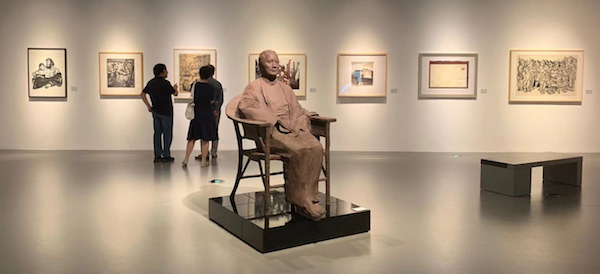
Exhibition site
The exhibition tells the story from the "red classics" in the context of "literature and art serve the people, workers, peasants and soldiers" in the early days of the founding of the People’s Republic of China to the confrontation and balance under the impact of foreign culture of reform and opening up, and then to the pluralistic coexistence of China’s artistic ecology under the background of contemporary globalization.
Ruan Jun, deputy director of Shanghai Liu Haisu Art Museum, explained three key words of the exhibition, namely, 70th anniversary of the founding of New China, showing people’s beautiful life, and how artists show their works, and interpreted the thematic works from the perspective of poetic Jiangnan meaning: "Jiangnan culture contains the pursuit of beauty and yearning for a better life, from which artists can see their understanding of life and intuitive observation of social changes."
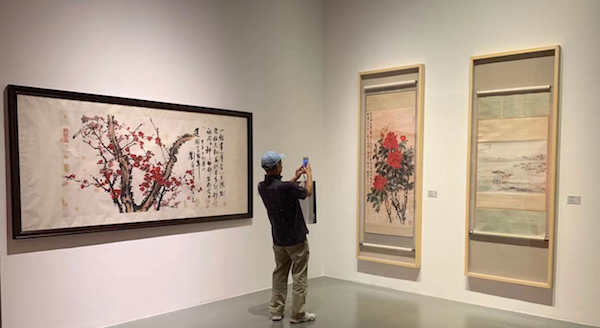
Exhibition site
How do artists transform in historical changes?
Walking into the exhibition hall, first of all, two large-scale flower works created by Liu Haisu for the 30th anniversary and the 35th anniversary of the founding of New China are presented. These two exhibits are from the Liu Haisu Art Museum in Changzhou, and they respectively use peony and red plum as metaphors for the new atmosphere of Shenzhou. Two oil paintings by Liu Haisu, "Picking the Mud" and "Strike the Iron", selected by Liu Haisu Art Museum, show the labor scene in full swing. At the same time, these two works also show the diversity of artists’ styles, among which "Strike while the Iron is Hot" seems to draw lessons from Van Gogh’s shadow.
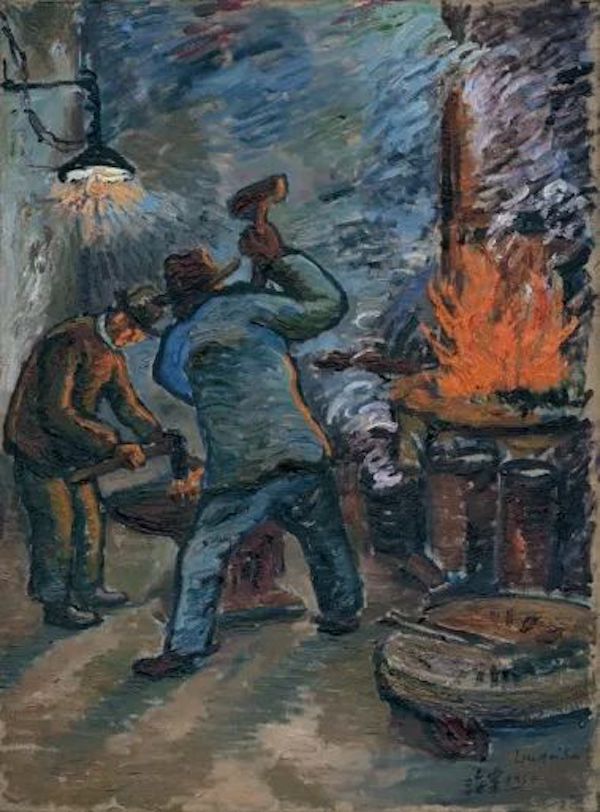
Liu Haisu’s Oil Painting While the Iron is Striked: 81×60.3cm Selected by Liu Haisu Art Museum
Next to these two colorful works is the 1958 work of the female painter Wu Qingxia, namely "Innovative Rice Transplanter with Agricultural Tools". From the inscription, it can be seen that this work was "sketched in the northern suburb of Hongqi No.1 Society". Like Liu Haisu, she walked out of Changzhou, and became famous as "Carp Wu" in middle age. In her octogenarian years, she donated her fine paintings and famous paintings and calligraphy jointly collected by her husband, Mr. Wu Yunrui, to Changzhou Municipal Government for free. The exhibition "Agricultural Tools Innovation Transplanting Boat" is from Changzhou Wu Qingxia Art Museum.
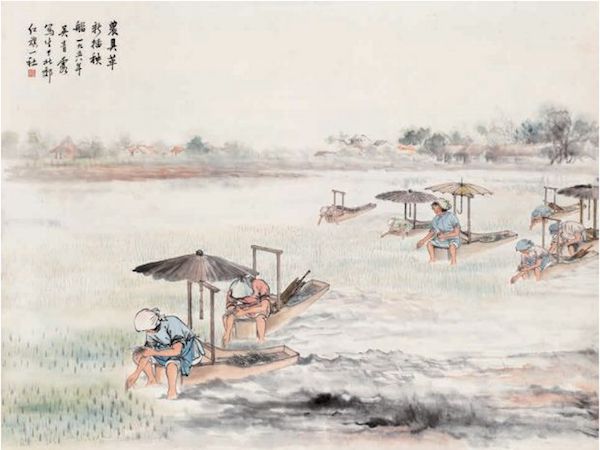
Wu Qingxia’s 56×75cm Chinese painting "Farm Tools Innovating Transplanting Boat" Selected by Wu Qingxia Art Institute.
Zhang Huan, the daughter of Wu Qingxia, told the The Paper reporter that Wu Qingxia came from a painting family, and Liu Haisu and Wu Qingxia’s cousins were good friends. Originally, they planned to go to Shanghai to run an art school, but Liu Haisu went to Shanghai alone after Wu Qingxia’s cousin died of illness. At that time, the China Painting Academy called on painters to go to the workers, peasants and soldiers, live in factories and rural areas, and eat, live and work with farmers, so as to draw such vivid works.
It is different from the image of farmers wearing straw hats and bending over to transplant rice seedlings. In this work, a woman dressed in Jiangnan sits at the front of the "boat", with seedlings to be inserted behind it, and there is also a special device for holding an umbrella to shade the sun. Just like the title of the work "Innovative Rice Transplanter with Agricultural Tools", Wu Qingxia recorded the working conditions of that era with a brush.
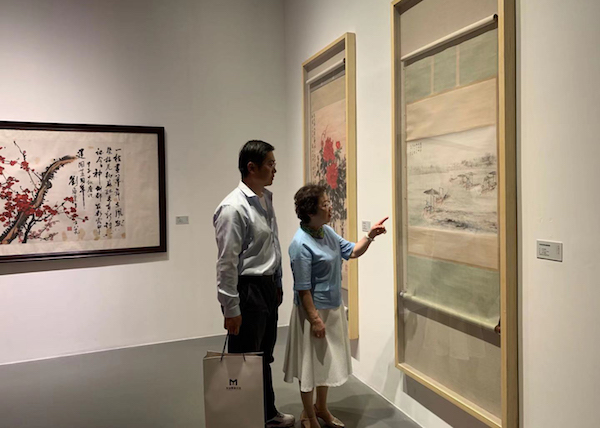
Zhang Huan, the daughter of Wu Qingxia, tells her son about Wu Qingxia’s works at the exhibition site.
How do different times and backgrounds affect artists’ creation?
The exhibition also exhibited works by Zhu Qizhan, Zong Qixiang, Ying Yeping and others. Among them, a landscape painting by Liu Kaiqu is quite rare. As we all know, Liu Kaiqu is a sculptor, and his masterpiece is the Monument to the People’s Heroes. The Statue of Cai Yuanpei in Shanghai Jing ‘an Park is also from Liu Kaiqu. One of Liu Kaiqu’s works in the exhibition is called "Scenery of the Motherland", which is a collection of Wang Qiangzhong. This work originated from his father, who was a military representative of the Central Academy of Fine Arts at that time. Liu Kaiqu thanked him for giving it.
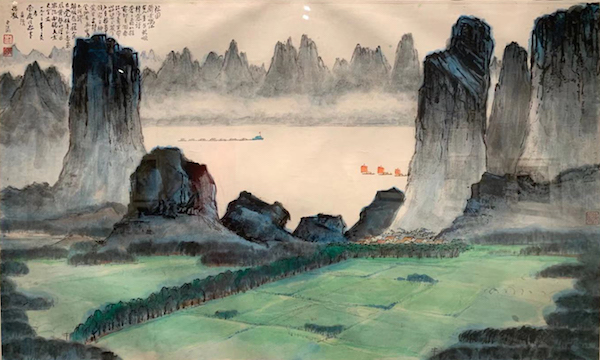
Liu Kaiqu, The Scenery of the Motherland.
Following the first part of the old man’s interpretation of the times, the second and third parts of the exhibition are the works of current artists. Shen Hu, an expert of the Art Committee of Liu Haisu Art Museum, used to appear as a theoretical researcher. In this exhibition, his "Wujintu" was created in the mid-1980s, depicting the production situation of coal miners.
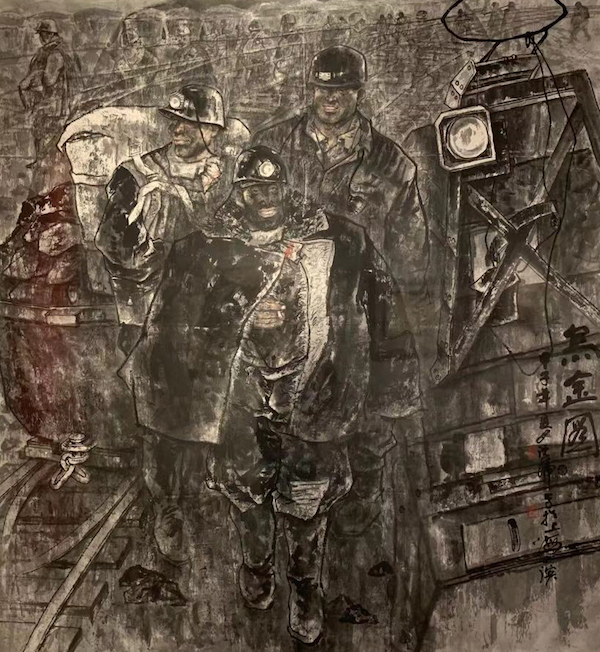
Shen Hu’s Wujintu
Huang Azhong’s "Workers’ Village" depicts the construction of the Shanghai Workers’ Village and the cultural and leisure life of the workers with relaxed brushwork. Pang Jun’s "East Courtyard of Broken Mountain Temple" selected by Changshu Art Museum, although it is also a sketch of scenery, covers the history of culture and art. The "Broken Mountain Temple" is located at the foot of Yushan Mountain in Changshu, and there is often a poem "a buddhist retreat behind broken-mountain temple" in the Tang Dynasty. The painting "East Courtyard of Broken Mountain Temple" seems to show the poetry of "my path has wound, through a sheltered hollow and of boughs and flowers, to a Buddhist retreat" in the Tang Dynasty as an oil painting landscape. These works express the theme creation in a relaxed and freehand way. He Xi’s "After Rain Clears Up" injects contemporary ideas into thematic creation.
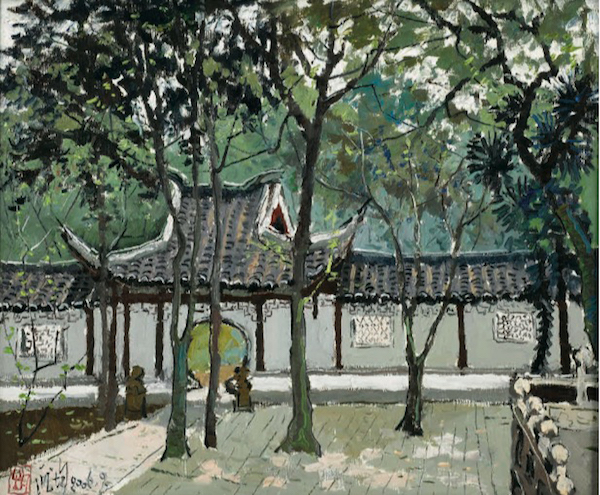
Pang Jun’s "Broken Mountain Temple East Courtyard"
According to Zhao Zongguan, secretary general of the collaboration mechanism of the Yangtze River Delta Art Museum, the works on display were collected from the works of art related to the founding of New China in various museums, and many collections were exhibited for the first time. Among them, we can see that the older generation of artists went deep into life to express the new achievements of socialism after the founding of New China. These old gentlemen used to paint traditional themes, and they incorporated new enthusiasm and sentiment into their traditional skills. The thematic works of art in different times bring different thoughts to Chinese people.
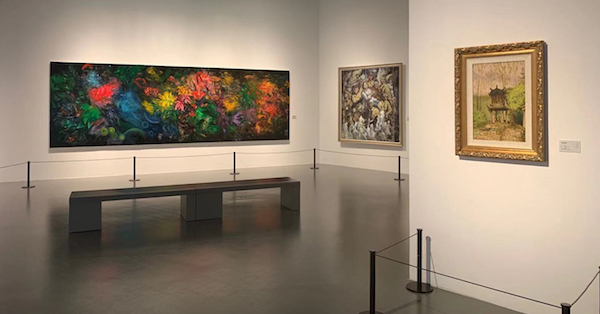
Exhibition site
The exhibition will last until October 10th.