The Reality and Future Role of "Professional Counterfeiters"
Supervisors wandering in the gray area
-the reality and future role of "professional counterfeiters"
Text/reporter Su Xiqiang
Counterfeiting or "extortion": Liu Jiang is not the only one on trial.
In December, 2011, Liu Jiang, a professional counterfeiter known as "the first person to crack down on counterfeiting in Chengdu", was suspected of extortion.
First, on December 1st, the Wanzhou District Court of Chongqing held a hearing on Liu Jiang’s alleged extortion case-Liu Jiang (whose real name is Huang Yong) was accused of extorting more than 300 TV stations across the country on the grounds of reporting false medical advertisements broadcast by TV stations, with a total amount of 2.42 million yuan.
This news quickly boarded the prominent position of major websites. Because of its specimen significance, it not only attracts a large number of professional counterfeiters from all over the country to attend, but also brings high public concern.
Half a month later, on December 15th, Liu Jiang, who had a history of counterfeiting for 14 years, was sentenced to 7 years’ imprisonment by the Wanzhou District Court of Chongqing for extortion. The court found that Liu Jiang illegally collected money in the name of counterfeiting, and his behavior met the constitutive requirements of extortion. According to Chengdu Business Daily, Liu Jiang, who was "quite out of control at one time after the verdict", has officially entrusted a lawyer to appeal to Chongqing No.2 Intermediate Court.
Liu Jiang’s "extortion case" has aroused widespread discussion in the society, and set off a war of words about "counterfeiting" and "faking". Some people think that "counterfeiting" cannot be reduced to "fake fighting"; There are also views that "fake fighting" is also a kind of "counterfeiting".
A detail mentioned in the report of Chengdu Business Daily is intriguing: on the day of Liu Jiang’s "extortion case" verdict, the reporter searched six channels of Wanzhou TV station at different times, but no medical advertisements were found.
I have to say that Liu Jiang’s "extortion case" once again shows that professional counterfeiters are a high-risk profession, which has both personal safety and the risk of crossing the legal line. They walk on the edge of morality and law, and if they are not careful, they will fall into the abyss.
Where is the boundary between "counterfeiting" and "counterfeiting" and how to define it? This is a heavy problem thrown by Liu Jiang’s "extortion case".
Liu Changsong, a well-known lawyer, wrote that the crime of extortion refers to the act of threatening others and demanding a large amount of public and private property for the purpose of illegal possession. Whether Liu Jiang’s behavior is guilty of extortion depends on two key factors, one is whether he used threats, and the other is whether he has a legal basis for obtaining money. If any element is not established, the crime cannot be established.
The first factor, he thinks that the determination of the judicial organs is no problem. Although Liu Jiang’s defender argued that Liu Jiang’s claim for compensation was that "all TV stations contacted the defendant only after being punished", these TV stations were not too concerned about the symbolic punishment of the local authorities. Liu Jiang claimed that if they did not pay compensation, they would complain to the higher authorities until they complained to the central government, which was really deterrent to them and conformed to the meaning of "threat".
The second factor is that he doesn’t quite agree with the determination of the judiciary. He said that according to the Consumer Protection Law, consumers have the right to get double indemnity for buying fake goods. This is the legal basis for professional counterfeiters Wang Hai to make a living by counterfeiting. When claiming for counterfeiting, the claims for preserving evidence, purchasing relevant commodities and traveling expenses between different places are generally counted as the cost of counterfeiting, and only the compensation equivalent to twice the price of commodities is the profit of counterfeiting. Liu Changsong believes that Liu Jiang sent people to various places to collect false advertising videos, engrave CDs, buy related goods, and advocate to the relevant TV stations … The expenses are not small. If the TV stations think that false advertisements have caused psychological harm to Liu Jiang, they are willing to compensate mental damage compensation again. "In this way, it is not a big sum to ask more than 300 TV stations for compensation of 2.42 million yuan. Moreover, it is really difficult to identify which of the 2.42 million yuan is legal and which is illegal. "
Liu Changsong also compared Liu Jiang’s extortion case with the previously sensational Huang Jing case. Huang Jing bought ASUS’s problem notebook, seized the serious injury caused by ASUS installing the test board into the product as a formal motherboard, and claimed tens of millions of yuan. As a result, he was accused of extortion, but in the end, he was actually treated as "excessive rights protection" and Huang Jing was acquitted. "Although Liu Jiang is targeting at TV stations, the operators of fake sales and TV stations that publish false advertisements actually set up joint infringement on consumers. Consumers can claim compensation from any of them according to law, or they can ask them to pay compensation jointly and severally." He believes that Liu Jiang’s "extortion case" is at most a problem of excessive rights protection, and he must not resort to criminal investigation at every turn.
However, Liu Changsong neglected an important issue. There is a huge difference in identity between Liu Jiang and Huang Jing-one is a "professional counterfeiter" with a history of 14 years, and the other is an "ordinary consumer" who fights counterfeiting and protects rights; Liu Jiang maintains the so-called "generalized" consumer rights, while Huang Jing maintains the individual consumer rights. The logic here is: Huang Jing, an individual consumer, certainly has the right to defend his rights, while Liu Jiang is more about defending his rights on behalf of consumers. At least under such a banner, who granted Liu Jiang the right to represent consumers?
This is another profound social and legal proposition reflected by Liu Jiang’s extortion case: the legitimacy and rationality of the identity of professional counterfeiters.
In fact, the living space of professional counterfeiters is not only given by counterfeiters, but also created by the lack of supervision by official regulatory authorities. However, have you ever seen fake businesses and regulatory authorities dereliction of duty and received heavy penalties like "7 years in prison" because of the "2.42 million" involved?
Liu Changsong is worried that "instead of hitting the counterfeiters and the producers and publishers of false advertisements, it will hit the counterfeiters. I am afraid that the social effect of handling such cases will not be good."
It should be noted that since the implementation of the Consumer Protection Law in 1994 gave birth to the professional group of "professional counterfeiters", the professional counterfeiters in China have basically followed Wang Hai’s "personal hero-style" anti-counterfeiting model, with little change. In the past ten years, with the development of China’s economy, under the public opinion environment of building a "society ruled by law" and a "harmonious society", higher requirements have been put forward for the group of professional counterfeiters-to stop the market irregularities by standardized means.
This is undoubtedly a difficult technical job for unofficial professional counterfeiters.
The problem is that in the past ten years, the shortcomings of market supervision still exist, and the situation that counterfeit goods are flooding the China market has not fundamentally changed. The market law determines that there will be new "Liu Jiang" constantly.
What deserves our reflection is that Liu Jiang was tried, but was it only Liu Jiang who was tried?
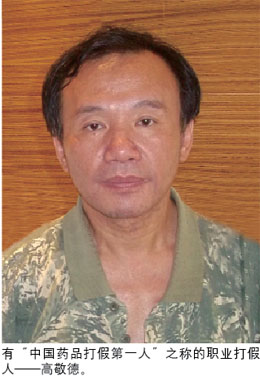
Gao Jingde’s Death: Encountering Survival Dilemma when Legally Counterfeiting.
Gao Jingde, a professional counterfeiter known as "the first person in China to counterfeit drugs", died.
From the suspicion of "being killed" to the official announcement that Gao Jingde died of "AIDS", the media still have doubts about this matter in questioning.
Although Gao Jingde’s so-called "AIDS patients" attract attention, the core label of Gao Jingde is still: professional counterfeiters.
From the beginning of professional counterfeiting in 2003 to his death, during his eight-year anti-counterfeiting career, Gao Jingde has been living in embarrassment in the media description. In a sense, Gao Jingde died of poverty rather than AIDS.
According to Nandu Weekly, in 2007, CCTV moved Chen Xiaolan, the person of the year and a retired doctor in China, who had been fighting against medical corruption for more than ten years, and began to consciously alienate Gao Jingde after dealing with him several times. Chen Xiaolan said that Gao Jingde "everything has to be related to money, which makes me feel a little unaccustomed".
Chen Xiaolan, who has a fixed income, may not need to worry about money, but Gao Jingde, who lives by counterfeiting, obviously can’t be so handsome.
According to the report of Nandu Weekly, Gao Jingde, who is "legally counterfeiting", should be poor and destitute. His main "mode" of counterfeiting drugs is to help the relevant drug supervision departments investigate and deal with counterfeit and shoddy drugs and medical devices, and then get bonuses from the drug supervision departments.
But the tragedy is that Gao Jingde, who has made enemies everywhere, has a high-profile anti-counterfeiting method that is "not liked by the drug supervision department". An example is-in the Hangzhou drug administration, some people’s evaluation of Gao Jingde is "difficult".
In other words, for Gao Jingde, the bonus of the drug supervision department is not so easy to get.
"Several years of professional counterfeiting has not improved Gao Jingde’s life. After embarking on the road of professional anti-counterfeiting, Gao Jingde has almost no fixed source of income except the income of several hundred yuan per month. The bonus from the drug supervision department obtained by the anti-counterfeiting report has become his extra income to a certain extent. " Nandu Weekly disclosed.
This can’t help but make people sigh. No wonder Gao Jingde and Chen Xiaolan met only a few times to talk about "the problem of money". He lived too hard.
In fact, within the existing institutional framework, it is not only Gao Jingde who is "struggling to survive", but also a general embarrassment.
In January 2011, Southern Metropolis Daily also reported a typical example. Luo Ming, a young Sichuanese working in Guangdong, quit his job and embarked on the road of professional anti-counterfeiting in the field of food and medicine "in order to arouse their attention to food and drug safety". Although "complaints about food and drug products can get 10 times compensation", he found that it is actually difficult to make money by seemingly glamorous counterfeiting. After half a year, he only earned more than 3,000 yuan by "buying fake claims"-much lower than when he was working. What annoys him most is that merchants often counterclaim him for "extortion".
Although during the interview, Luo Ming claimed that he would "continue to fight counterfeiting", how long can he persist without fighting counterfeiting for money?
For a long time, people have been advocating "public welfare counterfeiting", while "counterfeiting for money" has been criticized.
In recent years, the most talked about person is Chen Shuwei, a professional counterfeiter with pure public welfare nature. In June, 2006, Chen Shuwei, a well-known professional counterfeiter, spent one month writing a 130,000-word book exposing the fraud of communication operators to consumers, and published it on the Internet. After that, it quickly spread, alarmed the Ministry of Information Industry and even the State Council, which directly prompted communication operators to correct 17 relevant clauses and made 8 service commitments, which indirectly prompted the emergence of "one-way charging" for mobile phones. A court judge praised: "Professional counterfeiters like this are undoubtedly welcome. They have done work that our ordinary consumers have no energy and courage to complete, but we have gained tangible benefits."
However, "professional counterfeiters with purely public welfare nature" undoubtedly set a high threshold for counterfeiters, and more and more consumers will find it difficult to step into the camp of professional counterfeiters. What are the benefits besides making the counterfeiting cost of bad businesses lower?
And some professional counterfeiters "cross the border", using counterfeiting as a means of extorting money, and often demanding sky-high "hush money", and how many of them are forced by life to cross the border?
It must be noted that in the discussion of "counterfeiting for money" and "public welfare counterfeiting", the social evaluation of the group of "individual heroes" and even professional counterfeiters has quietly changed in the past decade, from being praised to being mixed, from being regarded as a "useful supplement" to "adding chaos and grabbing jobs".
This is a silent blow to the professional counterfeiters. Does this mean that the "golden age" of professional counterfeiters is far away?
In people’s impression, professional counterfeiters have always been strong, but in fact, compared with enterprises, they are just relatively "strong people" in this vulnerable group of consumers. They are just mortals, just more courageous than ordinary people.
If you see this clearly, you will know that perhaps, at least at present, our society has too little guidance, care and even relief for professional counterfeiters.
Wang Hai is happy to be a "gunman": Has the era of "commercialization" of counterfeiting arrived?
When it comes to professional counterfeiting, I have to say that Wang Hai, the "first person to eat crabs", is a figure that cannot be ignored. In the group of professional counterfeiters, he is one of the few who live a relatively chic life. Moreover, it can always lead the way.
On December 20th, 2011, in an interview with peninsula metropolis daily, Wang Hai uttered amazing words: "If a big company hires me as a gunman, I will be happy to do it." In Wang Hai’s view, the competitors of enterprises tear each other apart, "there is no harm in it", "Only when there is a shady opponent can more secret information be disclosed, and when there is a competitor exposed, consumers’ right to know will increase, which is beneficial to society!" For example, he said, A clothing factory said that the clothing of B clothing factory claimed to be real silk without any silk, while B clothing factory claimed that the clothing of A clothing factory used fake fur but called it real leather. "In this case, we will charge the clothing factory and then do the test, and finally tell the consumer what the truth is."
When questioned that some enterprises would prevent them from counterfeiting through economic temptations such as buying, Wang Hai explained that after identifying fake and shoddy products, he would first report to the government department and then sue. "Our purpose is to let consumers know", when "we have disclosed all the information, and the purpose has reached more than half. Is it still meaningful to buy it again?"
However, Wang Hai did not forget to emphasize that "it should be within the legal scope". Perhaps this is the magic weapon that he has been dancing on the tip of a knife for nearly 20 years.
Wang Hai does not deny that he has embarked on the road of "commercialization of counterfeiting" and criticized "people who say that I only counterfeit for money are stupid." The implication is clear-of course, counterfeiting needs to make money, but it is not just making money.
In Wang Hai’s view, as far as the so-called "nature" is concerned, there is no conflict between business and public welfare, and the anti-counterfeiting of commercial behavior itself has the nature of public welfare. He believes that the essence of individual anti-counterfeiting is that the state drives this mechanism by using individual anti-counterfeiting interests to combat counterfeiting and fraud. This interest drive refers not only to economic interests, but also to public welfare and spiritual interests.
Wang Hai called on the state to support and encourage professional counterfeiting. He believes that personal counterfeiting is "an additional and free welfare of society." Counterfeiting by the Industrial and Commercial Bureau and the Quality Supervision Bureau is a departmental act, which costs taxpayers’ money, but personal counterfeiting is free (free for society and the country, without spending taxpayers’ money).
According to Wang Hai, he has basically completed the "transformation" of the commercialization of counterfeiting. His professional anti-counterfeiting has been extended to the whole country. In addition to his company in Beijing, he has also opened branches in Guangzhou and Shenzhen, and his profits are not bad.
Wang Hai said that at present, he is mainly engaged in counterfeiting for some pharmaceutical companies, stationery, auto parts and other enterprises, and at the same time, he will also maintain intellectual property rights for some film and television works companies. "Now the phenomenon of online piracy of many film and television works is more serious, and this market is still relatively large."
In fact, there has been a constant social controversy over the commercialization of professional counterfeiting and even Wang Hai himself. Unlike most ordinary professional counterfeiters, Wang Hai is still a "celebrity". Smart as Wang Hai, he naturally knows how to maximize his interests. This is also the reason why he always declares in public that he is still keen on "public welfare counterfeiting".
However, under the current legal framework, the commercialization of counterfeiting is still in a gray area. How far is it from crossing the thunder pool? Can it really open up a new world for professional counterfeiters? It remains to be seen.
But one thing is certain. It is beneficial for both professional counterfeiters and ordinary consumers to examine Wang Hai objectively and learn from him.
It is necessary to remind that Wang Hai’s success is only a case at present and is not universal. Aside from the case of Wang Hai, the reality is that although people are constantly joining the ranks of professional counterfeiting, those well-known counterfeiters who once had extensive influence are increasingly withdrawing from the stage of "professional counterfeiting". Is this a phenomenon that should be paid attention to?