What about the recombination mutation of Delta Omicron, which was first discovered in France? Detailed explanation of pasteur institute
Recombination is a key process in the evolution of many organisms. Recombination often occurs in positive-strand RNA viruses such as coronavirus, which is considered to be related to major epidemiological events such as virus host range expansion, antigen transfer or toxic variation.
The World Health Organization (WHO) pointed out in its latest weekly report on the epidemiology of COVID-19 that SARS-CoV-2 virus continued to evolve. In view of the high horizontal transmission in the world, it is likely that there will be more variants, including recombinant variants. The recombinant variants that the organization is tracking include the recombinant variants of Delta(AY.4) and Omicron(BA.1) (XD Pango pedigree), and the recombinants of Ba.1 and BA.2 (such as XE Pango pedigree).
Among them, the XD recombinant variant seems to be still limited in spread, and it is regarded as a "variant under monitoring" (VUM). The available evidence does not show that it is more infectious than other popular variants. XE recombinant variants were first discovered in Britain on January 19th. By the end of March, about 600 sequences had been reported and confirmed. Early estimates show that XE has a community growth rate advantage of 1.1 times (about 10% communication advantage) compared with BA.2 However, WHO also stressed that this finding needs further confirmation.
For the above-mentioned XD recombinant variants, researchers from the French Pasteur Institute and other teams recently published a new study on the preprint platform Research Square, entitled "Rapid characterization of a Delta-Omicron SARS- CoV-2 recombinant virus found in Europe". They pointed out that this recombinant variant showed immune escape characteristics similar to those of Omicron, and its behavior in mice expressing human ACE2 receptor (hACE1) was more similar to that of Delta strain.
The research team believes that this recombinant variant provides a unique and natural opportunity to better understand the relationship between genotypes and phenotypes in SARS-CoV-2.
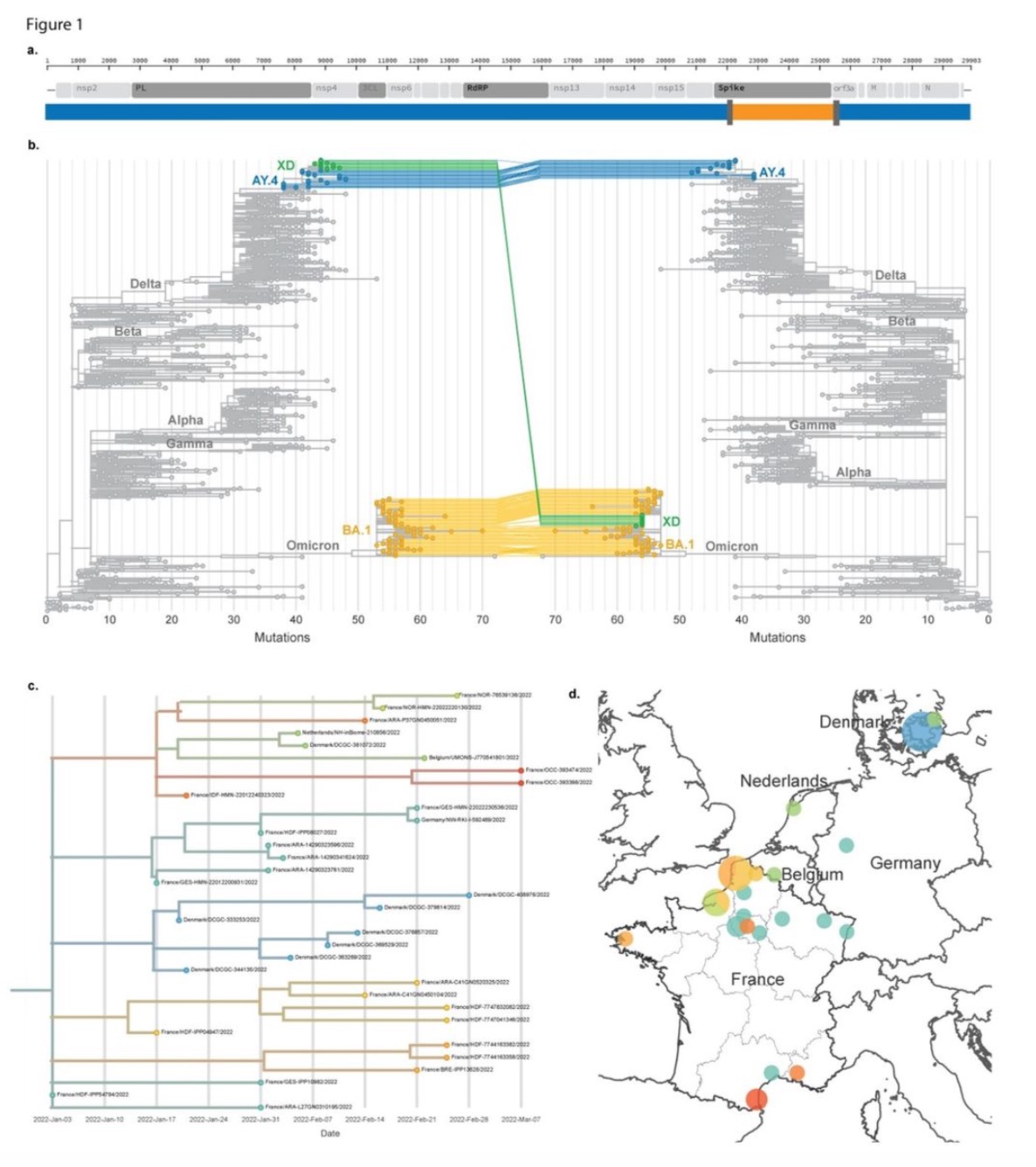
Genome and initial discovery of XD pedigree.
XD recombinant variants were found in routine monitoring in northern France.
Since the development of COVID-19 pandemic, there is constant concern that the mutant will trigger every climax in the "relay". Just before Omicron, Delta virus spread widely all over the world. Researchers from the Pasteur Institute in France and other teams pointed out in the paper that when two genetically different viruses co-infect cells, the recombination process may occur.
At the beginning of 2022, two sequences, which were initially classified as Delta AY.4 and 21J by Pangolin and Nextclade respectively, were publicly shared in the EMERGEN Union of France and several laboratories in Europe for routine SARS-CoV-2 genome monitoring. Further examination of these genomes shows that there are a large number of characteristic mutations of BA.1 pedigree in only a part of the genome, which highly suggests recombination.
This pedigree was designated as GKA by GISAID, then XD by Pango pedigree, and was classified as a mutant under monitoring by the European Center for Disease Control and Prevention (ECDC) on March 17th, 2022.
The earliest sequence of the recombinant mutant was obtained during routine monitoring in northern France on January 3. As of March 18th, XD pedigree has been detected in many regions of France, Denmark, Netherlands, Belgium and Germany through random sampling and cluster survey. Most of the cases investigated reported no travel history, except one case from Italy. According to the research, this shows that although it is widespread, it is less spread.
The data of their epidemiological investigation came from 32 confirmed XD cases and 6 suspected SARS-CoV-2 cases in France from January 3 to March 9. For comparison, they also used the epidemiological data obtained from a recent survey of Omicron (BA.1) cases in France using the same method.
The median age of XD-infected patients was 32.5 years old, which was similar to that of Omicron (35 years old). However, compared with cases in Omicron (11.3%), XD cases under 20 years old accounted for 25.7%. In addition, only two XD cases reported SARS-CoV-2 infection (5.6%), which was lower than that in Omicron (14%). No XD cases were over 70 years old, and no risk factors were reported. Only 6% of the recombinant cases were unvaccinated, compared with 27% in Omicron.
All XD cases in France in this study are symptomatic, and most of the reported symptoms are headache (61.1%), weakness/fatigue (58.3%), cough (44.4%), fever (38.9%) and myalgia (33.3%). Two cases of XD were hospitalized, one of which was less than 24 hours without intensive care.
It is pointed out that all XD viruses reported at present may come from a unique ancestor. They isolated the representative viruses of each parental lineage and the recombinant XD virus, which further proved the recombinant genotype. They mentioned that the AY.4 virus sampled in Ile-de-France on December 27th, 2021 was 100% identical with the Delta-like region of XD variant, and the BA.1 virus was 100% identical with the Omicron-like region of XD variant.
It is different from Omicron in infected mice.
Compared with the original SARS-CoV-2 strain sequence, Omicron has accumulated extensive mutations in spike protein. Because XD spike protein carries most of the characteristic changes of BA.1, including the whole receptor binding domain (RBD), the researchers hypothesized that this recombinant variant may have similar immune escape characteristics.
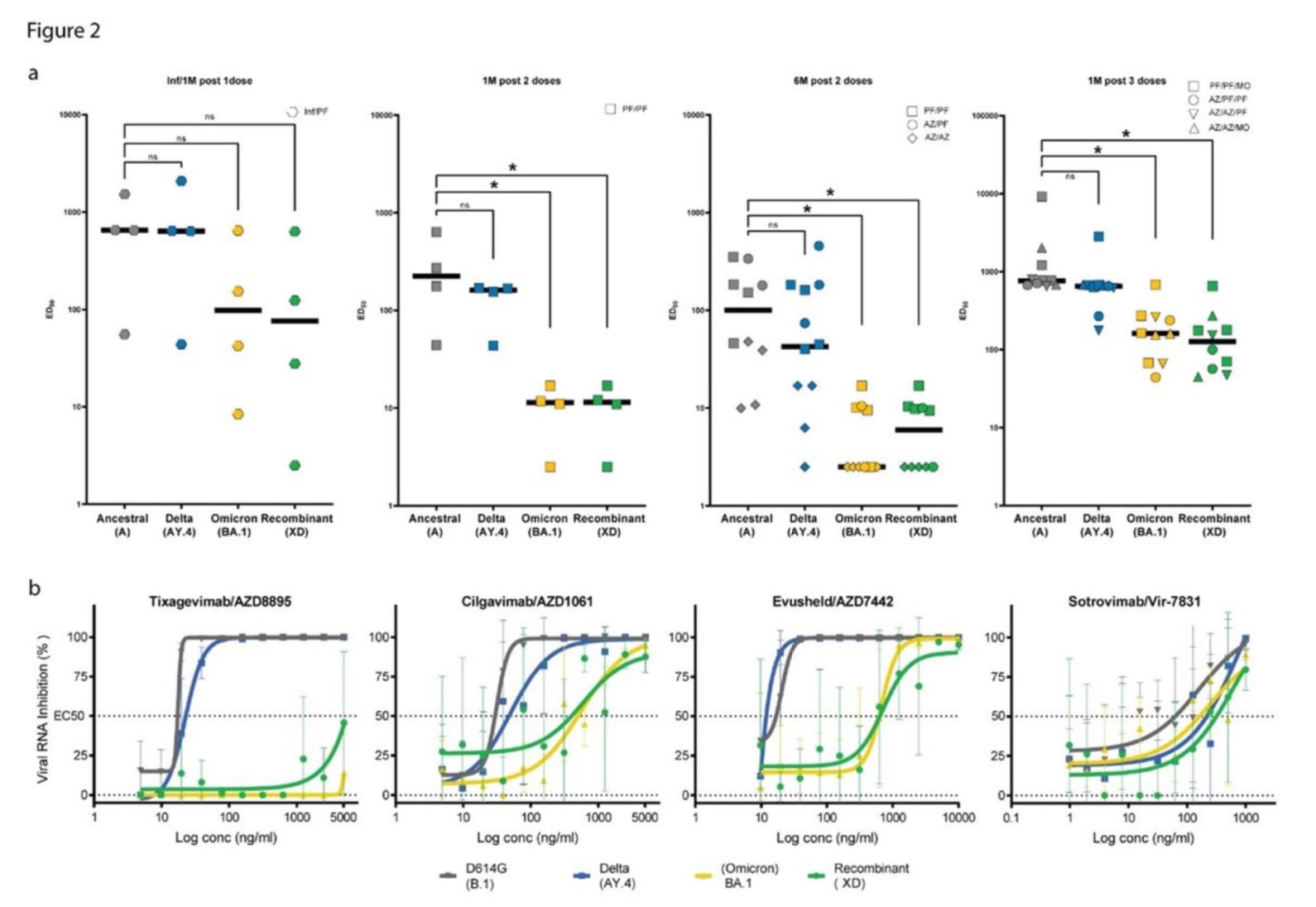
XD recombination and immune escape.
By testing the sensitivity of the virus to the serum of the vaccinator, it was found that compared with the original virus, the neutralization titer of the serum to Delta was only slightly reduced. In contrast, XD recombinant variants and BA.1 were hardly neutralized in serum samples 1 month or 6 months after two doses of vaccine. One month after the third dose of immunization, the titers were much higher, but compared with the original virus, their neutralization efficiency for BA.1 and XD was still reduced by 8 to 10 times.
The research team believes that these results show that XD variants show similar immune escape characteristics to BA.1, and further strengthen the main role of RBD epitope of spike protein in vaccine-induced neutralization reaction in serum group.
It is noteworthy that compared with Delta, BA.1 in Omicron is associated with a lower risk of serious diseases. Consistent, BA.1 has been proved to cause attenuated diseases in rodent models, including in highly sensitive models of human ACE2 transgenic (K18-hACE2) mice.
The research team conducted a virus challenge test on K18-hACE2 mice, and found that on the 3rd day (dpi) after infection, the RNA level in the lungs of mice infected with BA.1 or XD virus was equivalent, which was 3.7 times lower than that of animals infected with AY.4. In contrast, the viral load in the turbinate of XD infected mice was 8.5 times higher than that of BA.1 infected animals, only slightly lower than that of AY.4 infected mice. Similar differences were noted when measuring infectious titers.
They also monitored the weight loss and diseases of mice for 11 days. Like the main Delta pedigree, the disease of weight loss caused by AY.4 strain accelerated at 3 days after infection, and 6 of 7 mice reached the humanitarian end point at 7-9 days after infection. BA.1 infection has nothing to do with weight. For XD virus, researchers did not observe weight loss within 5 days after infection, but all mice deteriorated rapidly between the 5th and 8th days, and died or had to be euthanized on the 9th day.
The research team concluded that, in a word, these results indicate that the Delta-Omicron XD recombinant variant has different clinical characteristics from Omicron BA.1 in K18-hACE2 mice. This further indicates that the attenuated phenotype of BA.1 in this model can not only be regarded as related to the changes of spike protein, and further experiments are needed to determine the phenotypic basis of mice infected with XD, and to determine the relationship between this and human XD infection.
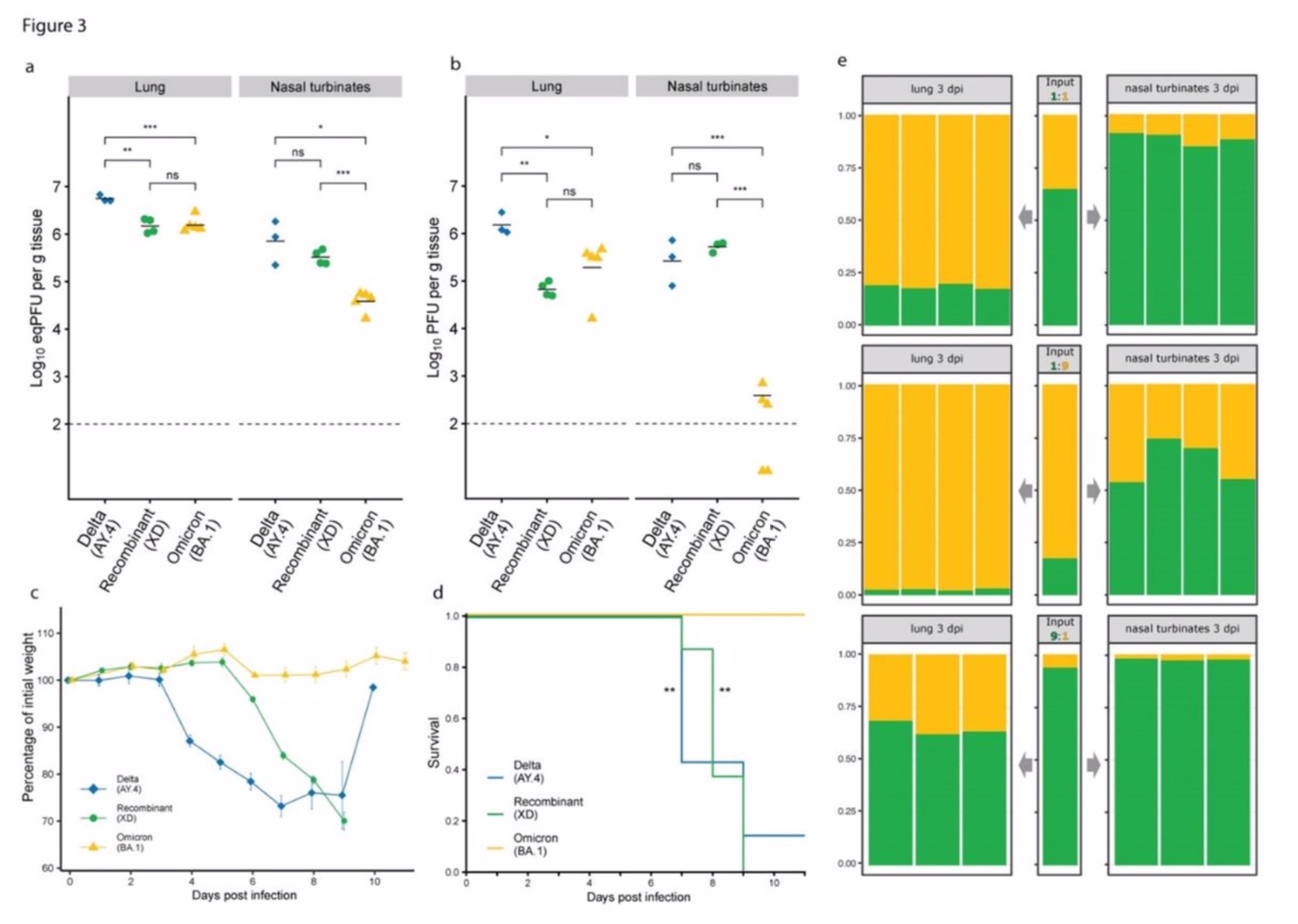
Phenotypic differences between XD (green) and Delta AY.4 (blue) and Omicron BA.1 (yellow) in K18-hACE2 mice.
The research team further studied the potential differences in replication adaptability of XD virus. They inoculated K18-hACE2 mice with a mixture of BA.1 and XD virus at the ratio of 1:1, 1:9 or 9:1, and used metagenome sequencing to estimate the ratio of virus genomes in lung and turbinate at 3 days after infection. The results showed that although BA.1 was always superior to XD recombinant variant in lung, the opposite situation was observed in turbinate.
To sum up, these results show that XD and BA.1 have their own replication advantages in different environments.
The research team stressed that the continuous diversification observed during the COVID-19 pandemic and the concern about the emergence of mutant strains may provide further opportunities for recombination. Continuous global monitoring and rapid risk assessment are very important for our long-term response to the SARS-CoV-2 cycle and our understanding of its biology.