The following article comes from Huaxia Cornerstone E Insight, author Wu Xiaobo, etc.
Chinese cornerstone e insight.
WeChat official account, the official of Huaxia Cornerstone Management Consulting Group, Peng Jianfeng, Huang Weiwei, Wu Chunbo, Hong Tianfeng, Shi Wei and Chen Chunhua are its main contributors. We strive to provide original, ideological and practical management articles; We deeply analyze the best practical management cases; We have zero-distance interactive answers to various management problems of enterprises and provide consulting solutions.

Near the end of the year, KPI, OKR, 360-degree EIA, 361 assessment … various performance assessments constantly touch the nerves of everyone in the workplace.
Performance appraisal is both a science and an art. Too harsh, so that employees fight internally and fall into involution; But too loose, and easy to breed corruption, lax work.
How to make all staff focus on making big cakes instead of dividing them through the assessment mechanism? How to maintain the enthusiasm and cooperation of employees and strive for common goals?
Share an article today, hoping to bring inspiration.
Author | Wu Xiaobo, Xu Guangguo and Zhang Wujie,
Source | Huaxia Cornerstone E Insight (ID: chnstonewx)
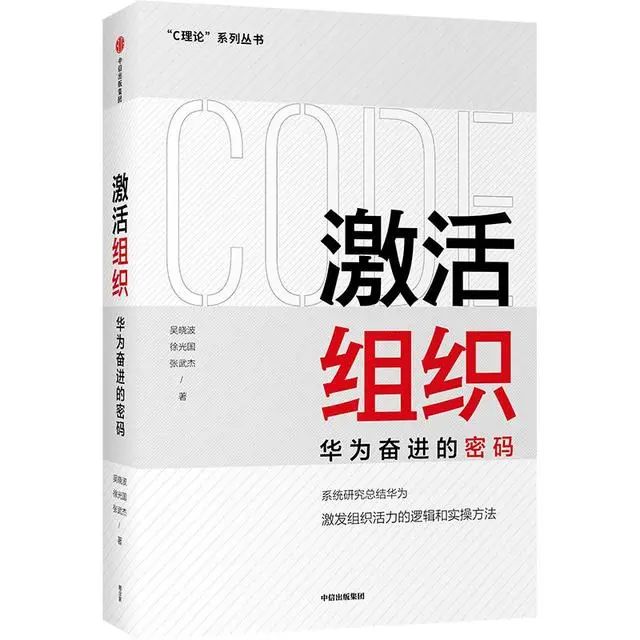
Excerpt from CITIC Publishing Group’s Activation Organization-The Password of Huawei Endeavour.
01
The assessment mechanism focuses on making big cakes.
In reality, we often see that when an organization develops to a certain extent, it often fights to the death inside.
In a modern enterprise or any large organization, or even a larger family, it is very difficult to achieve "one gun for the whole battalion".
One of the most famous examples is Microsoft.
There are three CEOs in the history of Microsoft, the first is Bill Gates, the second is steve ballmer, who joined in the incubation period of Microsoft, and the third is satyanarayana nadella, a professional manager.
Nadella became the CEO of Microsoft on February 4, 2014. He once said: "To some extent, I am deeply annoyed by the lack of responsibility and mutual accusations."
It takes a lot of pen and ink to give a real example of Microsoft, and it is not easy to grasp the main point. We use a simple image example to illustrate the similar infighting situation of Microsoft or other companies.
Goalkeeper, striker, center and defender form a complete football team. If the striker scores a world wave 50 meters away, will the defender and goalkeeper be happy?
Perhaps many people’s answer is happy, but that is the ideal situation, not the objective reality of the enterprise.
In reality, defenders and goalkeepers are very unhappy.
Because the striker shoots into the world wave, he may get the best grade (outstanding or A), while the defender and goalkeeper have a greater probability of getting the worst grade (C or D). On the contrary, defenders and goalkeepers keep a goal that must be scored, and strikers will be unhappy.
Under the performance management system of mandatory proportion in modern enterprises, many internal teams are hostile to each other in this way, which is also a drawback of mandatory proportion in performance appraisal.
This is the assessment system that focuses on dividing cakes, not how to make big cakes.
Let’s give another example of Huawei that Xu Guangguo, one of the authors of this book, personally experienced.
In 2016, a major change project team of Huawei recruited some excellent people from various regions and departments, and one of them was transferred to the project team from other departments. Huawei’s attendance system is to swipe the card every day, which is a management tool. According to China’s labor law, wages can be deducted from absenteeism, and Huawei has a similar system.
But Huawei has a humanized system. If you are late by the company shuttle bus, you don’t have to be late. Because Huawei has a large number of employees, there are shuttle buses in many places. If you are late for the shuttle bus, fill in an electronic flow to explain that the shuttle bus is late today, and then confirm that the bus is really late by the driver and the administration, you can not be late. The female expert was later found to have worked more than 200 days a year and the bus was delayed for 165 days.
As soon as this data is put on the table, everyone knows that it is impossible. It is possible that a bus will be delayed every day, but it can’t all happen to her, so this data must be fraudulent. After being discovered, Huawei wants to fire her, and other members of the change project team are very happy. Why?
Under normal circumstances, poor evaluation of subordinates may lead to employees leaving the company, and it is difficult for the supervisor to start. At this time, the person who is fired and the person who voluntarily leaves the company often becomes the person who takes the blame.
Huawei’s evaluation at that time was five grades: A, B+, B, C and D, so she had to recite the places of C and D. Of course, other members of the project team were very happy. However, it was later found that her evaluation was not in the project team, and the members of the project team were happy in vain.
It can be seen that such an organization that determines the future direction of the company has such a strong team psychology of subtle relationship between people, so any organization or enterprise is prone to such problems. After all, people are all interest animals.
Later, Microsoft thought of a way, and the assessment became "three bubbles".
Specifically, the original test was only a purple bubble: "your key personal contribution to the team, business and customer results", that is, the direct contribution of employees;
Now it’s changed, and we have to test the light blue bubble: "Your contribution to the success of others", that is, how many assists employees have given others;
Also test the third deep blue bubble: "How much help do you get from others to make your results better", that is, how much help do employees get from others.
After the "three bubbles" test, the internal atmosphere of Microsoft has changed greatly, and employees are willing to help others to improve their performance. The number of inter-departmental collaborative wins has increased by 70%, which is a very significant effect.
Microsoft didn’t grasp the era of Internet or mobile Internet, but after satyanarayana nadella came to power, Microsoft grasped the era of cloud.
Now there are so-called "five clouds" in the world, that is, five supercomputers. The first three clouds are undisputed, including Amazon, Microsoft and Ali, and the other two clouds are controversial.
Microsoft has successfully grasped the era of cloud and become one of the companies with the highest market value again, which has something to do with its cloud strategy, and of course, it has something to do with satyanarayana nadella’s advocacy of "three bubbles" to build a trust culture. It is to promote the team to focus on making big cakes instead of dividing them.
Since 2017, Huawei has gradually learned from Microsoft’s "three bubbles", including how to promote teamwork from the mechanism, focus on making big cakes instead of how to divide them, and how to tilt the focus of performance management to "coaching and development" to stimulate employees’ vitality, not just "differentiated evaluation" and create a competitive atmosphere.
On August 7, 2017, Ren Zhengfei’s speech at the communication meeting of "Human Resource Management Outline 2.0" pointed out that:
"The assessment should form a common spirit of struggle, like our past’ winning is to raise a glass to celebrate, and losing is to save each other’. Like the TV series "Top Secret 543", the whole battalion has one gun. Now, due to the unreasonable KPI assessment, the common spirit of struggle is weakened and selfishness is formed. This environment restricts the culture of group struggle and wolf tactics. "
"So, we should control the border, simplify the assessment, be results-oriented, and reshape this spirit. In the past, Huawei’s spirit of "winning means toasting each other, and losing means saving each other to the death" was very good. Everyone came to you for help as soon as they heard that there was something wrong with your products. At that time, although our products were not good enough, we could make up for them with diligence. Everyone helped each other and trusted each other. It is valuable for us to return to this state. "

Ren Zhengfei’s speech at the report meeting on personal performance management optimization on October 26, 2018 emphasized that performance management needs to be changed. This is what he said:
"Performance management has several optimization points:
First, adhere to the responsibility result-oriented, and the result of’ grain production’ can be calculated, and how much is it, such as 70%;
Second, emphasizing strategic contribution,’ increasing land fertility’ is appraised. According to the three articles of Microsoft Satya, relevant departments also have to vote, and the proportion can be explored, for example, 30%, which we have not done well at present;
The third is differentiated management, not across the board. ……”
"The three questions asked by Satya, president of Microsoft, to employees are very scientific and worth learning.
How do you use the company’s existing achievements to improve the efficiency of individuals or teams? What did you do yourself? What did you do to help others or teams?’ I think it can be used as a reference standard for evaluation and improvement.
In the result, don’t overemphasize personal contribution, just talk about your contribution to the team. The most important thing is that the whole team is making progress.
Just like’ one gun for the whole battalion’, the team can adopt absolute assessment method and let their project managers distribute it. Second, the strategic contribution also includes collaboration, and these 30 points include the evaluation of you by the collaboration department and the rating of the subordinates to the superiors. "
On November 9, 2018, the executive board of Huawei made the following resolutions on personal performance orientation:
(1) Purpose of performance management: Personal performance management should not only evaluate the responsibility results obtained by employees in the past, but also motivate employees to promote the continuous improvement of individual and team overall performance and ability;
(2) Orientation of personal performance: on the basis of adhering to the responsibility result, we should shift from single emphasis on "personal effective output" to the traction of "creating value for customers", "contributing to others’ output" and "using others’ output contribution" to better support "increasing land fertility";
(3) On the basis of insisting on distinguishing performance results and grasping the management at both ends, authorize the management team at the first level to formulate differentiated individual performance management plans according to local conditions according to business characteristics.
This resolution changes the purpose of Huawei’s personal performance management to motivate employees to make big cakes, from "one bubble" to "four bubbles" (Huawei added "creating value for customers"), and clarifies that the content of the responsibility result is to "get more grain and increase land fertility".

02
Managers’ eyes are down to stimulate cohesion.
In addition to activating the team to make a big cake in a hard mechanism, Huawei also makes all individuals focus on the team in the construction of team atmosphere, and strengthens the dialogue and communication within the team in many ways.
Here are some widely used and typical methods, such as OPENDAY (open door policy), Work-Out (job exposure) and MFP (manager feedback plan).
The core of all these methods is to make employees’ psychology toward organizational goals, work together with the organization, and realize their personal values while achieving organizational goals.
1. Put it straight.
OPENDAY is similar to the ——OPENDOOR policy, which has been proved to be more effective in the construction of organizational climate in western companies.
As the name implies, OPENDOOR is for managers to open the door and let employees and cross-level subordinates freely come in to report their personal thoughts, puzzles and suggestions.
Huawei’s R&D department first started OPENDAY in India, and then promoted it to the second-tier R&D departments in India. In R&D, almost 100% of the second-tier departments are seriously doing this work.
After years of repeated practice of OPENDAY, Huawei has basically formed a set of five-step operation methods that can be popularized:
(1) Planning stage: determine the communication host, communication time, executive secretary, etc.
(2) publicity preparation stage: publicize the significance, purpose, operation method, frequency and precautions of OPENDAY, and accept the appointment of employees who are willing to participate in OPENDAY;
(3) Implementation stage: the communication host communicates with employees, records relevant questions and answers;
(4) Problem solving stage: the Executive Secretary confirms the solution, the person responsible for solving the problems mentioned by the employees and the date of solving them, and asks for help for the problems that cannot be solved by the department at the same level;
(V) Preliminary report stage: The Executive Secretary consults the communication moderator’s opinions on this communication, and selects the communication that can be published for publicity within the department. After OPENDAY, it is necessary to investigate the opinions of employees involved in communication (the number of days is uncertain, and it can be conducted immediately or after one month).
OPENDAY is actually an "open door" policy, which gives employees the opportunity to talk about their personal feelings, suggestions and values to cross-level supervisors.
If an employee is dissatisfied with his work for a long time, his loyalty and vitality to the company will be reduced.
By respecting employees’ personal values, employees can feel the connection between personal goals and organizational goals.
Therefore, we should pay attention to listening to employees and solving problems.
When OPENDAY is implemented, the communication host must pay attention to listening, and avoid too much preaching and persuasion. The people who make an appointment are all people with preliminary ideas, so they should listen to his suggestions and ideas when time is limited. Ask employees’ opinions and basis before making a decision or reply, and then make a final decision.
In addition, attention should be paid to problem solving, and listening without solving problems is formalism.
The method of OPENDAY was explored and used by Huawei’s R&D department in 2002, and it is still used by the company today.
Visiting Huawei’s voice community website through the external network and searching for "OPENDAY" will find many related posts, which is a good way to understand the voice of employees.
2. The person closest to work knows the job best.
In 2000, Jack Welch, known as the world’s first CEO, retired from General Electric. Since 1981, he has increased the market value of GE by more than 30 times in 20 years, reaching $450 billion.
His autobiography "Jack:Straight from the Gut" published in 2001 has been translated into many languages, becoming a global bestseller, and the Chinese version is called "Autobiography of Jack Welch", which has been frantically studied by the business community. Huawei not only learned, but also carried out in-depth practice on related methods, such as Work-Out plan.
Work-Out, translated as "work exposure" in Autobiography of Jack Welch, as the name implies, is to expose the problems to be solved in the work.
Why did Jack Welch personally promote the Work-Out program?
Because Jack Welch attaches great importance to the growth of the team and the cultivation of managers.
Every year, Jack Welch personally teaches managers in Crotonville, General Electric Management Development Center. During his 20 years as CEO of General Electric, he has had direct communication with 18,000 GE managers.
After Welch personally explained the strategy and long-term goals, students often understood them better; Welch will continue to ask questions and guide the students to reflect. Students can often pour out all kinds of setbacks they have encountered in the company reform in class and make many good suggestions freely, openly and actively.
However, after these managers (trainees) returned to their jobs, they no longer had the active appearance of daring to point out problems and make suggestions during training, and everything returned to a dead state.
Even before the training, they were reminded that "you should be mentally prepared, and what you will hear in Crotonville is nonsense", and they did not forget to remind themselves that "this is different from what we heard when we went back" during the training.
One afternoon in September 1988, Welch left Crotonville with a heavy heart and was very depressed.
He constantly vented his feelings to Jim Bowman, the head of Crotonville Management Development Center: "Why can’t we let Crotonville’s frank atmosphere appear in every part of the company?" "We must reproduce Crotonville’s class throughout the company!"
Thus, a new reform plan of GE-"Work-out" was born.
When implementing the "job exposure" plan, GE invited 24 external trained professionals (mostly university professors) to help guide it. These consultants have no ulterior motives for employees’ conversations, and employees will feel at ease talking with these people.
A typical work exposure of GE lasts for 2~3 days, including three steps:
(1) Opening of the meeting: the manager attended the meeting to make a speech, put forward an important topic and arrange the general process;
(2) Job exposure: when the manager is not present, external professionals will inspire and guide employees to discuss, and 40~100 employees who attend need to make a list of their own problems and discuss them seriously;
(3) Commitment to solve: the manager returns and responds to every opinion on the spot, giving a clear yes or no answer to at least 75% of the questions. If there are questions that cannot be answered on the spot, they must be completed within the agreed time.
Employees can see their ideas get feedback quickly, which has greatly promoted the elimination of bureaucracy.
By 1999, about 200,000 General Electric employees had attended the "job exposure" meeting. Its significance can be summed up in the words of a middle-aged employee of General Electric: "For 25 years, you paid for my hands, but in fact, you could have my brain without paying any wages."
Work-Out method has also been practiced repeatedly in Huawei, and has been fully promoted in the R&D system.
Huawei’s Work-Out implementation process is as follows:
HR calls 10~30 employees to attend the meeting in the name of the department manager, which usually takes about 3 hours, and the whole process is divided into two sections. In the first half, HR professionals are the guides, and the department manager is not present, mainly discussing the views on the policies implemented by the department and the supervisor; In the second half, the manager returned and discussed the solution face to face with the employees.
Because HR guidance skills may be insufficient, employees are required to list problems or measures in four quadrants from two dimensions: good or bad methods and whether implementation is in place:
What methods are good in work and put in place, which need to be adhered to;
Which methods are good but not in place and need to be implemented;
Which methods are not good but are well implemented and need to be abandoned;
What methods are not good and not in place, and need to be changed.
This is a structural innovation of Huawei on the basis of GE method, and it also reduces the difficulty of guidance.
At the same time, managers and employees are required to discuss solutions face to face, and at least 80% of the questions should be answered clearly on the spot, and the rest of the questions should be answered within a specified time limit.
Professionals record every clear conclusion, put it forward at the next Work-Out meeting, and the employees collectively confirm the effect.
From this cycle, continuous improvement.
On the one hand, Huawei’s Work-Out conference provides a platform for team members to exchange their work views in a relaxed environment. Everyone can speak freely, discuss issues that can’t and are not easy to discuss at ordinary times, and point out which work methods need to be abandoned and changed, which plays a positive role in activating employees.
On the other hand, it also provides supervisors and department leaders with opportunities to communicate with employees, and puts forward the work that supervisors usually want to promote from the mouth of employees, which not only plays the role of answering questions, but also helps to promote work, pointing out which work methods need to be adhered to and implemented, and also plays a positive role in activating supervisors.
Work-Out is not a process of voting on the policies adopted by managers, but a process of using collective knowledge to solve problems and needs.
As Welch said, the Work-Out plan once again shows that "the people closest to work know the work best".
Later, Huawei continued to improve and called a similar method "democratic life meeting". Every department sat together once or twice a year to discuss various issues related to departmental development and business development. Employees’ suggestions and problems on company and departmental policies and daily management can be well communicated and solved through this channel.

3. Take feedback from subordinates as a mirror
MFP(Manager Feedback Plan (mfp) was recommended by IBM when it started to do ILD project for Huawei in December 2007.
IBM did this project for Huawei and recommended five toolkits:
PBC(PersonalBusiness Commitment).
MFP (Manager Feedback Program)
IDP(Individual Development Plan) is used for the personal development plan of executives.
AAD(Annual Appointment Decision).
TSP(Talent Succession Plan).
The goal of MFP is to improve the self-awareness of managers and solve the problem of how to manage people.
Huawei’s MFP is divided into three stages:
The first stage is an online questionnaire (conducted anonymously), in which subordinates put forward their opinions and suggestions on the specific behavior of supervisors in personnel management online;
The second stage is the feedback meeting, in which the supervisor presents the summary report of the questionnaire survey to his subordinates, and invites each subordinate attending the meeting to discuss the effectiveness of personnel management, the aspects that need improvement and suggestions face to face;
The third stage is the improvement plan and action. The supervisor publicizes the improvement plan and action to his subordinates and asks the employees to supervise the implementation.
Huawei began to pilot the MFP method in the Middle East in 2008, and began to fully promote it in 2009. It has been effectively carried out in Huawei’s sales service system, research and development system and other major systems, and it has continued to this day.
MFP is like a special mirror, which allows supervisors to know themselves from the perspective of others, improve their self-awareness level, and let managers see their performance in personnel management through feedback from subordinates, thus prompting supervisors to make self-improvement in personnel management.
The questions in the MFP questionnaire convey the company’s basic requirements and core expectations for supervisors in personnel management: supervisors should be honest, set an example, respect others, avoid bad management behaviors such as rude management, careless communication, centralized talk, and do a good job in performance management, two-way communication and counseling for team members.
We talked about three methods (OPENDAY, Work-Out, and MFP), which seem to be many, but as long as we take one method seriously (not necessarily one of these three methods), we can achieve better team cohesion.
Managers can see the confusion, difficulties and expectations of employees as long as their eyes are down. As long as they can help him and improve themselves, employees are actually very easy to integrate into the team.
However, managers are often not like this, and their eyes are very easy to face up. I don’t care whether the following people have achieved a gun in the whole camp, as long as I keep my manager position and corresponding welfare benefits under the existing system.
03
The third eye: let "force" out of a hole.
Huawei stimulates the hunger of the team by widening the gap and distributing according to work in value distribution.
However, if we only rely on our hunger to lead the team to grow, new problems will often arise because everyone only cares about their own interests. There is more competition (struggle) than cooperation (unity) between teams and team members.
Obviously, it is not enough to have a community of interests, so how should organizations create a community of destiny that "forces" a hole?
We explain how to maintain a high degree of consistency between teams and team members in the direction of struggle from two dimensions: assessment mechanism and team cohesion construction.
On the one hand, Huawei emphasizes guiding team members to make big cakes together by assessing their mutual contributions and creating value for customers, rather than just dividing cakes.
This is not the only way, organizations also need to develop activation methods that are conducive to improving team cohesion according to local conditions.
But the idea is the same, that is, squeezing out the "moisture" of personal contribution, or strictly safeguarding personal real contribution.
Under this mechanism, the actual contributions of teams and team members can be made transparent, and teams and team members are willing to help others and seek help from others in order to improve their own performance.
Of course, the most important premise is still "conducive to their own final performance". If the cake grows bigger, but their own performance has not changed, then employees are unwilling to support this mechanism.
Therefore, this change in the assessment mechanism not only emphasizes making big cakes, but also emphasizes being able to get bigger cakes on this basis.
On the other hand, there will be some emotional resonance or conflict within the team and among team members, not just tied together by interests.
Huawei has also used many methods to build team atmosphere, so that ordinary employees can fully express their team problems, and team leaders can solve them in time.
This kind of method is easy to understand, but it is also difficult to achieve results, which tests the mind and level of team managers.
There is no organization that doesn’t want to keep the gap between teams, departments, leaders and subordinates, but which enterprise can guarantee that it can do it all at once? How many leaders are willing to listen down and respond? How many employees can selflessly fulfill others?
A complete "one shot" is difficult to achieve, and a relative "one shot" is victory!
end
Related reading
If you don’t know the answer, no matter how hard you try, it will be a low-level repetition. How to make a high-quality annual plan? Yangtze river welfare
The new year is approaching, and Chang Xiaojiang has sent welfare!
Welcome to leave a message in the comment area to share your thoughts. By 18:00 on December 27th, the two friends who received the most praises will receive the 2022 Yangtze calendar.
Original title: How to avoid making performance appraisal an "involution"? 》