"Chain" finance, connecting capital breakpoints
Source: China Banking and Insurance Regulatory Commission, etc.
Cartography: Shen Yiling
Relying on real transaction information, banks provide credit support for upstream and downstream small and medium-sized enterprises around core enterprises.
"The factory has not started work for more than two months, the accounts receivable have not been collected, and the wages and raw materials have not been settled. How can this be resumed?" Affected by the epidemic, the Meihua frame covering factory in Changsha County, Hunan Province, which provided supporting parts for large construction machinery manufacturing enterprises, was once shut down, and Li Yong, the person in charge of the company, was anxious and helpless.
At a difficult time, Li Yong learned that Hunan Branch of China Construction Bank launched online supply chain financing products to support enterprises to pledge financing with accounts receivable. With the mentality of giving it a try, Li Yong applied online: "Unexpectedly, in less than an hour, a loan of 3.33 million yuan was credited."
Liu Jiahui in Bayannaoer City, Inner Mongolia is a small distributor of Haier air conditioning. At the peak of sales season, Liu Jiahui plans to prepare another batch of goods, but the funding gap of several hundred thousand yuan makes her a little worried.
Things soon took a turn for the better Liu Jiahui heard that the online merchant bank cooperated with Haier to launch the supply chain financial service, which can provide mortgage-free and guarantee-free financing support for downstream distributors. Liu Jiahui applied on Alipay, and a loan of 200,000 yuan soon arrived: "With this money, the business will definitely grow bigger."
Not long ago, the the State Council executive meeting proposed to encourage the development of supply chain financial products such as orders, warehouse receipts and accounts receivable financing, and promote the annual accounts receivable financing of small and medium-sized enterprises to reach 800 billion yuan.
What is supply chain finance? What do orders, warehouse receipts and accounts receivable financing mean?
"Supply chain finance refers to the cooperation between banks and core enterprises in the industrial chain to provide financing support for their upstream and downstream enterprises." Dong Ximiao, chief researcher of Xinwang Bank, said that when core enterprises in the industrial chain deal with small and medium-sized enterprises in the upstream and downstream, they often delay the payment cycle or ask upstream and downstream enterprises to make advances. For example, when some upstream enterprises do projects, they need to pay the initial start-up expenses themselves, and they can only get the payment from the core enterprises after the project is delivered, so enterprises need to prepare some funds to maintain their daily expenses. Due to light assets and lack of guarantee, these enterprises generally find it difficult to obtain loans from banks, and their cash flow is relatively tight.
Nowadays, it is precisely because of the close relationship with core enterprises that enterprises on the "chain" have more opportunities to obtain bank loans. Ceng Gang, deputy director of the National Finance and Development Laboratory of China Academy of Social Sciences, said that banks should take the supply chain of core enterprises as the breakthrough point, and through cooperation with core enterprises, obtain real transaction data of upstream and downstream enterprises and other information, so as to more fully and accurately judge the operating conditions and risks of enterprises, and better develop financial services accordingly. In addition, the accounts receivable issued by core enterprises can provide a stable source of repayment for upstream and downstream enterprises, and can also increase the credit for upstream and downstream enterprises through credit flow.
"Accounts receivable financing is to provide loans to enterprises with accounts receivable as the source of repayment; Order financing refers to the enterprise applying for a loan with the order of the core enterprise and repaying the loan after receiving the payment; Warehouse receipt financing means that the applicant with goods storage carries out pledge financing with the inventory documents issued by the warehouse. " Ceng Gang said that these methods have effectively expanded the financing channels of upstream and downstream small and medium-sized enterprises, and improved the financing availability and capital turnover efficiency of enterprises.
How many enterprises can benefit from 800 billion yuan accounts receivable financing?
"The demand for loans from small and medium-sized enterprises is often small, and some may only cost several hundred thousand yuan. 800 billion yuan of accounts receivable financing can benefit quite a few small and medium-sized enterprises. " Ceng Gang said.
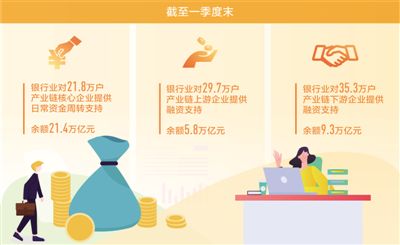
According to the relevant person in charge of China Banking and Insurance Regulatory Commission, as of the end of the first quarter of this year, the banking industry provided daily capital turnover support to 218,000 core enterprises in the industrial chain, with a balance of 21.4 trillion yuan; Providing financing support to 297,000 upstream enterprises in the industrial chain, with a balance of 5.8 trillion yuan; Financing support was provided to 353,000 downstream enterprises in the industrial chain, with a balance of 9.3 trillion yuan.
With the help of financial technology, supply chain finance can improve service efficiency and get through the "blocking point" of industrial chain funds.
Why is supply chain finance concerned during epidemic prevention and control? What are the innovation highlights?
— — Let upstream and downstream enterprises "not fall behind" and ensure the stability of the supply chain of the industrial chain.
"The upstream and downstream of the modern industrial chain, production, supply and marketing, large, medium and small enterprises are interlocking, and the interdependence of enterprises in the supply chain is high." The relevant person in charge of the Construction Bank said that due to the impact of the epidemic, the production and sales of some upstream and downstream enterprises were blocked, and the "breakpoint" of the capital chain of these enterprises may become the "blocking point" for the industrial chain to resume work. Supply chain finance is precisely to solve the capital problem along the industrial chain.
"If the upstream parts enterprises have no money to start work, the production of core enterprises may be ‘ Lack of nails and less riveting ’ ; Downstream dealers have no money to purchase goods, the sales of core enterprise products are not smooth, the income is reduced, and the entire industrial chain will also be affected. " Ceng Gang said that accurately identifying service targets along the supply chain of core enterprises, providing financing support to upstream and downstream enterprises, and ensuring the "continuous chain" of funds in all links of the industrial chain is the right prescription. "Suppliers improve their ability to receive orders, and sellers improve their sales ability. In turn, it can promote core enterprises to expand production, and the entire industrial chain can be stable and smooth, achieving coordinated resumption of production."
"In addition, some trading enterprises have a large backlog of goods and tight cash flow. Warehouse receipt financing and other methods can help enterprises use inventory to obtain loans and ease liquidity pressure. " Dou Yanhong, president of ProLogis Finance, said.
— — Empowering financial technology allows funds to accurately "drip" small and medium-sized enterprises.
An important issue of supply chain finance is how to identify the authenticity of transactions between upstream and downstream enterprises and ensure the safety of loan funds.
"With the help of big data, blockchain, Internet of Things and other technologies, supply chain finance can more accurately identify the real financial needs of enterprises and intelligently monitor financial risks." Dou Yanhong said, for example, big data technology can quickly and accurately identify the business risks of enterprises, and Internet of Things technology can realize real-time monitoring of goods storage and transportation. Through technological empowerment, financial institutions can provide enterprises with more accurate and convenient financing services while strictly guarding against financial risks.
The application of blockchain technology has improved the efficiency of supply chain financial services. According to the person in charge of Ant Financial, the company relies on blockchain technology to develop supply chain financial products "double-stranded". Through the blockchain distributed storage, peer-to-peer transmission, encryption algorithm, etc., the information such as accounts receivable vouchers, order data and transaction status of enterprises in the blockchain is more open and transparent. Risk control ability has improved, and financial institutions can lend to enterprises at more favorable interest rates.
— — "One-to-many" changed to "one-to-one", and the core enterprises obtained loans, shortening the payment period.
In the epidemic prevention and control, some small and medium-sized enterprises have more urgent financing needs. In this regard, supply chain finance has also been innovated. Under the guidance of the regulatory authorities, banks have changed the original way of risk assessment and single-family lending to enterprises in the "chain" one by one, and directly issued loans to core enterprises in the supply chain, followed up the demand for resumption of work and production in the upstream and downstream of the industrial chain, and promoted the core enterprises to shorten the account period, pay in time, and ease the financial pressure on upstream and downstream enterprises.
"By ‘ One-to-many ’ Change ‘ One-to-one ’ Banks save the time of risk assessment for upstream and downstream enterprises in the past, and the lending efficiency is higher. In addition, core enterprises are often credit customers of banks, and they can obtain loans with lower interest rates faster, which is conducive to their timely payment to upstream and downstream enterprises. " Ceng Gang said that through this way, the efficiency of supply chain financial services has been further improved, and the accounts receivable of upstream and downstream enterprises can be collected more quickly, which is conducive to "speeding up" the resumption of work and production.
Improve the assessment and incentive mechanism, strengthen the cooperation between regions and departments, and find the balance point of innovation and risk control.
Experts believe that in order to better develop supply chain finance, it is necessary for relevant departments to further strengthen policy support and guidance, and banks, core enterprises and other parties to participate more actively and strengthen innovation and cooperation on the premise of effectively preventing and controlling risks.
First of all, further improve the assessment and incentive mechanism, enhance the guarantee ability, and create a good environment for the development of supply chain finance.
Dong Ximiao believes that the assessment and incentive mechanism of supply chain financing business should be further improved, and the supply chain financing business should be appropriately tilted in terms of credit scale, economic capital assessment and internal capital transfer price, and banks should be supported to make differentiated arrangements for credit related to industrial chain collaborative resumption of production.
"We should increase government financing guarantees and other support for accounts receivable financing of small and medium-sized enterprises, further enhance the guarantee ability, smooth cooperation between banks and banks, improve the risk sharing compensation mechanism, and more effectively spread risks." Ceng Gang said, in addition, relevant laws, regulations and regulatory measures should be improved, penalties for fraudulent trading information should be increased, and banks’ willingness and efforts to serve small and medium-sized enterprises by means of accounts receivable financing should be strengthened.
Secondly, moderately simplify business processes, strengthen regional and departmental coordination, and provide more efficient services for enterprises.
Recently, the relevant person in charge of China Banking and Insurance Regulatory Commission requested to further optimize the supply chain financing business process. On the premise that the core enterprises assume the responsibility of payment or provide credit enhancement measures such as guarantee, repurchase and balance replenishment, when the upstream and downstream enterprises handle supply chain financing business, banks can moderately simplify the procedures such as customer rating access, incorporate them into the unified credit management of the core enterprises, and use the credit line of the core enterprises.
"Enterprises in the same supply chain are often distributed across regions, so it is necessary to further strengthen the cooperation of all localities and departments, actively establish and improve the coordination mechanism of supply chain financial services in different places, promote cross-regional and inter-bank cooperation, and better help enterprises enjoy the ‘ Good ’ 。” The relevant person in charge of China Banking and Insurance Regulatory Commission Zhejiang Supervision Bureau said.
Finally, strengthen the monitoring of the flow of credit funds, increase the verification channels of supply chain transaction information, and effectively improve the level of risk control.
The person in charge of China Banking and Insurance Regulatory Commission said that banks should clarify the access standards for core enterprises, carefully examine the financing needs and loan purposes of core enterprises, strengthen effective supervision over the flow of credit funds, and ensure accurate delivery. In addition, it is necessary to strengthen the management of collateral, effectively control the financing risk of inventory pledge, and monitor the collection of accounts receivable through special account management, agreed deduction or entrusted payment.
Ceng Gang said that banks should actively research and develop supply chain financial business systems, and strengthen the integration and sharing of data with industry and commerce, taxation, water and electricity, communications and other data, so as to better reflect the production, operation and credit status of enterprises and increase the channels for verifying supply chain transaction information.
The insiders believe that core enterprises should strengthen internal management when participating in supply chain finance business, and prevent relevant personnel from providing false trading information. Banks should also strengthen financial technology innovation, better grasp the risk changes of core enterprises and monitor the risks of upstream and downstream enterprises through technical means.